
Shop


Summarize this post with:


Newborn Sleep · Week 3
A 3 week old sleep schedule is loose by design. Expect about 14 to 17 hours of sleep a day, wake windows of 35 to 60 minutes, and a feed every 2 to 3 hours. Follow your baby’s cues, not the clock, and keep every sleep on the back in your room.
Week three often feels harder than week one. The sleepy newborn haze lifts, your baby is awake a little longer, and evenings can turn fussy. None of this means you are doing anything wrong. It means your baby is growing.
This guide gives you a realistic sample day, a wake window chart, and a simple night setup that keeps your baby close and safe. You will not find a rigid timetable here, because a baby this young cannot follow one. What you will find is a rhythm you can lean on when the days blur together.
Key Takeaways
- 01
A 3 week old sleeps about 14 to 17 hours a day in short pieces of one to three hours.
- 02
Wake windows run 35 to 60 minutes, feed included, so watch for early sleepy cues.
- 03
Build a rhythm of eat, short awake time, then sleep. A strict schedule comes later.
- 04
Every sleep is on the back, on a firm, flat, bare surface, in your room but not in your bed.
- 05
A bedside sleeper like the babybay keeps your baby close for night feeds on their own separate surface.
How Much Should a 3 Week Old Sleep?
Most babies at three weeks sleep somewhere around 14 to 17 hours a day. That sleep comes in short pieces of one to three hours, spread across day and night. A few babies sleep a little less and a few sleep more, and both can be normal when feeding and weight gain are on track.
Your baby’s body clock is not running yet. That is why naps and night stretches look about the same length right now. The longer night stretch usually starts to show up between six and twelve weeks. If your baby still mixes up day and night, our guide to fixing newborn day/night confusion walks through the light, noise and feeding cues that help.
Hunger sets the pace more than anything else. Newborns have small stomachs, so most wake every two to three hours to eat. Breastfed babies often feed more often than formula-fed babies. Your pediatrician will tell you if your baby needs to be woken for feeds, which is common in the first weeks until birth weight is regained.
Wake Windows for a 3 Week Old
A wake window is the stretch of time your baby is awake between sleeps. At three weeks it is short, usually 35 to 60 minutes, and that includes the feed, a diaper change and a few minutes of looking at your face.
Short wake windows surprise many parents. By the time you finish feeding and burping, your baby may already be ready to sleep again. If you wait for crying, your baby is often overtired, and an overtired baby takes longer to settle.
Wake windows and sleep at 3 weeks
| What to track | Typical range at 3 weeks | What it looks like |
|---|---|---|
| Wake window | 35 to 60 minutes | Feed, burp, change, a short cuddle, then sleepy cues |
| Naps per day | 4 to 7 | Nap length varies from 20 minutes to 3 hours |
| Total sleep in 24 hours | About 14 to 17 hours | Split fairly evenly between day and night |
| Feeds in 24 hours | About 8 to 12 | Every 2 to 3 hours, sometimes closer in the evening |
| Longest stretch | 2 to 4 hours | Often in the first part of the night |
Sleepy cues to watch for
Watch your baby, not the clock. Early sleepy cues include a glazed or far-off stare, slower movements, red eyebrows, a yawn, and turning away from faces or light. Rubbing the face and fussing come later. When you see the early signs, start winding down and lay your baby down drowsy, on the back.
Many sounds you hear after that are normal. Grunts, squeaks and twitches are part of light sleep. Our guide to why babies twitch in active sleep explains what is happening and when to wait before picking your baby up.
A Sample 3 Week Old Sleep Schedule
Treat this sample day as a shape, not a plan to follow to the minute. Your baby may feed earlier, nap longer or cluster feed for two hours in the evening. Slide the times to fit what your baby actually does.
7:00 am
Wake and feed
Open the curtains and feed in daylight. Daylight in the morning helps the body clock start to form.
7:45 am
Nap 1
After a short awake time, lay your baby down on the back in your room.
9:30 am
Feed and play
Feed, change, then a few minutes of tummy time on your chest or the floor while your baby is awake.
10:15 am
Nap 2
A daytime nap in a bright room with normal household sounds.
12:30 pm
Feed
Wake for a feed if your pediatrician has asked you to, then a short awake time.
1:15 pm
Nap 3
Some babies take their longest nap here.
3:30 pm
Feed and awake time
Talk, sing and show your face. Keep it calm and short.
4:15 pm
Nap 4
Often a shorter nap. A catnap of 20 to 40 minutes is fine.
5:30 to 8:30 pm
Cluster feeds and fussy hours
Many babies feed often in the evening. Dim the lights and keep things quiet.
9:00 pm
Last feed before your bedtime
Feed, change and lay your baby down in the dark room you sleep in.
Overnight
Night feeds every 2 to 4 hours
Keep lights low, talk little, change only when needed, and lay your baby back down on the back.
Notice what the sample day does not include: a fixed bedtime. A 3 week old does not have one yet. Most babies drift into a later evening sleep that slowly moves earlier over the next two months. For now, the goal is simple: plenty of daylight and activity by day, darkness and calm by night.
Can You Put a 3 Week Old on a Schedule?
You can build a rhythm, but not a strict schedule. A baby this age needs to eat when hungry. Stretching feeds to fit a clock can slow weight gain and lower milk supply if you are breastfeeding.
What works is a repeating pattern of eat, short awake time, then sleep. Doing the same few things in the same order before each sleep, like a diaper change, a dim room and a song, teaches your baby what comes next. Around two to three months, those patterns usually settle into a more predictable day.
Why Is My 3 Week Old Suddenly Awake More?
Many babies have a growth spurt around two to three weeks. You may notice more feeding, shorter naps and more fussing for a few days. It passes. Feed on demand and rest when you can.
Evening fussiness also tends to build from around two to three weeks and peaks at about six weeks. If crying is constant, high-pitched, or comes with fever, poor feeding, fewer wet diapers or vomiting, call your pediatrician the same day. Trust your instincts. You know your baby.
Setting Up Night Sleep the Safe Way
Where your baby sleeps matters as much as when. The American Academy of Pediatrics (AAP) safe sleep guidance says to place your baby on the back for every sleep, on a firm, flat surface with nothing soft in it. It also says to share a room but not a bed, ideally for at least the first six months.
Room-sharing on a separate surface keeps your baby close for night feeds without the risks of a shared adult bed. The AAP advises against bed-sharing in every case. That is the line between bed-sharing and bedside sleeping: your baby is next to you, but on their own firm mattress, with their own fitted sheet.
Why room-sharing matters
Up to 50%
Lower risk of sudden infant death syndrome when a baby sleeps in the parents' room on a separate surface
American Academy of Pediatrics, HealthyChildren.org
1Back to sleep, every sleep
Lay your baby down on the back for naps and nights. If your baby falls asleep in a car seat, swing or carrier, move them to a flat sleep surface as soon as you can.
2Firm, flat and bare
Use a firm, flat mattress made for the sleeper with one fitted sheet. No pillows, bumpers, blankets, positioners or toys.
3Close to your bed, not in it
Keep the sleep space in your room, within arm’s reach. You can hear every stir and feed without carrying your baby across the house.
4Dress for the room
Use a sleep sack or one more light layer than you wear, and no hat indoors. Our newborn sleep clothing chart matches layers to room temperature.
5Dark, quiet and boring at night
Use a dim nightlight for feeds. Keep talk soft and short, and lay your baby back down once burped.
6Plan for the safe handoff
If you are feeding in bed and feel sleepy, put your baby back in their own space before you nod off.
Where a Bedside Sleeper Fits
At three weeks you may be up two or three times a night. A sleeper that sits flush against your bed makes those feeds easier. You can reach your baby, settle them, and slide them back onto their own flat surface without standing up. That matters even more after a C-section, when getting in and out of bed hurts.
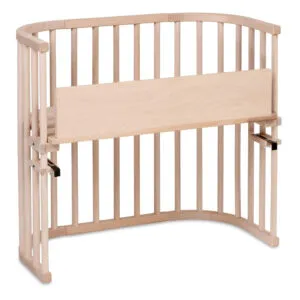
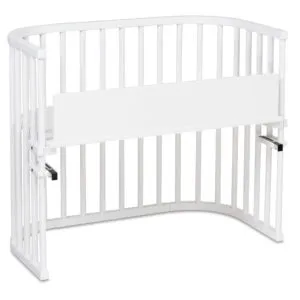
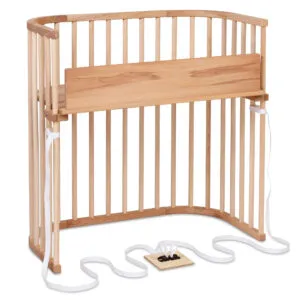
The babybay bedside sleeper range was built for exactly this stage. Each babybay is made in Germany from solid European beechwood with water-based finishes. It attaches to the side of your bed so your baby’s mattress sits level with yours. It meets the safety standards of the American Society for Testing and Materials (ASTM) and the Consumer Product Safety Commission (CPSC). Every model comes with a 10-year warranty, and a conversion kit turns it into a freestanding bassinet later.
- babybay Original
- Fits adult beds up to 28 inches high; $385
- babybay Maxi
- A wider sleeping platform for one baby; beds up to 28 inches high
- babybay Maxi Tall
- For taller boxspring beds up to 34.75 inches high
- Material
- Solid European beechwood, water-based finishes, no plastic and no netting
- Safety standards
- Meets ASTM and CPSC standards
- Warranty
- 10 years
For most standard beds, the babybay Original bedside sleeper is the value pick. If you want your baby to have more room to stretch, look at the Maxi. If your bed sits high on a boxspring, the Maxi Tall reaches up to 34.75 inches.
If your baby only wants to sleep in your arms, that is common at this age too. Our tips on getting a newborn to sleep in the bassinet cover warming the sheet with your hand, the slow lay-down and when to try again.
Should You Swaddle a 3 Week Old?
Swaddling is optional. Some babies settle faster when their arms are snug, and some fight it. If you do swaddle, keep the wrap firm around the arms and loose at the hips so the legs can bend. Always lay a swaddled baby on the back.
Stop swaddling as soon as your baby shows signs of trying to roll. A swaddled baby who rolls onto the tummy cannot push up. Many parents switch to a sleep sack with arms out at that point. A sleep sack keeps your baby warm without any loose blanket in the sleep space.
A Worked Example: Adjusting the Day After a Short Nap
Say your baby wakes at 10:40 am after a 25 minute nap and still looks tired. You do not need to restart the whole day. Feed if your baby seems hungry, keep the room dim and quiet, and try for sleep again after a short wake window of about 40 minutes.
Now say the next nap runs long, close to three hours. If your pediatrician wants feeds every three hours, gently wake your baby for that feed. Unwrap, change the diaper and talk softly. Then carry on with the rest of the day from that new start time.
The point of the example is simple. Each feed and nap resets the clock for the next one. When you stop chasing exact times, the day gets calmer for both of you.
Common 3 Week Old Sleep Problems
01
Short naps
Naps of 20 to 40 minutes are normal at this age. Your baby’s sleep cycles are short and naps lengthen later.
02
Day and night mixed up
Bright mornings, active daytime feeds and dark, quiet nights help the body clock form.
03
Grunting and squirming
Most of this is light sleep. Pause for a minute before picking your baby up.
04
Only sleeps when held
Hold for naps when you need to, and practice one sleep a day in the bedside sleeper while your baby is drowsy.
When to Call Your Pediatrician
Call your pediatrician if your baby is hard to wake for feeds, has fewer than six wet diapers a day after the first week, or feeds poorly. Call at once for a fever of 100.4°F or higher, any trouble breathing, or a blue or gray color around the lips. The National Institutes of Health Safe to Sleep campaign also has plain guidance you can share with anyone who cares for your baby.
QHow long should a 3 week old be awake?
Most 3 week olds can stay awake for about 35 to 60 minutes at a time, including the feed. If your baby yawns, stares off or turns away, it is time to wind down for sleep.
QHow many naps does a 3 week old take?
Usually four to seven naps a day. Some are short catnaps and some last two or three hours. The number is less important than total sleep and steady feeding.
QShould I wake my 3 week old to feed?
Many pediatricians ask parents to wake a newborn for feeds until birth weight is back, often every three hours. Once your baby is gaining well, your pediatrician may let your baby set the pace at night.
QIs it normal for a 3 week old to sleep all day?
Long daytime sleep is common, but your baby still needs regular feeds. If your baby is very hard to wake or not interested in feeding, call your pediatrician.
QCan a 3 week old sleep through the night?
No. A baby this age needs to eat every few hours, day and night. Longer night stretches usually begin between six and twelve weeks.
QIs a bedside sleeper the same as bed-sharing?
No. Bed-sharing means your baby sleeps on your adult mattress. A bedside sleeper gives your baby their own firm, flat mattress next to your bed, which matches AAP advice to share a room but not a bed.
QWhat should a 3 week old wear to sleep?
A fitted sleepsuit or a sleep sack, with about one more light layer than you would wear in the same room. Skip hats indoors and loose blankets.
Keep your newborn close
Find the babybay that fits your bed
Solid European beechwood, level with your mattress, and built to meet ASTM and CPSC standards. Compare the Original, Maxi and Maxi Tall by bed height.