Summarize this post with:


Every buying guide says a bassinet is compact. None of them tell you how much floor you actually lose — the footprint plus the space you need to stand beside it.
In a small bedroom the number that matters is not the bassinet’s footprint. It is the footprint plus the walkway. That is where an open-sided bedside sleeper quietly saves you about half the floor space.
The short version
- 01
Plan on 4 to 5 square feet — The babybay Original occupies about 34.5 by 18 inches — roughly 4.3 square feet. Most freestanding bassinets are similar on paper.
- 02
The walkway is the hidden cost — A freestanding bassinet needs its own access strip of about two feet. A bedside sleeper borrows the space you already walk past, so its real cost is close to its footprint.
- 03
Bed height decides the model — Measure from the floor to the top of your mattress. Original and Maxi fit beds up to 28 inches; Maxi Tall fits boxspring beds up to 34.75 inches.
- 04
Height, not width, is what fails — Almost every returned bedside sleeper is a height mismatch, not a floor-space problem. Measure before you buy, not after.
How much floor space does a bassinet really need?
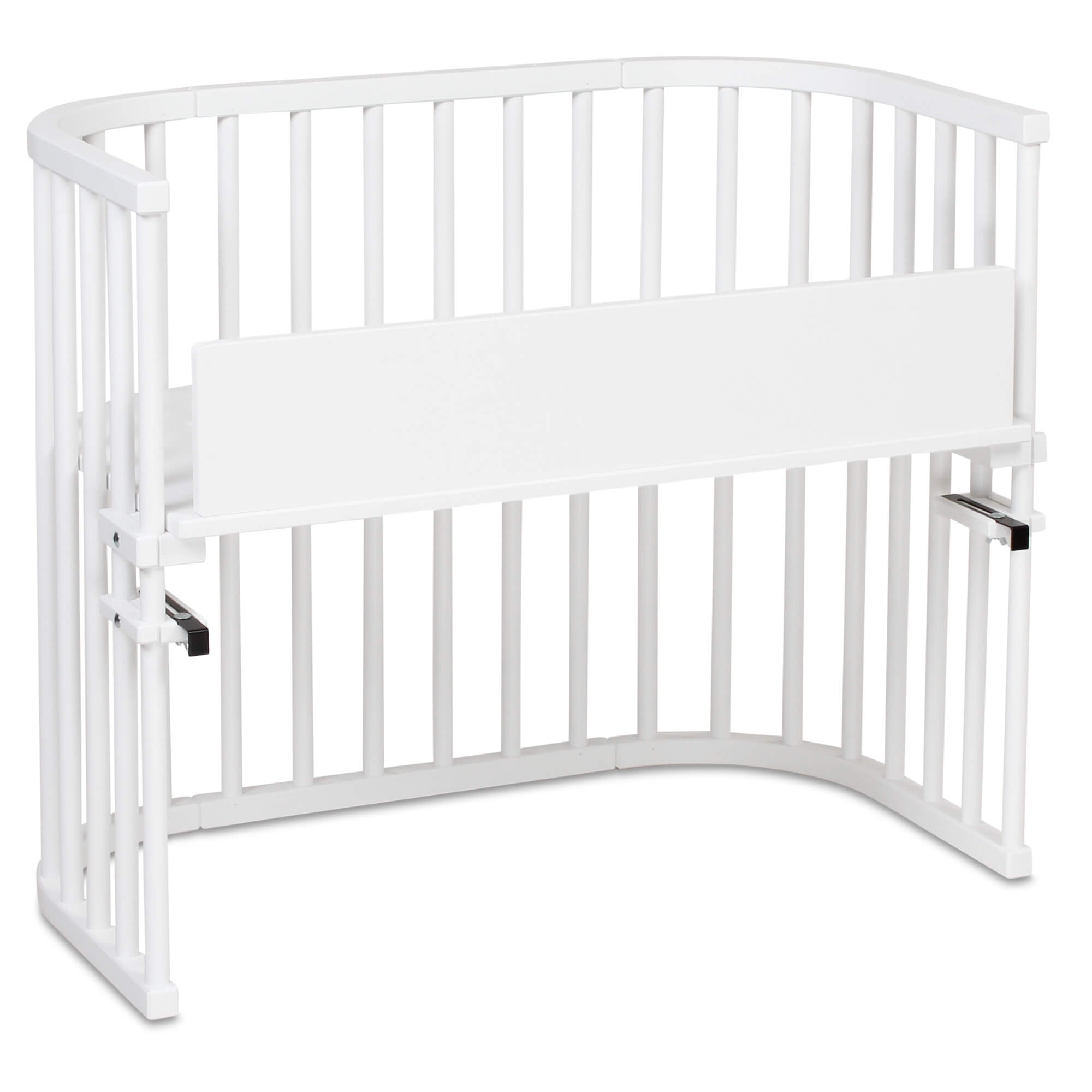
A bassinet needs about 4 to 5 square feet of floor. The babybay Original measures roughly 34.5 by 18 inches and stands 31 inches tall, which works out to about 4.3 square feet. A typical freestanding bassinet lands in the same range, and a playard-style sleeper is considerably larger at around 7 to 8 square feet.
But that is only half the answer, and it is the half every other guide stops at. A sleep surface you cannot reach is useless, so the real question is footprint plus access. A freestanding bassinet has four closed sides, which means you need clear floor along at least one of them — realistically about 24 inches — to lift your baby in and out at three in the morning. Add that strip and a 4.6 square-foot bassinet is costing you closer to 10 square feet of usable bedroom.
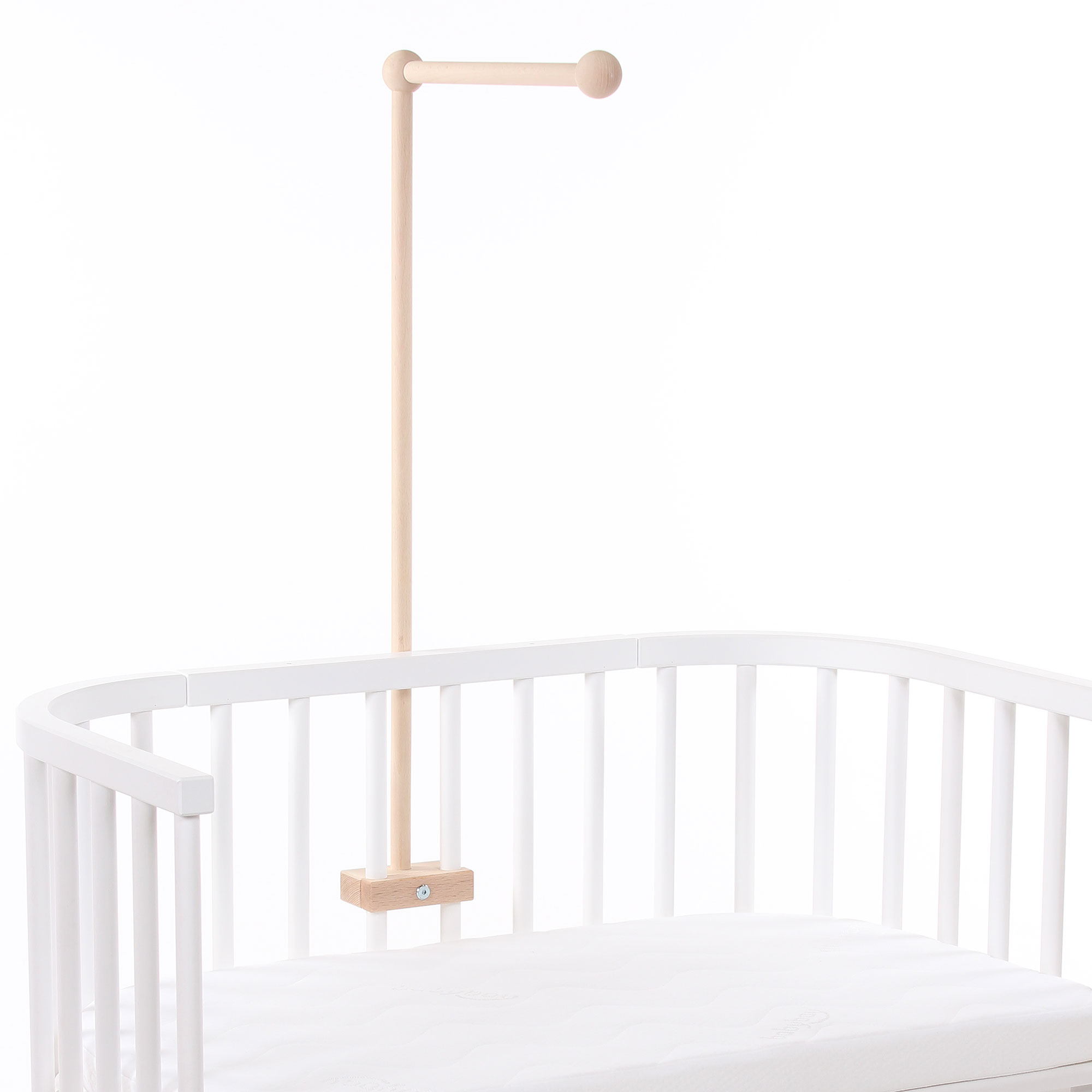
An open-sided bedside sleeper does not work that way. It sits against your mattress with one side open, and you reach your baby from the bed. The access you need is the space you already use to get into bed. That is the whole small-space argument in one sentence, and it is why the most compact bassinet on a spec sheet is often not the one that fits your room.
Bedside vs freestanding in a small bedroom (the walkway problem)
Where the floor actually goes
Freestanding bassinet
- Four closed sides — you reach in from outside
- Needs its own access strip, about 24 inches
- Effective floor cost roughly 9 to 10 square feet
- Has to go somewhere a door or wardrobe does not swing
- You get out of bed for every feed
Bedside sleeper (open side)
- One side open to your mattress
- Uses the bedside access you already have
- Effective floor cost close to its 4.3 square-foot footprint
- Sits in the gap beside the bed, out of every traffic path
- You reach your baby without standing up
In a 10 by 10 foot bedroom with a queen bed, that difference is the difference between a room you can walk around and a room you edge through sideways. It also tends to matter more over time than people expect: the first six weeks you will forgive anything, and by week ten the layout either works or it grinds on you every night.
There is a second benefit that has nothing to do with square footage. The American Academy of Pediatrics recommends that babies sleep in the parents’ room, on a separate sleep surface, ideally for at least the first six months — and a small bedroom is exactly the situation where people are tempted to give up on room-sharing because “there is no space.” A bedside sleeper is the arrangement that makes the recommended setup possible in a room that genuinely has no floor to spare. Our overview of bedside sleepers and co-sleeping covers how that works in practice, including the important distinction between bedside sleeping on a separate surface and bed-sharing, which are not the same thing.
Footprint comparison
Real floor cost, including access
| Option | Footprint | Access needed | Effective floor cost | Fits beds up to |
|---|---|---|---|---|
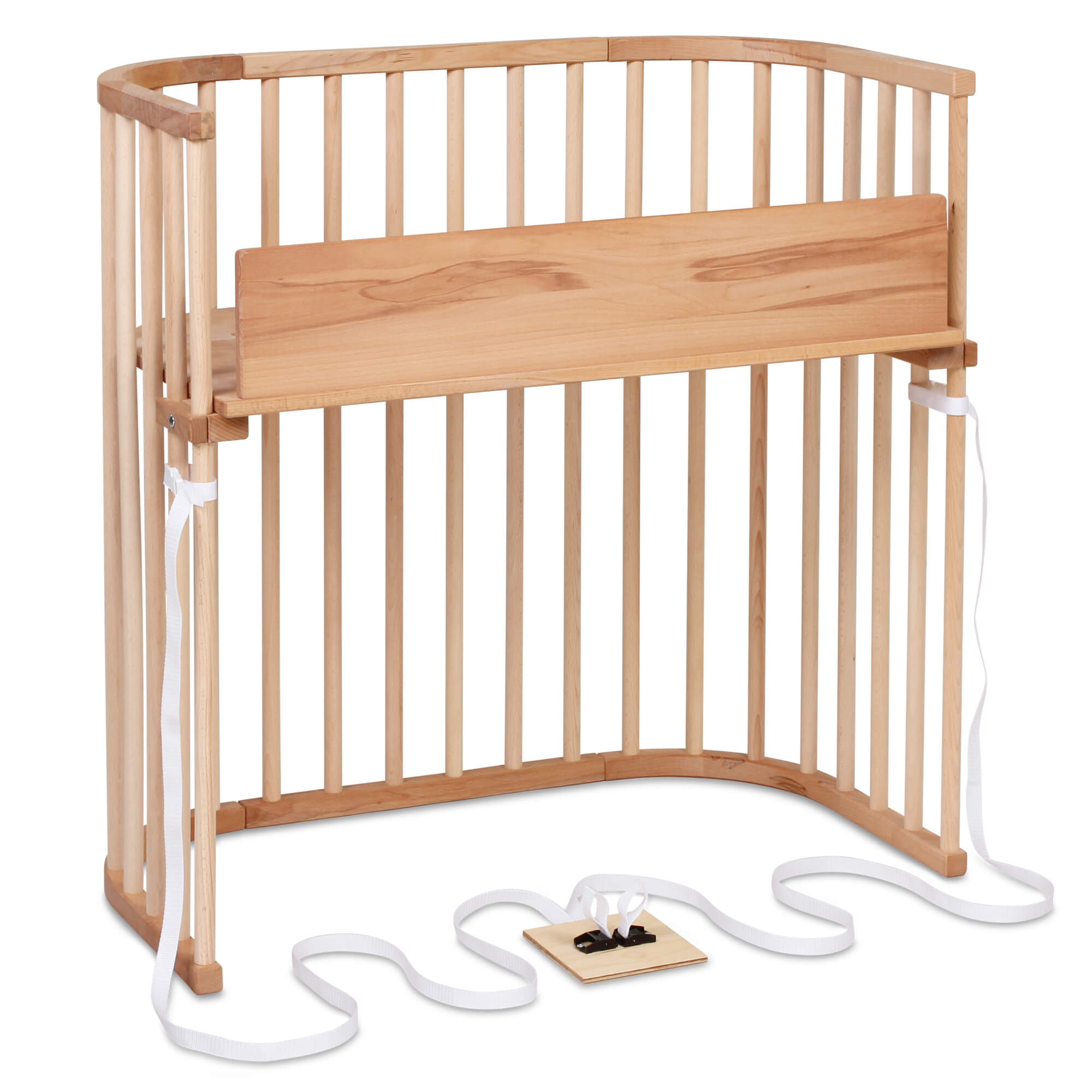
| babybay Original ($385) | 34.5 x 18 in (4.3 sq ft) | Shares bedside access | About 4.3 sq ft | 28 in |
| babybay Maxi | Wider sleeping platform for one baby | Shares bedside access | About 5 sq ft | 28 in |
| babybay Maxi Tall | Taller frame, same open-side design | Shares bedside access | About 5 sq ft | 34.75 in |
| Typical freestanding bassinet | About 33 x 20 in (4.6 sq ft) | 24 in on one side | About 9–10 sq ft | n/a — standalone |
| Playard-style sleeper | About 40 x 28 in (7.9 sq ft) | 24 in on one side | About 13 sq ft | n/a — standalone |
| Full-size crib | About 52 x 28 in (10.1 sq ft) | 24 in on one side | About 17 sq ft | n/a — standalone |
Two things stand out. First, on raw footprint the bedside sleeper and the freestanding bassinet are nearly identical — the advantage is entirely in the access column. Second, the gap widens fast as you move down the table: a playard-style sleeper costs roughly three times the usable floor of a babybay Original, which is why they are a poor fit for the rooms they are most often bought for.
The babybay Original is the most compact model in the range and the one we recommend for small bedrooms and studios. At $385 it is solid European beechwood with water-based finishes, no plastic and no netting, it meets ASTM and CPSC requirements, it carries a 10-year warranty, and it converts to a freestanding bassinet with the conversion kit when you want it away from the bed. For a room where every square foot is contested, the babybay Original bedside sleeper is the straightforward answer.
Bed-height fit: measure before you buy
This is where bedside sleepers actually go wrong, and it has nothing to do with room size. The frame has to bring the sleep surface level with the top of your mattress, so the measurement that decides your model is bed height — not bed size, not room size.
Step 1Measure floor to mattress top
Run a tape measure from the floor to the very top of your mattress, with the bedding on as you normally sleep. That figure, not the bed frame height, is what matters.
Step 2Include the mattress topper
A three-inch memory foam topper is three inches of height you will otherwise discover too late. Measure the surface you actually lie on.
Step 3Match to a model
Up to 28 inches: Original or Maxi. Up to 34.75 inches: Maxi Tall, which exists precisely because boxspring and platform-plus-topper beds run tall.
Step 4Check the gap side
Decide which side of the bed it will sit on and confirm there is clear wall — no radiator, no outlet you need, no door swing.
Step 5Confirm the fixing
The sleeper straps to the bed frame so there is no gap between surfaces. Check your frame has something to strap to; divan and some upholstered frames need a moment’s thought.
If your mattress top lands above 28 inches — common with a boxspring, and very common once a topper is added — the babybay Maxi Tall for boxspring beds is the model that fits, up to 34.75 inches. If you are between models or unsure, choose your babybay model walks through the measurement with you. It takes less time than a return.
Small-space setups that work
1
The studio apartment
In a studio, the bed is usually the only fixed point and the sleeper goes beside it — no separate nursery zone, no extra furniture. Fit babybay rolling casters and you can move it clear of the bed during the day, which matters when the bedroom is also the living room. This is the setup where the open-side advantage is worth the most, because a studio has no spare two-foot strip anywhere.
2
The small main bedroom
Queen bed, two nightstands, maybe a dresser. Sacrifice one nightstand for the length of the sleeper and put a small wall shelf in its place. Keep the sleeper on the side the primary night feeder sleeps on, and keep the door swing clear.
3
The shared room with an older sibling
A bedside sleeper keeps the newborn on a separate surface next to you rather than competing for floor with a toddler bed. Worth noting: babybay models are built for one baby — the Maxi is a wider sleeping platform for a single baby, not a two-baby product.
4
Travel and grandparents' houses
The frame disassembles, so it travels better than a playard in a car boot and sets up against whatever bed is at the other end — as long as you check the height there too. Measure the guest bed before you assume.
What to avoid in a small room
Avoid these
Choices that cost you floor or safety
- hard
Inclined or tilted sleep surfaces. CPSC and the AAP are unambiguous: infants sleep on a flat, firm, level surface.
Choose a flat sleep surface, whatever the marketing promises about reflux or settling.
- hard
Using the adult mattress as the sleep surface because there is no room for anything else.
A bedside sleeper is the small-space answer to exactly this — separate surface, arm’s reach, no extra walkway.
- soft
Rockers, swings and powered soothers as a sleep space. They are large, they occupy the floor all day, and they are not designed for unattended sleep.
Keep the sleep surface separate from the soothing device, and reclaim the floor.
- soft
Oversized bassinets with large storage baskets underneath. The basket adds width and depth you pay for in floor area.
Use wall shelving or under-bed storage, which costs no new floor at all.
- info
Anything that has to live in a doorway or a door swing because it was the only gap left.
Measure the gap beside the bed first and buy to that dimension.
The safety standards, plainly
Small-space shopping should not mean compromising here, so the short version: the AAP’s 2022 safe sleep policy recommends room-sharing on a separate sleep surface, ideally for at least six months; babies on their backs, on a flat, firm, non-inclined surface, with a fitted sheet and nothing else in the sleep space — no pillows, blankets, bumpers or positioners. The CPSC’s safe sleep guidance for cribs and infant products sets the federal requirements that bassinets and bedside sleepers sold in the US must meet.
babybay sleepers meet ASTM and CPSC requirements, are made in Germany from 100% ethically sourced European beechwood with water-based finishes, and the mattress pads and organic sheets carry OEKO-TEX certification with TUV Rheinland testing on the accessories. None of that changes in the compact model — the Original is smaller, not lesser.
One honest note on a crowded room: the safety rules about what goes in the sleep space matter more, not less, when space is tight, because a small room invites the habit of resting things on the nearest flat surface. Keep the sleep surface clear even when it is the only free surface in the room.
FAQ
QWhat is the smallest safe bassinet?
Among bedside sleepers, the babybay Original is the most compact at about 34.5 by 18 inches and 31 inches tall — roughly 4.3 square feet. Smaller products exist, but be careful: below a certain size you are looking at a soft-sided or inclined product rather than a firm, flat sleep surface, and that trade is not worth making. The safe floor is a flat, firm surface meeting ASTM and CPSC requirements.
QCan a bassinet fit next to a bed in a small room?
Yes, and a bedside sleeper is the design intended for it. Because one side is open to your mattress, you reach your baby from the bed rather than needing a separate two-foot access strip. Practically, you need a clear stretch of wall beside the bed roughly 35 inches long for the Original, and the bed height has to match the model — up to 28 inches for the Original and Maxi, up to 34.75 inches for the Maxi Tall.
QHow wide is a bedside bassinet?
The babybay Original is about 18 inches deep and 34.5 inches long, so it projects roughly a foot and a half out from the wall alongside your bed. The Maxi offers a wider sleeping platform for a single baby, and the Maxi Tall keeps the same open-side design on a taller frame for boxspring beds.
QCan I use a bassinet in a studio apartment?
A bedside sleeper is well suited to a studio, because it occupies the gap beside the bed rather than claiming its own zone in a room that has none. Fitting rolling casters lets you move it clear during the day. It is also the arrangement that makes AAP-recommended room-sharing straightforward when the bedroom and living room are the same room.
QDo I need a walkway around a bassinet?
Around a freestanding bassinet, yes — about 24 inches on at least one side, because all four sides are closed and you have to reach in from outside. Around a bedside sleeper, no: the open side faces your mattress and you reach your baby from the bed, so it adds no access requirement of its own. That single difference is most of the small-space case.
QWhat if my bed is too tall for a bedside sleeper?
Measure from the floor to the top of your mattress including any topper. Up to 28 inches, the Original or Maxi fits. Up to 34.75 inches, the Maxi Tall is the model built for boxspring and taller platform beds. Above that, a bedside sleeper is not the right product and a freestanding bassinet positioned as close to the bed as the room allows is the safer plan.
QWill a compact bassinet last long enough to be worth it?
A bedside sleeper covers the newborn period through roughly the point your baby can push up on hands and knees, which is also the window the AAP room-sharing recommendation is aimed at. babybay models convert to a freestanding bassinet with the conversion kit, and the frame is covered by a 10-year warranty — which is why the cost per month of use compares well against a cheaper product you replace.
Find the model that fits your bed
Measure floor to mattress top, then match it to a model in two minutes. The Original for beds to 28 inches, the Maxi Tall to 34.75 inches — solid European beechwood, ASTM and CPSC compliant, 10-year warranty.