
Shop


Summarize this post with:


Bassinet Fit & Care
Move your baby from a bassinet to a crib when they start to roll, push up on hands and knees, or reach the limits printed in your bassinet’s manual, whichever comes first. Many families also add a middle step: the bassinet stands on its own in your room for a few weeks before the crib.
The short version
- 01
Watch the baby, not the calendar — Rolling, pushing up and the limits in your manual decide the date. Age is only a rough guide.
- 02
The crib can stay in your room — The American Academy of Pediatrics (AAP) advises room-sharing on a separate sleep surface, ideally for at least the first six months. A crib next to your bed meets that advice.
- 03
A middle step softens the change — Unhooking a bedside sleeper so it stands alone gives your baby a little distance from you before the bigger switch.
- 04
Go gradual when you can — Start with one nap a day in the crib, then nights, over one to two weeks.
When to Move Baby from Bassinet to Crib: The Quick Answer
There is no single birthday for the bassinet to crib move. Your baby tells you when it is time. The three signals are rolling over, pushing up on hands and knees, and reaching the weight or size limit in your bassinet’s manual. Whichever comes first is your deadline, even if your baby is only a few months old.
Some babies never hit those signals early, and many parents start thinking about the switch near six months anyway. That timing lines up with the 2022 AAP safe sleep recommendations, which suggest your baby sleeps in your room, on a separate surface made for infants, ideally for at least the first six months. That advice is about where the bed is, not which bed it is. A crib pushed close to your bed counts.
So the real question has two parts. First, has your baby outgrown the bassinet? Second, are you ready for your baby to sleep in another room? You can answer yes to the first and no to the second. Plenty of families move to a crib and keep it in the parents’ bedroom for months.
Definition
Room-sharing — Your baby sleeps in your bedroom on their own safe sleep surface, such as a bassinet, bedside sleeper or crib. It is not the same as bed-sharing, where a baby sleeps on the adult bed.
The Three Signs It's Time
01 · Movement
Your baby rolls over or tries to
Rolling changes the picture. A bassinet is small and shallow, and a baby who can flip can also push against the sides. Once you see rolling, or real attempts at it, start the switch.
02 · Strength
Your baby pushes up on hands and knees
A baby who can lift their chest and push up can lean over a low side. This sign often arrives with rolling, but some babies push up first. Treat it as a hard stop for bassinet sleep.
03 · Size
Your baby reaches the limits in the manual
Every bassinet lists its own weight and size limits. Some babies reach them before they roll. Check your manual, write the number on a sticky note, and weigh your baby at each checkup.
You may also notice softer hints. Your baby’s head or feet touch the ends. They wake each time an arm hits a side. Naps seem shorter than they used to be. None of these is a safety deadline on its own, but together they tell you the space is getting tight.
If you use one of our babybay bedside sleepers, the same rule holds. Read the limits in the manual for your model and follow them. The manual for your exact product always beats a general guide, including this one.
Keep in mind
Signs that do not mean it's time
- Note
A few rough nights in a row.
Growth spurts, teething and new skills all disturb sleep. A new bed will not fix them.
- Note
Advice from a relative that your baby is “too old” for a bassinet.
Go by the three signs and your manual, not by age alone.
- Caution
Wanting a quick fix for night waking.
A bed change can add a few unsettled nights at first, so plan it for a calm week.
The Middle Step Most Guides Skip: Freestanding First
Most guides treat the move as one jump: from a bassinet beside your bed to a crib in a nursery down the hall. That is a lot of change at once. The baby loses your closeness, the room, the smells and the sounds in a single night.
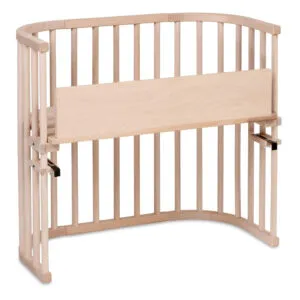
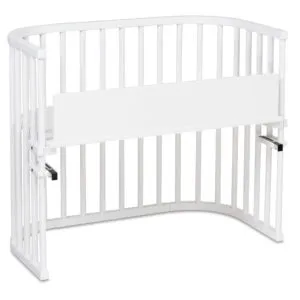
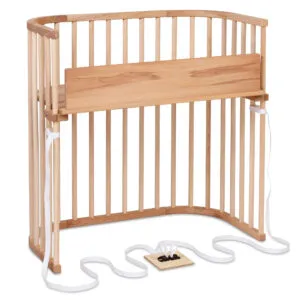
A bedside sleeper gives you an extra step in the middle. A bedside sleeper attaches to the side of your bed, so your baby sleeps on their own surface at arm’s reach. With the babybay bassinet conversion kit, you unhook it from your bed and it stands on its own as a freestanding bassinet. Your baby keeps the same mattress, the same sheet and the same room, just a little farther from you.
Why does this help? Your baby gets used to falling asleep without you right there. You get used to hearing your baby from a short distance instead of seeing them the moment you open your eyes. When the crib arrives, only one thing changes: the bed itself.
The two-stage move
Bedside sleeper, attached at arm's reachFreestanding bassinet in your room, then a crib
Do the middle step while your baby is still well inside the limits in your manual. Once a stop sign appears, go straight to the crib.
Attached vs freestanding: what changes for your baby
Attached to your bed
- ✓Baby sleeps at arm’s reach on their own surface
- ✓Easy night feeds without getting up
- ◦You hear and see every small stir
- ✗A big jump if the next bed is in another room
Freestanding in your room
- ✓Same mattress, same sheet, same room
- ✓Baby learns to settle with a bit more space
- ✓Can move to a quiet corner for naps
- ◦Same size and weight limits as before
One honest point matters here. Standing on its own does not make a bassinet bigger. The limits in your manual still apply, so the freestanding stage works best a few weeks before your baby starts rolling, not after. Think of it as practice for the crib, not a way to stretch bassinet time.
If you have a babybay Original bedside sleeper, there is a conversion kit made for that model. Owners of the wider models can use the conversion for the Maxi and Maxi Tall. Adding babybay rolling casters lets you move the freestanding bassinet from room to room for daytime naps.
How to Make the Transition Easier
Babies like what they know. The more the crib feels like the old bed, the faster most babies settle. These small moves help without breaking any safe sleep rules.
Before the first night
A calm-start checklist
- Put the crib in your room first if you can. Change the bed before you change the room.
- Use a fitted crib sheet your baby has already slept near. Tuck it beside your pillow for a night or two so it smells familiar.
- Keep the same bedtime steps: feed, change, sleep sack, song, lights down. Only the bed is new.
- Start with one daytime nap in the crib. Naps are lower stakes than a full night.
- Lay your baby down drowsy but awake, on their back, so they learn to fall asleep in the new space.
- Keep the crib bare: a firm, flat mattress and a fitted sheet, nothing else.
That last point is not optional. The CPSC safe sleep dos and don’ts from the Consumer Product Safety Commission (CPSC) sum it up as “bare is best.” That means a firm, flat surface with only a fitted sheet. No pillows, blankets, bumpers or toys. A bigger crib can make a baby look small and cold, so it is tempting to add soft things. Use a wearable sleep sack for warmth instead.
The AAP also says to place your baby on their back for every sleep, naps included. If your baby rolls onto their tummy on their own and can roll both ways, you do not need to flip them back. You still put them down on their back each time.
Change one thing at a time: the bed first, the room later.
A simple rule for an easier moveCommon Transition Setbacks and What to Do
- Short naps in the crib
- Normal for the first week. Keep offering one crib nap a day at the same time, and do not give up after two tries.
- More night waking
- A new space can wake a light sleeper. Respond the way you always do, keep the room dark, and keep visits short and quiet.
- A sleep regression at the same time
- Many babies go through stretches of worse sleep as their sleep patterns mature. If the timing overlaps, the crib is often blamed for something it did not cause.
- Baby only settles in your arms
- Go back a step. Do the first part of bedtime in the crib room, then lay your baby down a little earlier while still awake.
- You cannot sleep without seeing your baby
- That is common. Keeping the crib in your room for a while solves it, and it matches the room-sharing advice for the early months.
Most setbacks pass within one to two weeks. Consistency is what moves things along. If you keep changing the plan every night, your baby never learns the new pattern. Our older post on why consistency is the secret goes deeper on how to stick with one routine when nights get hard.
Some families also plan a broader change, from sleeping close together to a crib in a nursery. If that is your situation, read how to transition your baby from co-sleeping for the steps that fit a bigger move.
A Simple Week-by-Week Transition Plan
Here is a plan you can follow if your baby has not yet hit a stop sign. If your baby is already rolling, skip the bassinet steps and move straight to the crib tonight, then use weeks two and three as written.
Week 1
Freestanding bassinet, same room
Unhook the bedside sleeper and let it stand on its own a short step from your bed. Keep the bedtime routine the same. Many babies take this small change in stride.
Week 2
Crib naps begin
Set up the crib in your room. Offer one nap a day in the crib, such as the first nap of the day. Nights stay in the bassinet.
Week 3
Crib nights in your room
Move bedtime to the crib. Keep the room, the sleep sack and the routine the same. Expect a few wake-ups in the first nights.
Week 4 and later
The nursery, when you are ready
If you plan to use a nursery, move the crib once nights feel steady. There is no rush. Room-sharing on a separate surface for at least six months is the AAP’s advice.
You can stretch any stage if your baby needs more time. You can also shrink the plan if your baby takes to the crib on night one. The only part you should not stretch is bassinet sleep after a stop sign appears.
Do You Need a New Mattress or New Sheets?
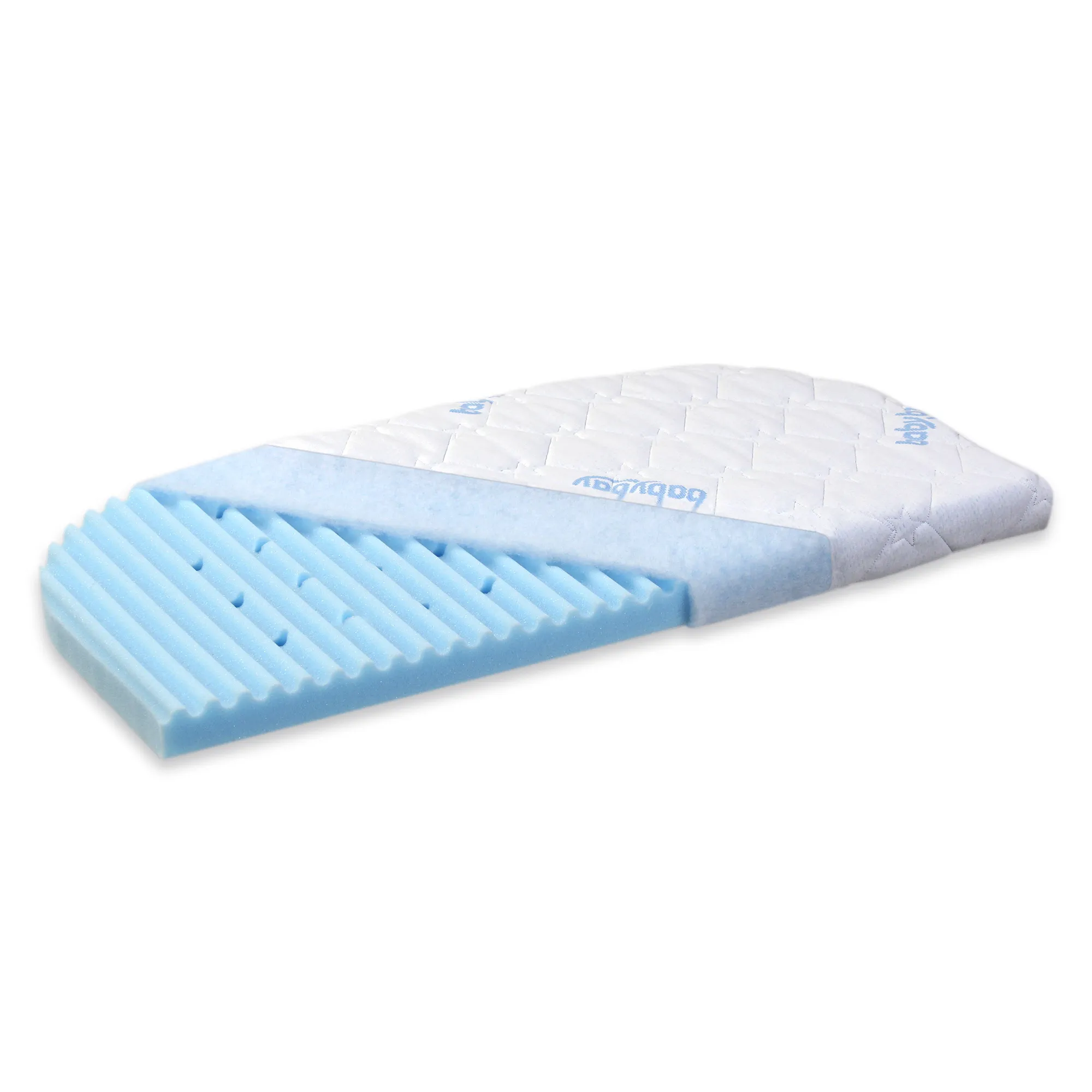
Yes, you need a crib mattress, because a bassinet mattress is sized for the bassinet. The crib mattress should be firm and flat and fit snugly, with no gap that could trap a hand or face. Use only fitted sheets made for that mattress size.
Your old bassinet sheets are still useful if you keep the bassinet for daytime naps in another room. Keep them on the bassinet mattress they were made for.
What About Sleep Training?
You do not need to sleep train to move to a crib, and you do not need to move to a crib to sleep train. Doing both in the same week stacks two big changes on one small person. If you plan to try a sleep training method, settle the crib first and give it a week or two before you start.
QWhat is the latest age to move a baby from a bassinet to a crib?
There is no fixed latest age. The deadline is whichever comes first: rolling over, pushing up on hands and knees, or reaching the weight and size limits in your bassinet’s manual. Many babies reach one of those well before six months, so watch for the signs rather than waiting for a birthday.
QShould I move my baby to a crib gradually or all at once?
Gradual is usually easier if your baby has not hit a stop sign yet. Start with one crib nap a day, then move nights. If your baby is already rolling or pushing up, move to the crib right away and use the gradual steps for the room change instead.
QCan I keep using a bedside sleeper after converting it?
Yes, as a freestanding bassinet, within the same limits listed in its manual. With the conversion kit, a babybay can stand on its own in your room or, with casters, roll to another room for naps. Once your baby rolls, pushes up or reaches the limits, it is time for the crib.
QWhy does my baby sleep worse after moving to a crib?
A new space feels different. The crib is bigger, the sheet smells new, and you may be farther away. Keep the routine the same, use a familiar sheet, start with naps and give it one to two weeks. A sleep regression at the same time can also make things look worse than they are.
QDo I need to change the mattress when moving to a crib?
Yes. A bassinet mattress is sized for the bassinet, so the crib needs its own firm, flat mattress that fits with no gaps. Use only a fitted sheet on it, with no pillows, blankets or bumpers.
QCan the crib go in my bedroom?
Yes. The AAP advises room-sharing on a separate sleep surface, ideally for at least the first six months, and a crib in your room fits that advice. Many parents keep the crib in their room first, then move it to a nursery later.
Plan the middle step
One sleeper for the early weeks and the step after
A babybay sits beside your bed for easy night feeds, then converts to a freestanding bassinet for the gentle middle step. Made in Germany from solid beechwood, with a 10-year warranty.