Summarize this post with:


Choosing a Bassinet
Short answer: most families need both, but not at the same time. A newborn needs a small, firm sleep space in your room for roughly the first four to six months, and a crib after that. The real decision is not bassinet or crib — it is which small sleep space you put beside your bed for those first months, because that is the one you will be reaching into six times a night.
The 30-second answer
- 01
A newborn needs a bassinet-sized space in your room first — The AAP recommends room-sharing on a separate surface, ideally for at least six months. A full-size crib rarely fits beside an adult bed; that is the practical reason bassinets exist.
- 02
Bassinets and cribs are built to different federal standards — They are separate product categories with separate rules, separate size definitions and very different lifespans — roughly six months against three years or more.
- 03
You will almost certainly buy both — So the question worth asking is which one you buy well. The bassinet does the hardest months of parenting; the crib does the easy ones.
- 04
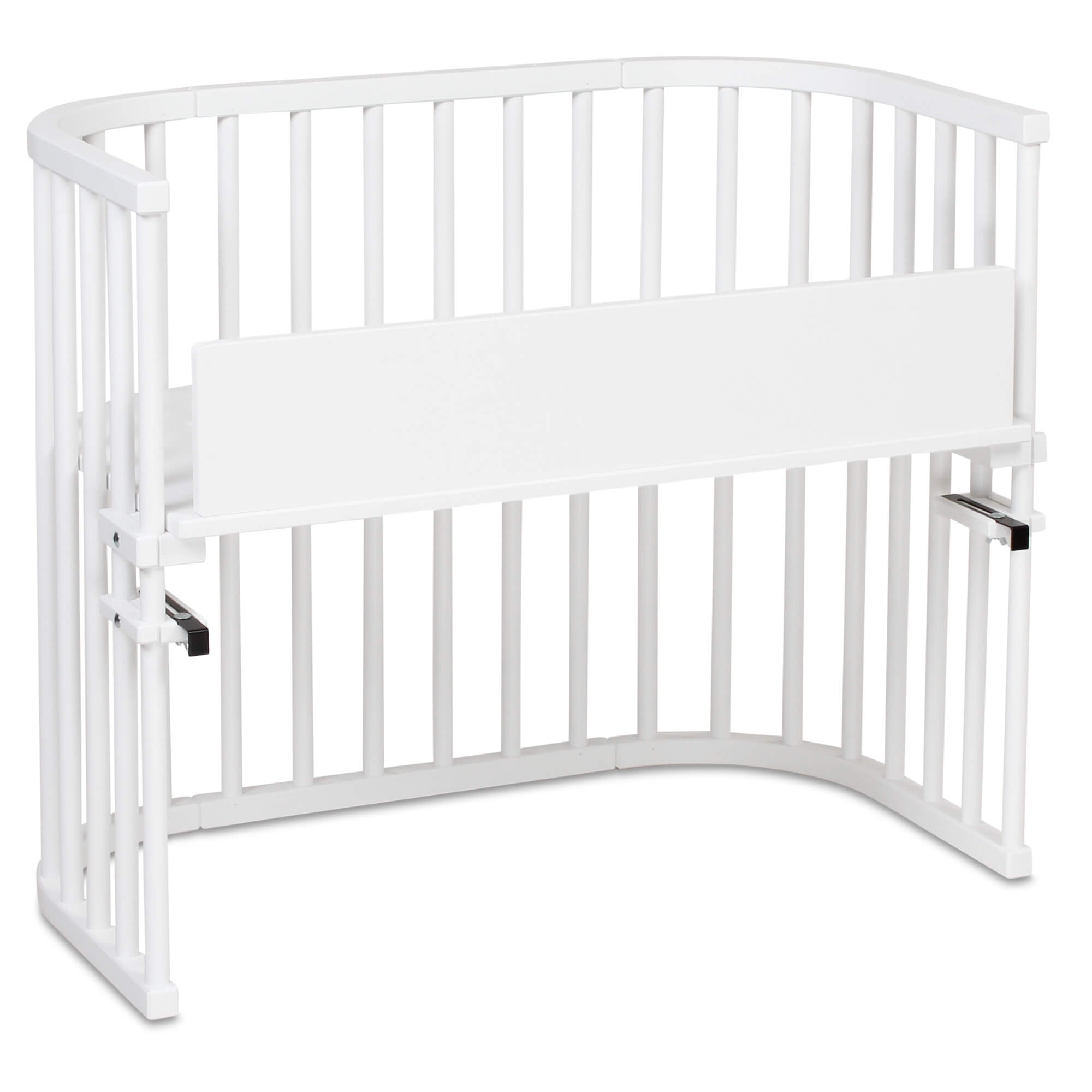
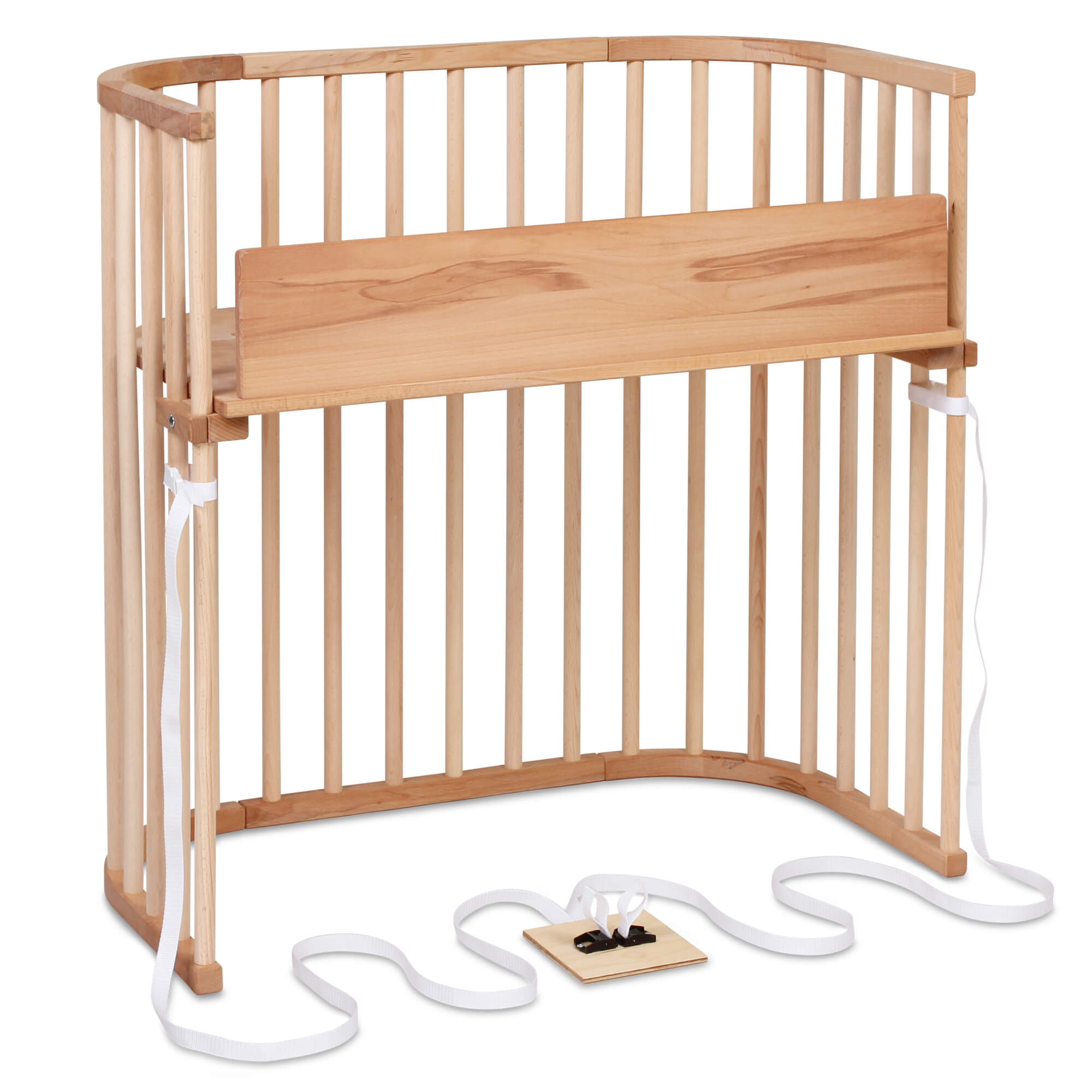
A bedside sleeper does the bassinet job better — It brings the sleep surface level with your mattress so you can reach the baby without standing up — which matters enormously after a C-section and during night feeds.
The 30-Second Answer: Newborns Need a Bassinet-Sized Sleep Space for the First 4-6 Months
A newborn does not need a large sleep space, and a large sleep space is not safer. What a newborn needs is a firm, flat surface, close to you, with nothing in it. The American Academy of Pediatrics safe sleep guidance is specific about this: babies should sleep in the parents’ room on a separate sleep surface, ideally for at least the first six months, always on their back, on a firm and non-inclined surface, with no pillows, blankets, bumpers or toys.
Read that back and the practical problem becomes obvious. In the parents’ room. A full-size crib is a piece of furniture roughly four and a half feet long. In a typical American bedroom with a queen or king bed in it, there is often nowhere for one to go — and if there is, it is against the far wall, which means getting out of bed and crossing the room for every feed. That is the gap a bassinet fills, and it is why the bassinet-versus-crib question is really a question about the first six months rather than a choice between two alternatives.
The number that shapes the first months
6 months
How long the AAP recommends room-sharing on a separate sleep surface — and roughly how long a baby fits a bassinet
American Academy of Pediatrics
Bassinet vs Crib: The Real Differences (Size, Height, Standard, Lifespan)
These are not two sizes of the same thing. They are separate product categories with separate federal standards, and the differences line up almost exactly with the two different jobs they do.
Bassinet, bedside sleeper and crib compared
Crib interior dimensions per the federal full-size crib definition. babybay figures are the manufacturer's own specifications.
| Bassinet | Bedside sleeper (babybay) | Full-size crib | |
|---|---|---|---|
| Typical sleep-space size | About 30-33 in long | About 31 in long, sized for a newborn | 28 in x 52 3/8 in interior (federal definition) |
| Floor footprint | Small — fits beside a bed | Small, and open on one side against your mattress | Large — usually needs its own wall |
| Sleep-surface height | Fixed or lightly adjustable | Adjustable to sit level with your mattress | Adjustable mattress base, well below bed height |
| Fits parent beds up to | n/a — freestanding | 28 in (Original) or 34.75 in (Maxi Tall) | n/a — freestanding |
| Federal standard | Bassinets and cradles standard | Meets ASTM/CPSC requirements | Full-size crib standard, drop-sides banned |
| Usable from | Birth | Birth | Birth, but impractical in the parents’ room |
| Usable until | Baby rolls or pushes up, ~4-6 months | ~6 months, then converts to a freestanding bassinet | Roughly 3 years or the transition to a bed |
| Material | Commonly fabric over a metal or plastic frame | Solid European beechwood, water-based finish | Wood or engineered wood |
| Typical price | $100-$400 | $385 (Original) | $200-$800 |
Two rows in that table do most of the work. The first is sleep-surface height. A crib mattress sits low, by design — the rails have to be tall enough to contain a baby who will eventually stand up. A bedside sleeper does the opposite: it raises the sleep surface to sit level with your mattress, so the baby is at arm’s reach rather than at floor level across the room. At 3 a.m., after a caesarean, that is not a convenience feature. It is the difference between reaching over and standing up.
The second is lifespan, and it cuts the other way. A bassinet is finished when the baby can roll over or push up on hands and knees, which for most babies is somewhere between four and six months. A crib lasts until the toddler bed. Nobody gets around that, and any product promising a bassinet that lasts three years is either a crib or is overstating the age limit. If the model you are comparing includes a hood, read what a canopy on a bassinet is genuinely for before you count it as a safety feature.
On the standards, it is worth being precise because marketing is often vague here. Bassinets and cradles are regulated under their own federal standard, distinct from cribs. Cribs sit under the full-size crib rule, which defines that 28-inch by 52 3/8-inch interior and, since 2011, bans drop-side rails outright. The Consumer Product Safety Commission’s crib safety rules set out both. When you are comparing products, the question to ask is which standard a given item is certified to — not whether the box says the word “safe”.
Do You Need a Bassinet AND a Crib?
Usually yes, and it is worth understanding why rather than treating it as an unavoidable expense. The two products cover different phases, and the overlap is small.
Who can skip the bassinet — and who really cannot
You might manage with just a crib
- ✓Your bedroom genuinely has floor space for a full-size crib within arm’s reach of your side of the bed
- ✓You are formula feeding with a partner splitting nights, so getting up is shared
- ✓You had an uncomplicated birth and moving around at night is easy
- ✗Even then, most parents find the crib rail height a nightly annoyance for the first months
You need a small bedside space
- ✓You are recovering from a C-section — repeatedly standing and lifting from a low crib is genuinely painful
- ✓You are breastfeeding and feeding every two to three hours through the night
- ✓Your bedroom cannot physically take a four-and-a-half-foot crib beside the bed
- ✓You want the closeness of co-sleeping without sharing a sleep surface
- ✗It is a second purchase — which is why it is worth buying one that converts rather than one that ends up in the loft
That last point is the one that changes the arithmetic. A bassinet you use for five months and then store is a real cost per night. A bedside sleeper that converts into a freestanding bassinet keeps working after the bedside phase ends, and the frame does not become dead weight the week your baby learns to roll. The babybay bassinet conversion kit is exactly this: the same beechwood frame, reconfigured to stand on its own once you no longer want it attached to the bed.
A pack-and-play is the other thing parents ask about here. It has a bassinet insert, it is genuinely useful for travel and for downstairs naps, and it is not a good primary night-time sleep space for a newborn beside your bed — the sleep surface sits low, the sides are soft and tall, and reaching in over them at night is awkward in exactly the way a crib rail is. Have one; do not let it be the only thing you have. Once you have settled that you want a bassinet for the first months, How Much Does a Bassinet Cost splits the market into real price bands and shows what each one includes.
Why a Bedside Bassinet Wins the Newborn Months
Set the safety standards aside for a moment — both a compliant crib and a compliant bassinet give you a firm flat surface. What separates them in daily use is geometry, and geometry is what you feel at four in the morning.
01 · One
The sleep surface sits level with your mattress
With one side open against the bed, you can lift the baby across rather than standing, bending and lifting out of a well. Over an eight-week newborn stretch that is several hundred fewer full standing lifts, which is the single biggest reason C-section parents choose this format.
02 · Two
It is room-sharing exactly as the guidance describes it
A separate, firm, flat sleep surface, in your room, at arm’s reach. Not bed-sharing — the baby has their own surface with their own fitted sheet and nothing else in it. That distinction is the whole design brief of a bedside sleeper.
03 · Three
Night feeds get shorter
Not because the feed is faster, but because the wake-up is. Reaching over rather than crossing a room means both of you settle again sooner, and the baby is often still drowsy when they go back down.
04 · Four
It fits a bedroom that a crib does not
The footprint is a fraction of a full-size crib’s and it uses the space beside the bed that is otherwise wasted. For apartments and smaller bedrooms this is frequently the deciding factor.
The practical constraint is bed height, and it is worth measuring before you shop. Measure from the floor to the top of your mattress, including any topper. The babybay Original bedside sleeper fits beds up to 28 inches, which covers most standard bed frames. Taller beds — particularly boxspring setups, which routinely reach into the low thirties — want the babybay Maxi Tall, which is built for mattress heights to 34.75 inches. A bigger baby, or a family who simply wants more room in the sleeper, is the Maxi’s job. The full range and how the models differ sits on our bedside sleepers and co-sleeping bassinets page.
On materials, there is a real difference between a fabric-and-metal frame and solid wood, and it is not only aesthetic. babybay sleepers are made from 100% ethically sourced European beechwood with water-based finishes — no plastic, no netting — made in Germany and backed by a ten-year warranty. If the toxin question is what brought you here, our guide to side bed bassinet and crib types goes through what each construction actually involves.
What Happens at 6 Months: The Transition Plan
Every bassinet has an end date, and it arrives on the baby’s schedule rather than yours. The signals are clear enough that you will not miss them.
Watch for
Rolling over, or pushing up on hands and knees
This is the standard end point for any bassinet regardless of brand. Once a baby can push up, the sides are no longer the containment they were designed to be.
Watch for
Reaching the stated weight limit
Check the specific product’s figure rather than a general rule. It is printed on the frame or in the manual, and it is not a suggestion.
Then
Convert rather than replace
With a conversion kit, the bedside sleeper becomes a freestanding bassinet — useful for daytime naps in another room while the crib takes over nights.
Then
Move the crib into the bedroom first
The easiest transition keeps the room the same and changes only the bed. Move the crib into your room for a week or two before moving the baby into the nursery, so only one variable changes at a time.
Finally
Keep the sleep environment identical
Same sleep sack, same routine, same fitted sheet, nothing else in the crib. Babies notice the room and the routine far more than the furniture.
One caution on timing: do not rush the move because the bassinet looks small. Babies routinely have plenty of room left when they hit the rolling milestone, and the milestone is the limit, not the fit. Equally, do not stretch it — a baby who can push up in a bassinet needs the crib that night, not at the weekend.
Non-negotiables in either product
What has to be true of any sleep space you use
- hard
The surface is firm, flat and level — never inclined, never a wedge or positioner
- hard
There is a fitted sheet and nothing else — no pillow, blanket, quilt, bumper or toy
- hard
The baby sleeps on their back, every sleep, until they can roll both ways unaided
- hard
The product meets the current federal standard for its category and has not been recalled
- soft
A bedside sleeper is strapped and adjusted so there is no gap between its surface and your mattress
- info
Room-sharing on a separate surface is what the guidance recommends — the baby’s own surface, in your room
Where the Money Is Actually Well Spent
Here is the counterintuitive part of the budget. Most families instinctively spend the larger share on the crib, because it is the bigger object and it is the one in the nursery photographs. But look at what each item is asked to do.
The crib holds a baby who sleeps through most of the night, in a room you are not in, on a surface you rarely reach into. It needs to be sturdy, compliant and non-toxic — which a competent mid-priced crib is. The bassinet, by contrast, does the four hardest months of your life. It gets reached into six times a night, it lives eighteen inches from your face, and its height, stability and materials determine how physically hard those months are.
At $385, the babybay Original sits in the same band as a mid-range fabric bassinet while being solid European beechwood, meeting ASTM and CPSC requirements, carrying a ten-year warranty, and converting to a freestanding bassinet rather than retiring at six months. Spread across the months it is used and the years the frame survives, it is the better half of the budget to invest in — and the half most families underweight.
QCan a newborn go straight to a crib?
Yes, if the crib is in your room. A newborn can safely sleep in a compliant full-size crib from birth. The practical difficulty is that safe sleep guidance recommends the baby sleeps in the parents’ room for at least the first six months, and a crib is around four and a half feet long — in most bedrooms it will not fit beside the bed, which means getting up and crossing the room for every night feed.
QHow long can a baby sleep in a bassinet?
Until they can roll over or push up on their hands and knees, or until they reach the product’s stated weight limit — whichever comes first. For most babies that is somewhere between four and six months. The milestone matters more than how much room is left; a baby who can push up needs to move that night.
QIs a bassinet safer than a crib for a newborn?
Neither is inherently safer — both are safe when they meet the current federal standard for their category and are used correctly, with a firm flat surface, a fitted sheet and nothing else. What a bassinet gives you is the ability to keep the baby in your room on a separate surface, which is what the AAP recommends, in a bedroom where a crib will not fit.
QDo you need a bassinet if you have a pack n play?
A pack-and-play with a bassinet insert is a genuinely useful second sleep space, especially for travel and daytime naps. It is a poorer primary night-time space beside your bed: the surface sits low and the soft, tall sides make reaching in at night awkward in the same way a crib rail does. Most families end up using both, for different things.
QWhat is the difference between a bassinet and a bedside sleeper?
A bassinet is freestanding and enclosed on all four sides. A bedside sleeper attaches to your bed with one side open or lowered, so its sleep surface sits level with your mattress and you can reach the baby without getting up. The baby still has their own separate, firm sleep surface — it is room-sharing, not bed-sharing.
QDo you need both a bassinet and a crib?
In sequence, almost always. The bassinet covers roughly the first four to six months in your room; the crib covers everything after that until the toddler bed. The saving to look for is not skipping one, but choosing a bedside sleeper that converts into a freestanding bassinet so the frame keeps earning its place after the bedside phase ends.
QHow do I know which babybay model fits my bed?
Measure from the floor to the top of your mattress, including any topper. The Original fits beds up to 28 inches, which covers most standard frames. The Maxi Tall is built for taller beds up to 34.75 inches, which is the usual answer for boxspring setups. The Maxi is the wider model, for a bigger baby or a family who wants more room in the sleeper.
QWhen should I move my baby from a bassinet to a crib?
As soon as they roll or push up on hands and knees, or reach the weight limit. To make it easier, move the crib into your room first and let the baby sleep in it there for a week or two before moving to the nursery, so only one thing changes at a time. Keep the sleep sack, the routine and the bare fitted sheet exactly the same.
Where better sleep is born
Find the babybay that fits your bed
Original, Maxi or Maxi Tall — the answer comes down to one measurement and whether you are expecting one baby or two. Solid European beechwood, made in Germany, ten-year warranty.