
Shop

Summarize this post with:


Materials & Sustainability
752 kg/m³
Average density of European beech wood at 12% moisture, measured in a peer-reviewed forestry study
Journal of Forest Science, 2008
Solid beech wood is one of the best materials for nursery furniture. It is hard, smooth, close-grained and odor-free, and it holds a water-based finish well. That is why German makers like babybay have built their bedside sleepers from it for more than twenty years.
Key Takeaways
- 01
Beech is a top nursery wood — It is hard, dense, smooth and odor-free, and it holds up to years of daily handling.
- 02
The finish is what to check — Choose untreated wood or a water-based finish that an outside lab has tested for harmful chemicals.
- 03
Material plus standard — For anything a baby sleeps in, solid beech should come with proof that it meets the federal bassinet standard.
- 04
babybay is built for this — Solid European beech, water-based finishes, made in Germany, built to the federal bassinet standard, and a 10-year limited warranty.
Is beech wood good for furniture?
Yes. Solid beech is a strong, dense hardwood that resists dents, wears evenly and stays smooth for years. It has a fine, tight grain with few knots, so it sands to a soft, splinter-free surface. It also has no strong smell and very little resin, which matters in a small bedroom where a newborn sleeps.
Beech has been a favorite of European furniture makers for generations. Chairs, toys, kitchen tools and children’s furniture are often made from it because it can be shaped cleanly and takes a lot of daily handling. For a nursery, those everyday qualities add up to one thing: a piece that stays safe to touch and good to look at long after the baby stage.
The rest of this guide explains what beech is, how it compares with other common nursery materials, what to ask about finishes, and how babybay uses it in its bedside sleepers.
Definition
European beech — a broadleaf hardwood tree (Fagus sylvatica) that grows across much of Europe. Its wood is pale cream to light pink-brown, with a fine, even grain and small dark flecks.
What beech wood looks and feels like
Freshly cut beech is a light, warm color somewhere between cream and pale salmon. Over time and in daylight it mellows into a soft honey tone. The grain is straight and even, with tiny dark flecks rather than bold stripes, so a beech piece looks calm instead of busy. That quiet look suits a nursery, where most parents want a room that feels restful.
Run your hand over sanded beech and it feels close to silk. The pores are small and spread evenly through the wood, so there are no open channels to catch crumbs or rough up over time. Pine, by contrast, has soft and hard bands side by side, and the soft bands wear away faster.
Beech is also heavy for its size. A peer-reviewed study of European beech properties in the Journal of Forest Science measured an average density of 752 kilograms per cubic meter at 12% moisture. That density is what gives beech its solid, planted feel when you lean on it or bump it in the dark.
Beech vs pine, oak, MDF and plastic for nursery furniture
Most baby furniture in the US is built from one of five materials. Each has a place, but they behave very differently over years of use. The comparison below covers what matters most in a nursery: how the surface holds up, what the material may release into the room, and whether it can be repaired.
| Material | Hardness and wear | What it may release | Repairable? | Best use |
|---|---|---|---|---|
| Solid beech | Hard and dense; resists dents from bumps and teething | Nothing from the wood itself; depends only on the finish | Yes; light scratches sand out | Sleepers, chairs, toys, anything handled daily |
| Solid pine | Soft; dents and scuffs easily | Natural resin with a noticeable smell | Yes, but soft spots keep wearing | Budget shelves, decor |
| Solid oak | Hard; open grain can trap grime | Nothing from the wood itself | Yes | Dressers, large case pieces |
| Medium-density fiberboard (MDF) and particleboard | Surface only as good as its veneer or foil | Glues in the board can give off formaldehyde, limited by federal rules | Rarely; chips and swelling are hard to fix | Low-cost flat-pack furniture |
| Plastic and metal frames | Varies; plastic can crack or scratch | Depends on the plastic and coatings used | Rarely | Travel and folding products |
The pattern is simple. Solid hardwoods win on durability and on what they do not add to the air. Of the hardwoods, beech has the closest grain and the cleanest surface, which is why it is the classic choice for things a child touches, chews or sleeps beside.
Why solid beech suits a nursery
01
It shrugs off knocks
Beech is a dense hardwood, much harder than pine. Rails and edges keep their shape through years of bumps, vacuum cleaners and climbing toddlers.
02
The surface stays smooth
Its tight, even grain sands to a silky finish without raised fibers. That means fewer rough spots and no splinters on the parts little hands grab.
03
No strong smell
Beech carries very little natural resin. A solid beech piece does not fill a closed bedroom with the piney scent some parents notice in softwood furniture.
04
It takes gentle finishes well
Beech accepts water-based finishes and oils evenly. Makers do not need heavy, solvent-based coatings to get a clean, wipeable surface.
05
It can be repaired
Light scratches on solid wood can be sanded out. A veneered board, once chipped, usually cannot be fixed at home.
Beech wood finishes: untreated, oiled or white
With solid beech, the wood itself is the safe part. What you need to check is the finish. A finish protects the surface from spills and moisture, but it is also the layer your baby is most likely to touch or mouth.
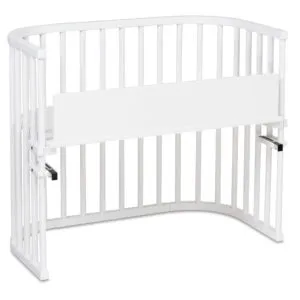
There are three common choices. Untreated beech is raw wood that has simply been sanded smooth. It has nothing on the surface at all, and small marks can be sanded away. Oiled beech has a natural oil worked into the wood, which deepens the color a little and helps repel water. Painted or white beech uses a colored coat, which hides the grain but suits a bright, modern room.
Whichever look you like, ask the maker two questions. First, is the finish water-based? Water-based finishes release far fewer volatile organic compounds, the fumes that give fresh paint its smell. Second, has the finished product been tested for harmful chemicals by an outside lab? A clear yes to both is what you are looking for.
From the material to the product
What makes beech a good nursery woodHow babybay builds with it
The sections below cover babybay’s own beechwood, finishes, testing and warranty, as babybay states them.
How babybay uses beech wood
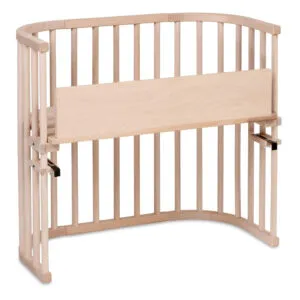
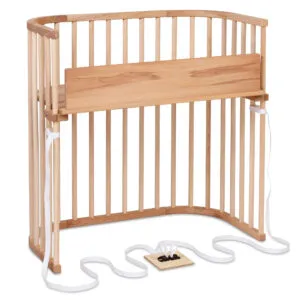
babybay has made its bedside sleepers in Germany since 2003, and every model is built from solid beech. The company describes its wood as 100% ethically sourced European beechwood, harvested from forests in Europe. Its finishes are water-based, and its glue is water-based too. There is no plastic in the frame and no netting around the sleeping area.
The untreated version is raw beech, sanded down to a smooth, natural feel. The coated versions use only water-based finishes. According to babybay, these are tested to the highest standards in the US and Europe and certified free of harmful chemicals. The company names the American Society for Testing and Materials (ASTM), Technischer Überwachungsverein (TÜV) Rheinland and the Confidence in Textiles label among the standards behind its sleepers and textile accessories.
You can see the full line on the babybay bedside sleeper range page. It explains how each model attaches flush to the side of your bed, so your baby sleeps on their own surface within arm’s reach.
- Wood
- 100% ethically sourced European beechwood
- Finishes
- Untreated natural wood or water-based finishes, such as white
- Glue
- Water-based
- Made in
- Germany, since 2003
- babybay Original
- For beds up to 28 inches high; $385
- babybay Maxi
- A wider sleeping platform; for beds up to 28 inches high
- babybay Maxi Tall
- For boxspring beds up to 34.75 inches high
- Freestanding option
- Bassinet conversion kit turns the sleeper into a standalone bassinet
- Warranty
- 10-year limited warranty on solid wood products, with registration
For most standard beds, the babybay Original bedside sleeper is the place to start. At $385 it puts solid German beech, water-based finishes and a decade of warranty cover within reach of most registries. If your bed sits high on a boxspring, the babybay Maxi Tall for boxspring beds fits mattress tops up to 34.75 inches.
Solid beech vs beech veneer: how to tell them apart
Many products described as beech are not solid beech at all. Some use a thin beech veneer glued over particleboard or fiberboard. Others use a printed foil made to look like wood grain. Both can look convincing in a photo, so it pays to check before you buy.
Start with the edges and the underside. On solid wood, the grain runs around corners and continues across cut ends. On veneer, the edge often shows a thin line of wood on top of a pale, crumbly core, or a strip of edging tape. Foil looks perfectly repeated, with the same knot or fleck showing up again a few inches along.
Next, feel the weight. Solid beech is heavy for its size, so a solid sleeper or chair feels sturdy when you lift one end. A board-based piece of the same size usually feels lighter and less firm in the hand.
Finally, read the product description closely. Words like “beech finish”, “beech effect” or “beech color” describe a look, not a material. Look for clear wording such as “solid beech” or “solid beechwood” throughout. babybay describes every sleeper as made from 100% ethically sourced European beechwood.
Is beech wood furniture safe for babies?
The wood is only part of the answer. In the US, any product sold as a bassinet or cradle must also meet a federal safety standard. The Consumer Product Safety Commission (CPSC) bassinet and cradle rules make the ASTM F2194 standard mandatory. That standard covers stability, sleep-surface angle, spacing between parts and the strength of the frame.
So when you shop, look for two things together. The material should be solid hardwood with a tested, low-fume finish. The design should meet the federal bassinet standard. A beautiful beech piece that was never tested as a sleep product is still furniture, not a safe place to sleep.
babybay sleepers meet the ASTM and CPSC requirements for the US. If you want to understand what each label on a baby product actually means, our guide to bassinet safety certifications decoded walks through them one by one.
Is beech wood sustainable?
European beech is a native tree that regrows naturally across much of the continent. When the forests it comes from are managed with care, cutting beech for furniture does not shrink the forest over time. Solid wood also stores the carbon the tree took in for as long as the piece is in use, which is a strong reason to buy something built to last.
babybay goes a step further with its own planting program. The company says it plants one tree for every tree it harvests, and that it has planted more than 24,000 trees over the last 20 years. Because the sleeper is made in Germany from European wood, the material also travels a shorter path to the workshop than tropical hardwoods do.
Longevity is the other half of sustainability. A sleeper that converts and lasts can be used for one child after another, then passed on. You can read more about how that works in our piece on what convertible bassinets offer.
Downsides of beech wood to know about
Keep in mind
Where beech needs a little care
- Caution
Beech reacts to big swings in humidity and can move slightly as the air dries or dampens.
Keep it away from radiators, heating vents and humidifiers aimed straight at the wood.
- Caution
Untreated beech can show water rings and marks more easily than finished wood.
Wipe spills quickly; small marks on untreated wood can be sanded out lightly.
- Note
Beech is not made for outdoor use and will decay if left wet for long periods.
Use beech furniture indoors only.
- Note
Solid beech is heavier than pine or fiberboard pieces of the same size.
Rolling casters make a solid sleeper easy to move around a room.
How to care for beech nursery furniture
Step 1Wipe, don't soak
For everyday cleaning, use a clean cloth dampened with plain water. babybay recommends this for both its varnished and unvarnished models.
Step 2Dry it straight away
After wiping, go over the surface with a dry cloth so no water sits on the wood.
Step 3Skip harsh cleaners
Avoid bleach, solvent sprays and abrasive pads. They can dull a finish and leave residue where your baby’s hands go.
Step 4Sand small stains on untreated wood
On untreated beech, a light pass with fine sandpaper removes small stains. Follow the grain and wipe away the dust afterward.
Step 5Check the hardware now and then
Every few weeks, make sure screws and clamps are snug. Solid wood can settle slightly as the seasons change.
Buying checklist for beech wood nursery furniture
QIs beech a hardwood or a softwood?
Beech is a hardwood. It comes from a broadleaf tree and is much denser and harder than softwoods such as pine, which is why it resists dents and wears so evenly.
QIs "beech finish" furniture made of real beech?
Not always. “Beech finish” or “beech effect” usually means a board covered with a beech veneer or a printed foil. If you want real wood, look for the words “solid beech” and check the edges for continuous grain.
QIs beech wood toxic for babies?
Solid beech wood itself is not treated with anything and has very little natural resin. What matters is the finish on top. Look for untreated beech or a water-based finish that has been tested for harmful chemicals, as babybay’s are.
QIs beech better than oak for nursery furniture?
Both are strong hardwoods. Beech has a tighter, smoother grain than oak, so it sands to a softer surface and has fewer open pores to trap grime. That makes it a better fit for pieces a baby touches every day.
QDoes beech wood scratch easily?
Beech is hard, so it resists dents better than most furniture woods. It can still scratch under sharp objects. On solid beech, light scratches can be sanded out, which is not possible on veneer or laminate.
QIs beech wood furniture expensive?
Solid beech costs more than pine or fiberboard, but it lasts far longer. The babybay Original, built from solid European beech with a 10-year limited warranty, sells for $385. Because solid wood lasts through more than one child, that cost is spread over many years of use.
QHow do I clean beech wood baby furniture?
Wipe it with a clean cloth dampened with plain water, then dry it. Avoid harsh cleaners and soaking the wood. On untreated beech, small stains can be removed with a light sanding along the grain.
Solid beech, made in Germany
Find the babybay that fits your bed
Every babybay is built from solid European beechwood with water-based finishes and backed by a 10-year limited warranty. Compare the Original, Maxi and Maxi Tall and see which one fits your bed.
Cite this article
babybay (2026). babybay.