Summarize this post with:


Baby Sleep Safety
Feed and settle your baby fully, wait until they are in deep sleep, then lower them bottom-first onto a warmed, flat sheet with your hand held on their chest for thirty seconds before you let go. Most newborns need the bassinet close enough to touch, and most need a week of this before it sticks.
The short version
- 01
A newborn who wakes the moment you put them down is reacting to a startle reflex, a temperature drop and the loss of your smell and sound — three things you can each do something about.
- 02
Put down bottom-first, not head-first, and keep one hand on the chest for twenty to thirty seconds after contact before lifting it away slowly.
- 03
Wait for deep sleep. Limp arms and a slack jaw mean ready; fluttering eyelids and curled fists mean too soon.
- 04
Distance matters more than parents expect. A sleep surface within arm’s reach and level with your mattress takes the reaching, lifting and standing out of every night feed.
- 05
Never solve this with an incline, a positioner, a pillow or by letting the baby sleep on you while you sleep. Those fixes carry real risk, and there are safe alternatives for every one of them.
Why newborns fight the bassinet (and why it is not you)
Nothing has gone wrong. A baby who will only sleep on a person is behaving exactly as a newborn is built to behave, and the specific reasons are worth knowing because each one has a practical answer.
The first is the Moro reflex — the startle. Up to around four months, a sudden change in head position or a feeling of falling makes a baby throw their arms out, and that reflex is what fires when you lower them through the air and away from your chest. It is not that they noticed the mattress. It is that the descent itself triggered a hardwired response. That is why how you put them down matters more than where.
The second is temperature. Your chest runs at about 98 degrees; a cotton sheet that has been sitting in a cool bedroom does not. A newborn’s skin registers that drop immediately, and cold is an arousal signal. The third is sensory: on you, a baby has your heartbeat, your breathing sounds, the pressure of your arms around them and your smell. A flat quiet surface has none of those, and the contrast is what wakes them.
The fourth reason is simply that newborn sleep cycles are short — around 45 to 50 minutes — and they surface into light sleep at the end of each one. On you, they resettle without truly waking. Alone, that surfacing becomes a full waking unless the environment is doing some of the work. If your baby is also fighting sleep before the put-down rather than after it, why babies fight sleep covers the overtired and undertired ends of that problem, which is a different issue from this one.
Worth saying plainly
Contact naps are not a bad habit
You cannot spoil a newborn, and holding your baby while they sleep during the day does not stop them learning to sleep alone at night. What matters is that when you are likely to fall asleep yourself, the baby is on their own firm flat surface — not on your chest, and not on a sofa or armchair, which is the single most dangerous place for a baby and an adult to fall asleep together.
Set the bassinet up so it works with you, not against you
Do this before you attempt the technique, because the setup determines how much the technique has to accomplish. Half of what parents experience as a put-down problem is a setup problem.
Position first. The American Academy of Pediatrics safe sleep guidance recommends that babies sleep in the parents’ room, close to the parents’ bed but on a separate sleep surface, ideally for at least the first six months. Close is the operative word. A bassinet across the room means that every put-down ends with you walking away, and every waking starts with you getting out of bed — which wakes you fully, takes longer, and makes the baby wait. A sleep surface immediately beside you means you can settle a stirring baby with a hand before they escalate into a real waking.
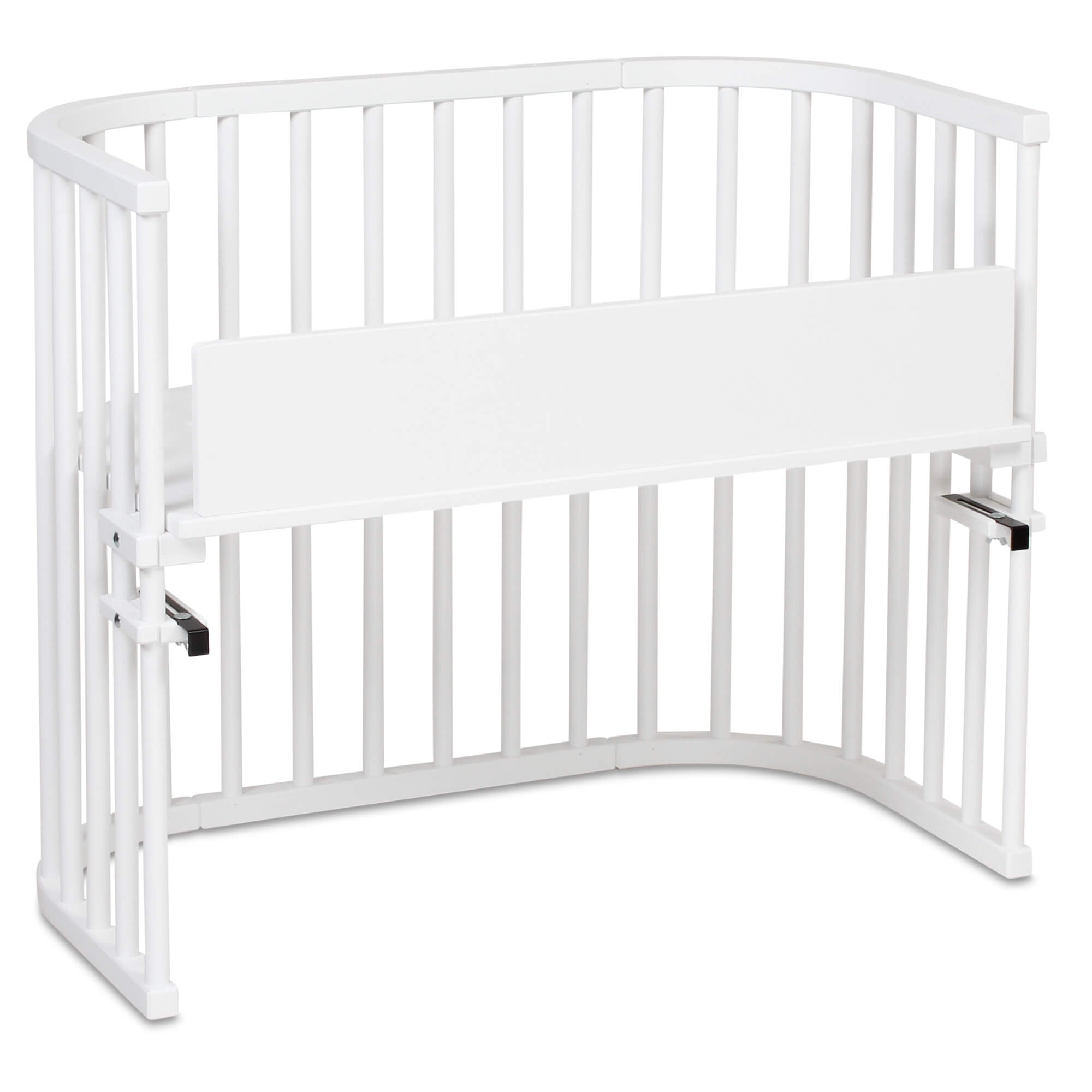
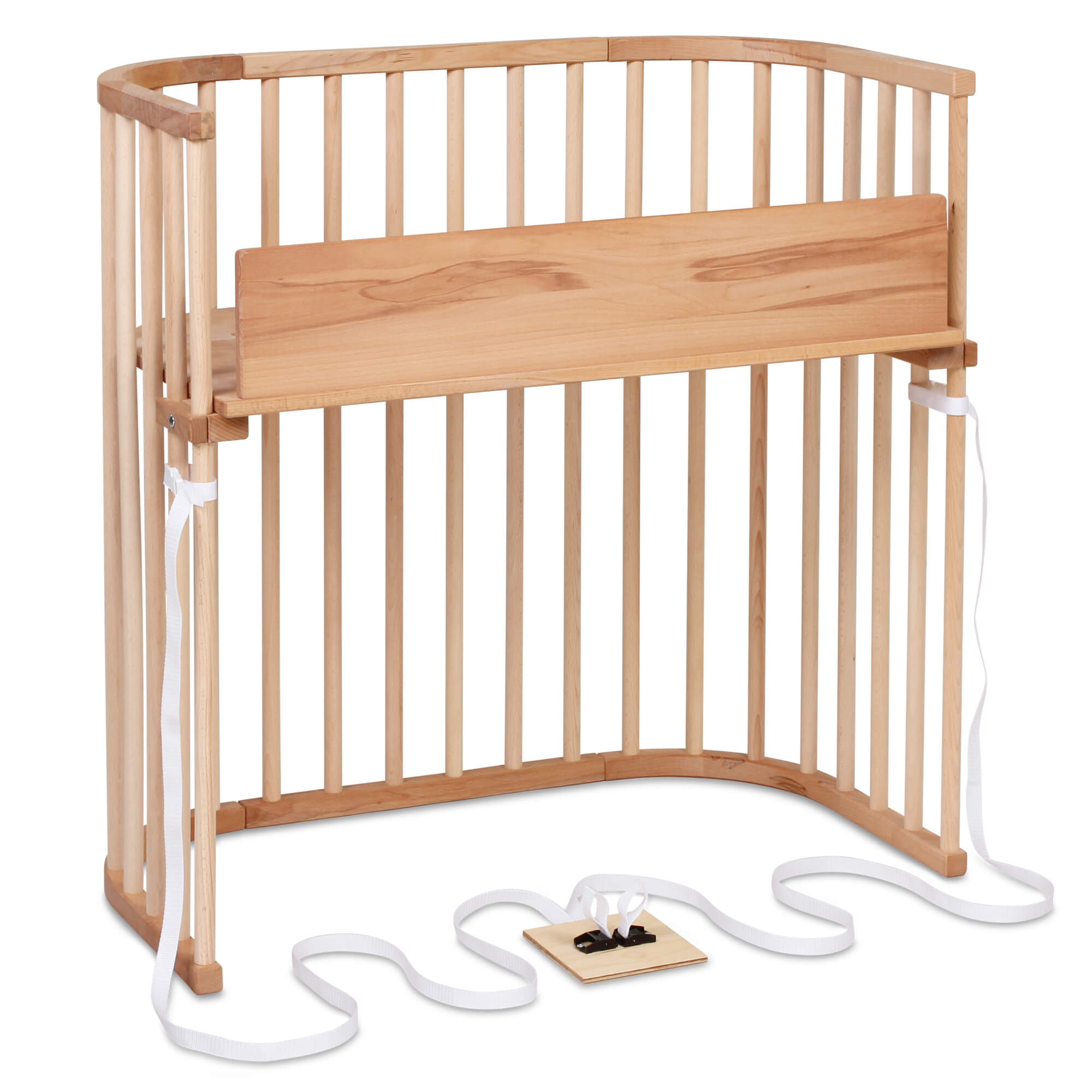
Height is the part people discover too late. If the sleeping surface is well below the top of your mattress, every night feed involves sitting up, twisting and lifting a baby up over a rail with both arms, which is precisely the movement a C-section recovery cannot easily do. A bedside sleeper level with your mattress removes that entirely — the baby comes across to you and goes back at the same height, without lifting. This is why the sidecar arrangement works so well for the first months, and why the babybay Original is designed to adjust to the height of an adult bed up to 28 inches rather than sitting at a fixed bassinet height.
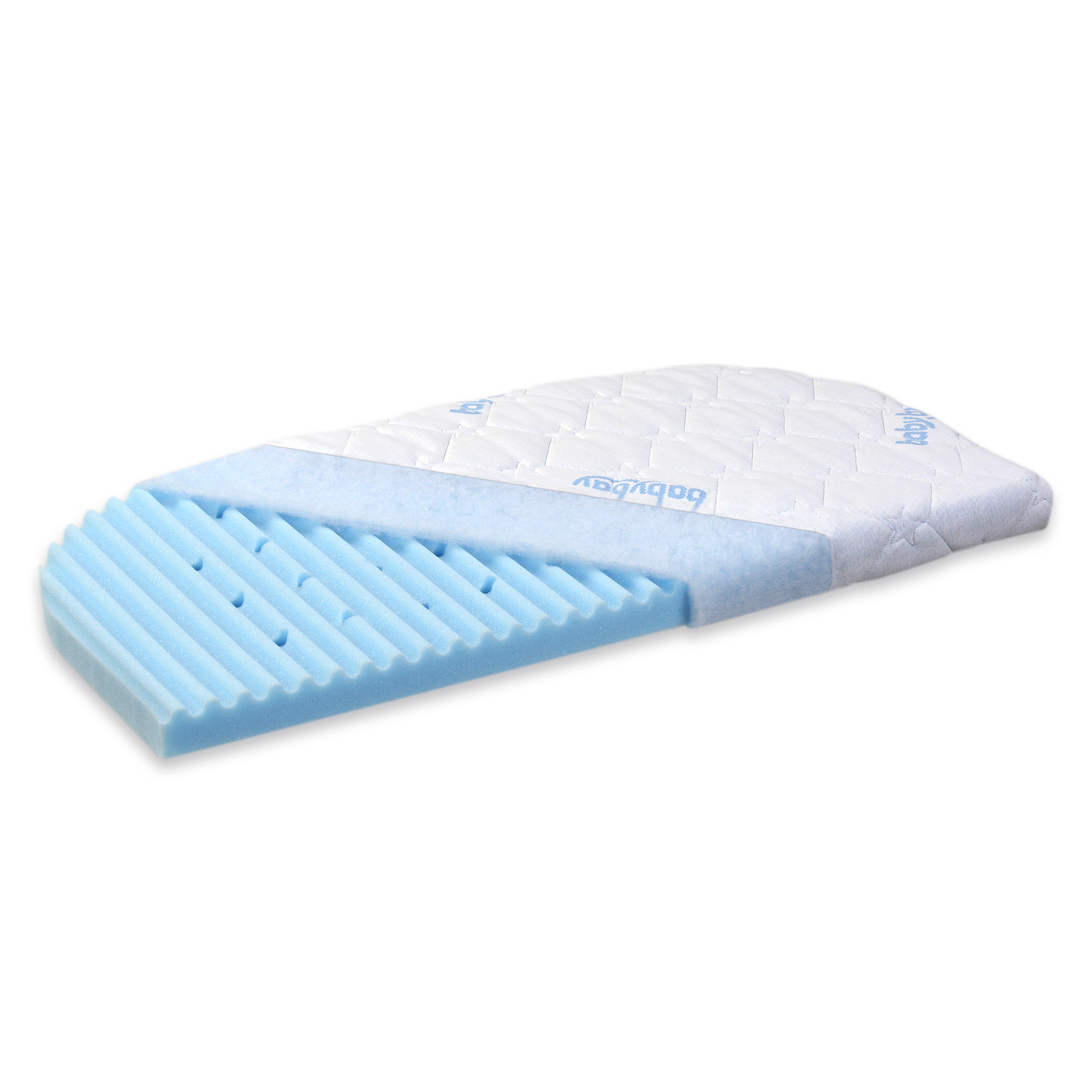
Then the surface itself. Firm, flat and level, with a fitted sheet sized to the mattress and nothing else in there at all. NICHD Safe to Sleep is unambiguous on this: no pillows, blankets, quilts, bumpers, wedges or positioners, and the baby on their back for every sleep. A firm surface feels less inviting to an adult hand than a soft one, and that instinct is exactly the one to override — firmness is what keeps an airway clear if a baby turns their face.
Finally the room. Dark enough that daylight is not doing the waking, a continuous low white-noise sound running all night rather than something that switches off, and a room temperature in the high 60s. Dress the baby in one more layer than you are comfortable in, and use a wearable sleep sack rather than anything loose.
Step-by-step: putting a sleeping newborn down without waking them
STEP 01Warm the sheet before you feed
Lay your hand or a warm water bottle on the sheet while you feed, and remove it just before you put the baby down. Warm the surface, never the baby, and check it is warm rather than hot with the inside of your wrist.
This single change solves the temperature drop that causes a large share of instant wakings.
STEP 02Feed and burp fully, then keep them upright a few minutes
A baby put down with a half-full stomach or trapped wind will wake regardless of technique. Feed to the end, burp properly, and hold them upright for five to ten minutes afterwards — longer if they are a spitty baby or you suspect reflux.
Those minutes upright are not wasted time. They are part of the put-down.
STEP 03Wait for deep sleep and check for it
Light sleep looks like fluttering eyelids, curled or clenched fists, sucking movements and small twitches. Deep sleep looks like a slack jaw, an open relaxed hand and a heavy arm. Lift one arm an inch and let it go: if it drops limp, you are ready.
Most parents are trying to put down a baby who is still four or five minutes from deep sleep. Waiting those minutes out is the highest-return thing on this list.
STEP 04Lower bottom-first, head last
Keep the baby tucked close to your body as you move, then lower them so their bottom and legs touch the mattress first and the head arrives last, staying supported in your hand throughout. Lowering head-first triggers the falling sensation that fires the startle reflex.
Keep your own body bent over them as you do it, so they stay within your warmth and smell until the last moment.
STEP 05Hold a hand on the chest for thirty seconds
Once they are down on their back, rest one open palm flat and still on their chest and leave it there for twenty to thirty seconds. Do not pat, rock or jiggle — stillness is the message. The contact and light pressure bridge the gap between being held and being alone.
Then lift your hand away gradually, fingers last, rather than removing it all at once.
STEP 06Stay close and shush before you leave
Keep your face near them and make a low continuous shushing sound for another half-minute. If they stir, keep the hand on and the sound going rather than picking them up immediately. Many babies settle at this point with no more intervention.
If they fully wake and cry, pick them up, resettle completely, and start again. Restarting is not failure; it is the process.
STEP 07If it fails three times, stop for that sleep
Three genuine attempts in one settling is enough. Beyond that, everyone is more upset and you are teaching the baby that the bassinet is where the struggle happens.
Hold them for that nap, then try again at the next one. Progress is measured across a week, not within a single evening.
Most parents are not failing at the put-down. They are attempting it four minutes too early.
babybaySafe fixes vs unsafe shortcuts
The internet offers a lot of solutions to this problem, and some of them carry real risk. The distinction is easy to hold onto: anything that changes how you put the baby down, or what the room feels like, is fair game. Anything that changes the sleep surface itself — its angle, its firmness, or what is on it — is not.
System constraints
Safe to try
- hard
Warming the sheet before the put-down, with your hand or a warm bottle removed before the baby goes down
- hard
A wearable sleep sack in place of any loose blanket
- hard
Continuous white noise running all night at a low, conversational volume
- hard
A snug, hip-safe swaddle for a baby who is not yet showing any sign of rolling, arms in, chest not tight
- hard
A pacifier offered at sleep onset, once feeding is established, and not reinserted after it falls out
- hard
Sleeping the baby within arm’s reach on their own firm flat surface, level with your mattress
- hard
Moving the baby across to feed and back again without lifting them up over a rail
System constraints
Never, whatever you have read
- hard
Inclining the bassinet or putting anything under the mattress — an inclined surface lets an airway close and is not a reflux treatment
- hard
Any pillow, wedge, positioner, nest, bumper or rolled towel in the sleep space
- hard
A blanket, quilt, comforter or loose muslin over a sleeping baby
- hard
Leaving a baby asleep on your chest while you sleep, and above all on a sofa, couch or armchair
- hard
Putting a baby down on their front or side to help them settle
- hard
Continuing to swaddle once a baby shows any sign of starting to roll
- hard
A car seat, bouncer, swing or carrier for routine sleep — sitting devices are not sleep surfaces
When it is more than a habit: reflux, hunger, illness
Technique cannot fix a medical reason, and if a week of consistent effort produces nothing at all, look for one. A baby who arches, cries and pulls away during or after feeds, who is hoarse, who refuses to lie flat at any point in the day, or who is not gaining weight as expected may be dealing with reflux or a feeding problem rather than a settling problem. Those need a pediatrician, and the answer is never an inclined sleep surface.
Hunger is the other common cause, and it is simplest to test: if the baby settles readily after a longer or additional feed, they were hungry. Growth spurts around three and six weeks genuinely do change how much and how often a baby needs to feed, for about a week at a time. Reading the baby sleep cues in the wind-down window helps you catch the difference between a baby who needs feeding and a baby who is simply overtired and cannot switch off.
Call your pediatrician the same day for a baby who is feeding poorly, has a fever, is unusually floppy or unusually difficult to rouse, is breathing noisily or with effort, or has stopped producing normal wet diapers. Trust your read of your own baby over any plan on any page, including this one.
A realistic 7-night plan
Nights 1-2
Change only the setup
Move the sleep surface within arm’s reach and level with your mattress, warm the sheet, start continuous white noise and darken the room. Do not change anything about how you settle the baby yet. You are removing the environmental causes before you work on technique.
Nights 3-4
Add the technique at the first sleep of the night
Use the full sequence — deep-sleep check, bottom-first, hand on chest, shush — for the first settle of the evening only, when the baby is most tired and you are least depleted. Hold them for the rest of the night’s sleeps if that is what works. One reliable success beats five attempts.
Nights 5-6
Extend to night feeds
Apply the same sequence after night feeds. Expect it to take longer at 3 a.m. than at 8 p.m., because the baby is in lighter sleep and so are you. Keep the room dark and the interaction minimal so the feed does not become playtime.
Night 7
Take stock honestly
Look for direction of travel, not perfection: is the baby staying down longer than on night one, even by fifteen minutes? That is the plan working. If nothing at all has shifted in seven consistent nights, stop iterating and talk to your pediatrician about reflux, feeding or an unrecognised discomfort.
Weeks 2-8
Let maturation do the rest
The startle reflex fades between three and four months and sleep cycles lengthen, so the same technique that took twenty minutes in week one starts taking two. What you build now is the routine; biology supplies the improvement. For what changes after this stage, help your baby sleep through the night picks up where the newborn window ends.
Last updated
QWhy won't my newborn sleep in the bassinet?
Four reasons, usually together. The Moro startle reflex fires as you lower them through the air, so they wake on the descent rather than on the mattress. The sheet is cooler than your chest, and that temperature drop is an arousal signal. They lose your heartbeat, breathing sounds, pressure and smell all at once. And newborn sleep cycles run only 45 to 50 minutes, so they surface into light sleep often and need help resettling. Each of those has a fix: put down bottom-first with a hand held on the chest, warm the sheet first, run continuous white noise, and keep the sleep surface within arm’s reach.
QHow long should I let my newborn cry in the bassinet?
You should not leave a newborn to cry. Sleep training methods that involve leaving a baby to cry are not appropriate under about four to six months, and for a newborn crying is the only way to signal a need. Respond to your newborn’s cries. What you can do is pause a few seconds before lifting, because babies make a lot of noise while resettling and some of those sounds are not a real waking. If the crying is genuine and escalating, pick them up, resettle fully, and try the put-down again.
QIs it OK for a newborn to sleep on my chest?
While you are fully awake and upright, yes — contact naps are normal and beneficial, and they do not create a bad habit. The danger is falling asleep yourself, because a baby can slip into a position where their airway is blocked. The riskiest version of this is falling asleep together on a sofa, couch or armchair, which carries a substantially higher risk than an adult bed. If there is any chance you might doze off, put the baby on their own firm flat surface first. That is precisely the argument for having that surface within arm’s reach.
QShould the bassinet be right next to my bed?
Yes. The AAP recommends room-sharing on a separate sleep surface, close to the parents’ bed, ideally for at least the first six months, and the closer that surface is the more the arrangement actually helps you. Within arm’s reach means you can settle a stirring baby with a hand before they fully wake, and you can feed without getting out of bed. A surface level with the top of your mattress goes further again, because you can bring the baby across and back without lifting them up over a rail — which matters a great deal during C-section recovery.
QCan I put my newborn in the bassinet awake?
You can try, and it is worth trying occasionally from early on, but do not expect it to work reliably with a newborn. “Drowsy but awake” is a real skill that most babies develop closer to three or four months. With a newborn, put them down in deep sleep most of the time and attempt drowsy-but-awake once a day at the sleep where they settle most easily. If it works, wonderful. If it does not, settle them fully and use the put-down sequence — you have not missed a window, and this gets easier as the startle reflex fades.
QHow do I know when my baby is in deep enough sleep to put down?
Check three things. The jaw goes slack and the mouth may fall slightly open. The hands uncurl and the fingers relax rather than staying fisted. And the arms are heavy — lift one an inch and let go, and it should drop limply rather than resisting or repositioning. Fluttering eyelids, sucking motions and small twitches mean the baby is still in light sleep and will almost certainly wake. Waiting an extra four or five minutes at this stage is the difference between a put-down that works and one that does not.
Where better sleep is born
Find the babybay that fits your bed
The put-down is easier when the sleep surface is within arm’s reach and level with your mattress. Our bedside sleepers adjust to adult bed heights, are made from solid European beechwood with water-based finishes, meet ASTM and CPSC standards, and carry a 10-year warranty. Answer three questions about your bed and we will show you the right model.