Summarize this post with:


Sleep · Newborn
Your baby is not confused. They were born without a working body clock, and building one takes weeks. What you can do meanwhile is give that clock something to set itself by — and most families see a real difference inside seven days.
8–12 weeks
when most babies settle into a day-night pattern of their own
Day/night confusion is not a disorder and your baby is not doing it on purpose. A newborn arrives without a functioning body clock, so sleep and waking arrive in short bursts scattered evenly around the twenty-four hours. The internal rhythm that concentrates sleep into the night has to be built, and the research puts that somewhere between eight and twelve weeks.
That is the honest answer, and it is not the answer most parents want at three in the morning. So the rest of this guide is about what you can actually change in the meantime: the signals that help a developing clock find north, a seven-day routine that most families see results from, the things that are widely recommended and do not work, and the signs that what you are dealing with is not day/night confusion at all.
The short version
- 01
Newborns are born without a settled circadian rhythm. The evening melatonin rise that tells a body it is night does not get going until around two months.
- 02
Most babies show a clear day-night pattern between 8 and 12 weeks, with partial improvement much sooner once days are bright and nights are dull.
- 03
You cannot sleep-train a newborn and nobody should try. You can only give the clock strong signals: daylight and household noise by day, dim and boring nights, full daytime feeds.
- 04
Keeping night feeds dark, quiet and low-effort is the highest-leverage change most families can make — which is exactly what a bedside sleeper is for.
- 05
Persistent 24-hour unsettledness with poor weight gain, arching after feeds or fewer wet nappies is not day/night confusion. That is a call to your pediatrician.
What Day/Night Confusion Actually Is
Definition
Day/night confusion — The normal newborn pattern of sleeping in short blocks spread evenly across twenty-four hours, with longer stretches often falling in the daytime. It reflects an immature circadian system rather than a habit, a feeding problem or anything a parent has done wrong.
In the womb, your baby’s rhythm was set by yours. Your melatonin crosses the placenta, so the fetus is given a night signal it does not have to generate. At birth that supply stops and nothing has yet replaced it, which is why the first weeks look so disorganised. A newborn’s sleep is not badly timed; it is untimed.
The system then comes online in pieces rather than all at once. A detailed study that tracked one infant from birth to six months, published in the journal Sleep, found the waking rhythm reached statistical significance at about day 45 — around the same time salivary melatonin started rising at sunset — with the sleep rhythm following after day 56. Temperature came first, within the first week. That staggered arrival is why improvement feels gradual rather than sudden: one part of the clock starts working before the rest catches up.
Two other things are happening at the same time, and they matter for what you should expect. Newborn sleep cycles are short, roughly 45 to 50 minutes against an adult’s 90, and a much larger share of that is active sleep — the noisy, twitchy, eyes-flickering kind that looks like waking and often is not. And a newborn stomach holds very little, so feeds are needed every two to three hours regardless of what the clock says. Even a baby with a perfect rhythm would still be waking at night.
How Long It Lasts
Most babies settle into a recognisable day-night pattern between eight and twelve weeks, and a diurnal pattern with genuinely more sleep at night is usually established by around twelve to sixteen weeks. Before six weeks, there is very little to be gained from expecting it — the biology is not there yet.
What changes earlier is the shape of it, and this is the part nobody tells you to watch for. The signs that things are moving are small and worth noticing, because they arrive well before the long night stretch does.
Weeks 0–2
No pattern at all
Sleep in 2 to 4 hour blocks distributed evenly day and night. Nothing you do will change this and nothing needs to. Focus on feeding, recovery and getting light into the daytime.
Weeks 2–6
Light starts to register
Daytime waking begins to look a little more alert and a little more social. Evening fussiness and cluster feeding often appear here. Keep the signals consistent; do not expect results yet.
Weeks 6–8
The longest stretch moves to the night
The first real sign. Your baby’s longest single block of sleep, whatever its length, starts landing after dark rather than at two in the afternoon. This is the change to look for.
Weeks 8–12
A rhythm you can recognise
Evening melatonin is rising. Night feeds shorten and the baby resettles faster afterwards. Daytime alert periods lengthen and start falling at similar times each day.
Weeks 12–16
A settled day-night pattern
Most of the twenty-four hours’ sleep is now happening at night. Night waking continues — that is normal and often continues for months — but it is waking within a pattern rather than a scattering.
The Seven-Day Reset
You cannot install a body clock. What you can do is make the difference between day and night unmissable, so the developing system has a strong signal to lock onto instead of a weak one. Run all of the following together for a full week rather than picking one — it is the contrast between the days and the nights that does the work, not any single change.
Days: light, noise and full feeds
STEP 01Get daylight on your baby in the first hour after waking
Open the curtains, or take them near a window, or step outside if the weather allows. Bright morning light is the single strongest cue a circadian system has, and it is free.
You do not need direct sun and you should not put a newborn in it. Ordinary daylight through a window is plenty.
STEP 02Do not tiptoe around daytime naps
Run the dishwasher, talk normally, let older children be children. Daytime sleep should happen against a background of ordinary household noise and ordinary light so it feels different from night sleep.
Blackout blinds for newborn naps work directly against what you are trying to teach.
STEP 03Make daytime feeds full and unhurried
A baby who snacks through the day makes up the calories at night. Keep them awake enough to take a full feed: change a nappy mid-feed, a cool cloth on the feet, switch sides.
This is the change that most often moves the needle in families where nights are worst.
STEP 04Talk, play and engage while they are awake
Newborn alert windows are short — often 45 to 90 minutes including the feed. Use them. Face-to-face time, a walk, a nappy-free stretch on a mat.
An under-stimulated day makes for a wide-awake evening.
Nights: dim, dull and boring
From the last evening feed onward, everything changes register. Lights down as far as you can manage while staying safe on the stairs. No overhead lights at all after dark — a warm, dim lamp on the lowest setting you can still see by. Keep your voice to a whisper or say nothing at all, and skip the eye contact and the chat that you would have used at two in the afternoon.
Night nappy changes should be efficient and unremarkable: change only if it is soiled or truly soaked, use a wipe warmer or warm the wipe in your hand so the shock does not wake them fully, and do it before the feed rather than after so they can drift off at the end. The aim is that nothing interesting ever happens after dark, so night becomes the least rewarding part of the day.
Screens matter more than people expect. The phone you check while feeding is a bright light source held close to two pairs of eyes, yours included, and yours matters because your own rhythm is part of how you cope. If you need something during long feeds, audio is the better choice.
Night feeds without waking everyone up
Here is the practical problem at the centre of every night in these weeks. Your baby needs feeding every two to three hours. Getting up, crossing a cold room, lifting a baby out of a nursery crib and switching on a light to see what you are doing wakes both of you completely — and then you have two people to resettle, one of whom has to be at work in five hours.
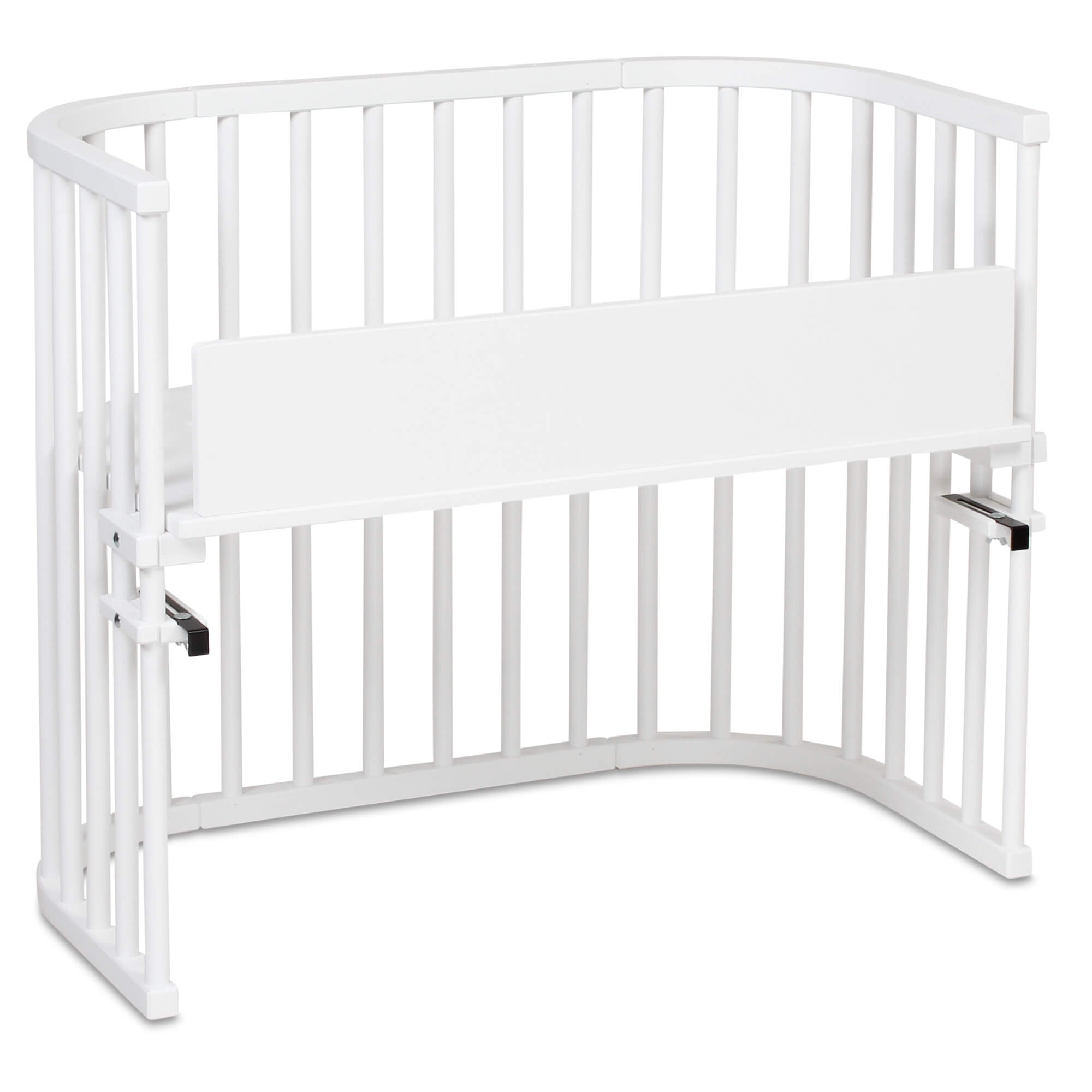
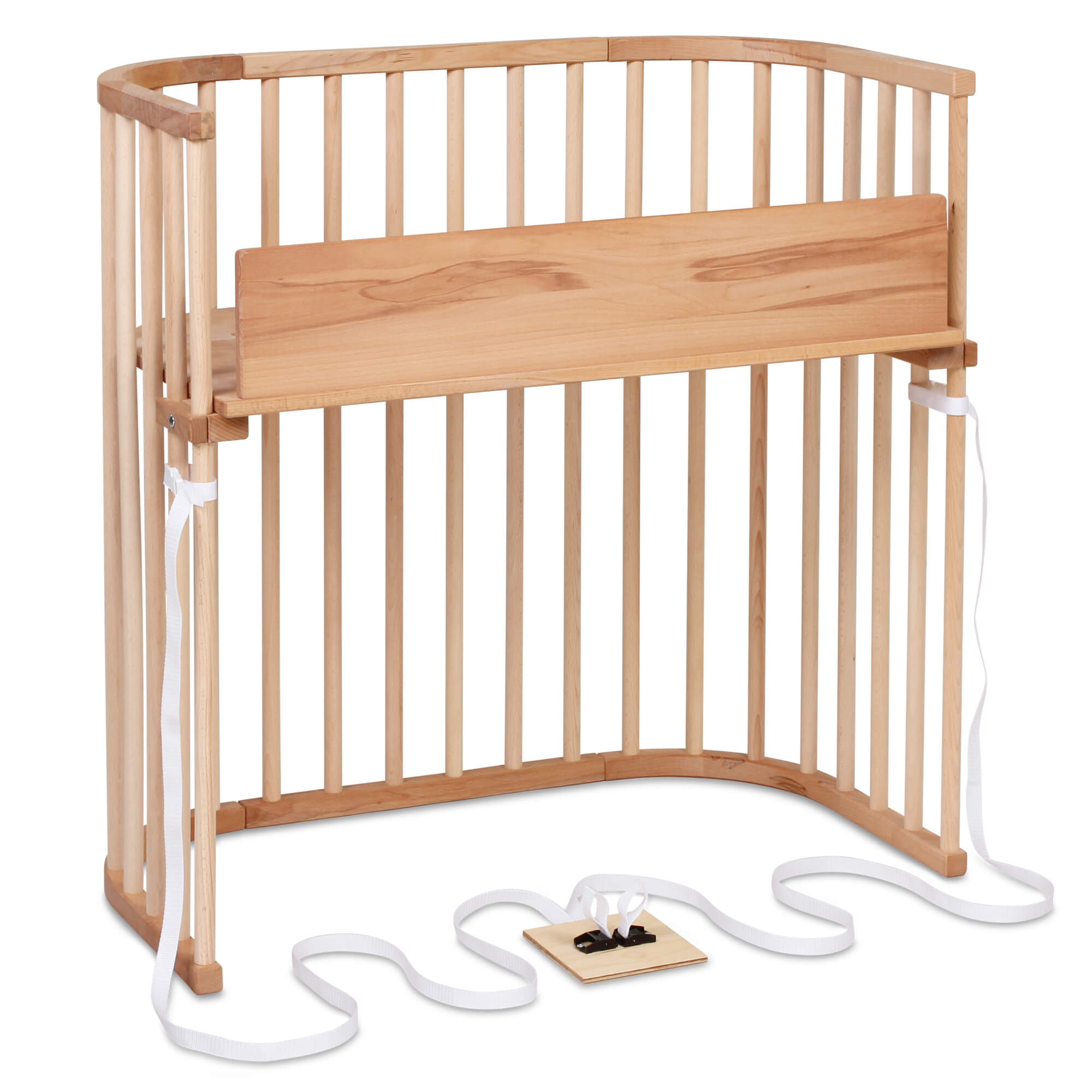
The American Academy of Pediatrics is clear on the arrangement it recommends: room-sharing on a separate sleep surface, in the parents’ bedroom, ideally for at least the first six months — and specifically not in the parents’ bed. That is the sweet spot a bedside sleeper is built for. The baby is on their own firm, flat, level surface, an arm’s length away, with no standing, no crossing the room and no ceiling light at 3am.
In practice that changes a night feed from a fifteen-minute wake-up into a four-minute one. You reach, feed, settle, and neither of you has fully surfaced. Over a week of four-feed nights the difference in how much sleep both parents actually get is substantial, and it is the reason our bedside co-sleeper bassinets exist in the first place. For mothers recovering from a caesarean, not having to get up and lift is often the whole difference between managing and not.
Which babybay fits your bed
babybay US model specifications
| Model | Fits mattress-top height up to | Sleeping platform | Best for |
|---|---|---|---|
| babybay Original | 28 in | Standard | Most standard bed frames and platform beds |
| babybay Maxi | 28 in | Wider | Standard bed heights where more room for one baby is wanted |
| babybay Maxi Tall | 34.75 in | Wider | Boxspring and taller beds where the Original will not reach |
Measure from the floor to the top of your mattress before you choose — that number, not the bed’s style, is what decides the model. The Original starts at $385 and is solid European beechwood with water-based finishes, meets ASTM and CPSC standards, carries a ten-year warranty and converts to a freestanding bassinet when you are ready to move out of the bedroom. If you are between sizes or on a boxspring, compare the three babybay models before ordering, and our guide to using a co-sleeper with a tall bed covers the measuring properly.
Whether to wake a sleeping newborn
Usually yes, during the day, in these early weeks. If a daytime nap is running past three hours, waking your baby for a feed is reasonable and helpful: it protects the daytime calorie intake and it stops a four-hour afternoon block from becoming the longest sleep of the twenty-four. Once your pediatrician is happy with weight gain and your baby is back above birth weight, ask whether you still need to wake at night — many families are told they can stop.
At night, do the opposite. If your baby stirs, grunts, squirms or makes noise without properly waking, wait. Active sleep looks remarkably like waking and a good proportion of newborn sleep is spent in it. Pausing for a minute or two before you intervene means you are not lifting a baby who was going to resettle on their own — and learning to read the difference is the same skill as reading baby sleep cues in the daytime.
What Does Not Work (and Why It Keeps Being Recommended)
Widely suggested
Things to skip, and the reason they keep coming up
- hard
Sleep training a baby under four months.
There is no rhythm yet to train and night feeds are a genuine need. It keeps being recommended because it does work later. Wait until at least four months, and talk to your pediatrician first.
- hard
Cereal or rice in a bottle to make the baby sleep longer.
It is a choking and aspiration risk, it does not improve sleep, and solids are not recommended before about six months. Never do this.
- soft
Blackout blinds and total silence for daytime naps.
It produces longer daytime naps, which is why parents like it — and longer daytime naps are precisely the problem. Keep days light and normal; save the dark for nights.
- soft
Keeping the baby awake all evening to “tire them out”.
An overtired newborn is harder to settle, not easier, and fights sleep more. Feed, dim the lights and settle at the first tired cues instead.
- info
Expecting a schedule in the first six weeks.
Routine helps you; a clock-based schedule does not help a newborn who has no clock. Consistent signals in a consistent order beat fixed times every week until about eight weeks.
It is worth saying plainly that none of the above appears on lists because people are careless. Each one solves a real short-term problem — a longer nap, a quieter evening, an unbroken stretch — and each one does it by working against the thing you are trying to build. The test to apply to any new advice is simple: does this make the difference between day and night bigger or smaller?
When It Is Not Day/Night Confusion
Day/night confusion means sleep in the wrong places, not sleep that will not come at all. A baby with an immature rhythm still sleeps a normal total across the twenty-four hours, feeds well, gains weight and settles reasonably once fed. When that is not the picture, the pattern is telling you something else, and it is worth a call rather than another week of routine adjustments.
- Unsettled around the clock, not just at night
- Ask about feeding, reflux or discomfort — a rhythm problem has good stretches somewhere
- Arching, back-stretching or crying during and after feeds
- Worth raising as possible reflux or a feeding-mechanics issue
- Fewer than six wet nappies a day after day five
- Call today — this is about intake, not sleep
- Not back to birth weight by two weeks
- Pediatrician, not a sleep plan
- Feeds taking 45 minutes and still hungry
- Ask for a feeding assessment — latch, transfer or supply
- Parental exhaustion tipping into despair or anxiety
- This counts as a medical reason to call. Say so honestly at the appointment.
That last line is not padding. Sleep deprivation at this level is a health issue for the parent as well as a logistics problem, and postpartum mood conditions are common, treatable and frequently missed because everyone assumes tiredness explains everything. If the nights are affecting how you feel about yourself or your baby, tell someone with a prescription pad, not a forum. And in the meantime, take the practical help: our full safe co-sleeping guidance covers setting the bedroom up so that the person who is not feeding can actually sleep through it.
Where better sleep is born
Make the 3am feed a four-minute job
A babybay sits flush against your bed on its own firm, flat surface — room-sharing exactly as the AAP recommends, without the light, the cold floor or the full wake-up. Solid European beechwood, ASTM and CPSC compliant, ten-year warranty.
QWhy does my newborn sleep all day and stay awake all night?
Because the body clock that concentrates sleep into the night has not developed yet. Before birth your melatonin gave your baby a night signal; after birth that stops and nothing replaces it for several weeks. Sleep then arrives in short blocks spread evenly across the day and night, and long daytime naps mean more waking after dark.
QHow long does newborn day/night confusion last?
Most babies show a clear day-night pattern between 8 and 12 weeks, and a genuinely night-weighted sleep pattern by around 12 to 16 weeks. The first sign of progress comes earlier: somewhere around 6 to 8 weeks the longest single sleep block starts landing after dark instead of in the afternoon.
QShould I wake a sleeping newborn during the day?
In the early weeks, yes, if a daytime nap runs past about three hours. It protects daytime calorie intake and stops a long afternoon block becoming the longest sleep of the day. Once your pediatrician is happy with weight gain and your baby is above birth weight, ask whether you can stop waking at night.
QDo I need to keep night feeds completely dark?
As dark as you can while staying safe. No overhead lights — a warm, dim lamp on its lowest setting is enough for a nappy change and a latch. The bigger win is not having to leave the bed at all, which is why a bedside sleeper changes these weeks more than any lighting choice does.
QIs day/night confusion a real medical thing or just a phrase?
It is a plain-English name for something real: an immature circadian system. The underlying biology is well documented, with the waking rhythm and the evening melatonin rise appearing around six to eight weeks. It is not a diagnosis and it needs no treatment — it needs time and consistent light and dark signals.
QWhen should I talk to a pediatrician about it?
When the pattern is not just misplaced sleep. Unsettledness around the clock with no good stretches anywhere, poor weight gain, fewer than six wet nappies a day after day five, arching or crying during feeds, or feeds that take 45 minutes and leave your baby still hungry. Also call if your own exhaustion is affecting your mood — that is a legitimate reason.