
Shop

Summarize this post with:


Baby Sleep Safety · Pacifiers
Yes. A newborn can sleep with a pacifier, and pediatricians suggest offering one at naps and bedtime because it is linked to a lower risk of sudden infant death. What matters is how you use it: a plain pacifier, nothing tied to it, and no need to put it back once it falls out.
If you are reading this at 3 a.m. with a pacifier in one hand, you are in good company. Many parents worry that letting a newborn sleep with a pacifier is a bad habit, or even a danger. The short answer is reassuring. For most babies, a pacifier at sleep time is safe, and it may lower risk.
The 2022 safe sleep policy from the American Academy of Pediatrics (AAP) lists offering a pacifier at nap time and bedtime among its ways to reduce the risk of sudden infant death syndrome (SIDS). The same policy explains that roughly 3,500 babies in the United States die each year from sleep-related causes. That number is why the details below are worth a few minutes of your time.
Key takeaways
- 01
A newborn can sleep with a pacifier, and the AAP suggests offering one at naps and bedtime.
- 02
Use a plain one-piece pacifier with nothing tied to it during sleep.
- 03
If it falls out after your baby is asleep, you do not need to put it back.
- 04
Breastfed babies do best when the pacifier waits until feeding is going well.
- 05
A pacifier works alongside back sleeping and room-sharing on a separate surface, never instead of them.
Can a newborn sleep with a pacifier?
Yes, with a few conditions. Your baby should be placed on their back, alone, on a flat and firm surface with only a fitted sheet. The pacifier should be a simple one-piece design with no clip, cord, ribbon or stuffed toy attached. If your baby refuses it, that is fine too. You never need to force a pacifier on a baby who does not want one.
Breastfed babies are the one group where timing matters. Pediatricians suggest waiting until breastfeeding is going well before you offer a pacifier, usually after the first few weeks. Formula-fed babies can start sooner. We cover the breastfeeding question in its own section below.
Definition
Sudden infant death syndrome (SIDS) — The sudden, unexplained death of a baby under one year old, usually during sleep, where no cause is found after a full investigation. It is one part of a wider group called sudden unexpected infant death, which also includes accidental suffocation in bed.
Why a pacifier is linked to lower SIDS risk
Researchers have seen the link for years, even though nobody knows exactly why it happens. One leading idea is that sucking keeps a baby’s airway a little more open. Another is that a baby with a pacifier rouses more easily from very deep sleep. Neither idea is proven, so treat them as theories.
A review of pacifier and SIDS studies on PubMed pooled the results of several earlier studies. The authors estimated that one SIDS death could be prevented for about every 2,733 babies who use a pacifier when put down to sleep. They advised offering it at every sleep, naps included, through the first year.
That number also shows the scale. A pacifier is one small layer of protection. It works alongside the big safe sleep habits, never in place of them. A baby with a pacifier still needs a back-sleeping position, a bare sleep space and a smoke-free home.
Keep it in proportion
The sleep space does the heavy lifting
A pacifier is an extra, not a substitute. Back to sleep, a firm flat surface, nothing loose in the sleep space and room-sharing on a separate surface remain the habits that matter most.
The pacifier safety rules that matter at night
1 · Design
Use a one-piece pacifier
Pick a pacifier sized for your baby’s age, with a shield wide enough that it cannot fit in the mouth. Check the nipple often and replace it at any crack, tear or sticky feel.
2 · Attachments
Nothing tied to it during sleep
No clip to clothing, no cord around the neck and no plush toy fixed to the handle. Cords and fabric near a sleeping baby’s face raise strangulation and suffocation risk.
3 · Timing
Offer it as your baby settles
Give the pacifier when you lay your baby down for a nap or for the night. If your baby is not interested, leave it and try again another day.
4 · Falling out
No need to put it back
Once your baby is asleep and the pacifier drops out, you can leave it. The benefit seems to come from going to sleep with it, not from keeping it in all night.
5 · Coating
Never dip it in anything sweet
Honey, sugar water and syrup do not belong on a pacifier. Honey is never safe for babies under one year old, and sugar harms the first teeth.
6 · Cleaning
Clean it, don't share it
Wash the pacifier with hot soapy water or follow the maker’s sterilizing advice. Avoid cleaning it in your own mouth, which passes your germs to your baby.
What if the pacifier falls out while your baby sleeps?
This is the question that keeps many parents awake. The good news is simple. If the pacifier slips out after your baby falls asleep, you do not have to put it back in. Safe sleep guidance from the AAP says exactly that.
If your baby wakes and fusses, you can offer it again. Many babies learn to settle with a pacifier for a few minutes, then let it go as they drift deeper. That is normal and not a sign that anything is wrong.
Do not try to wedge the pacifier in place with a rolled blanket, a pillow or a toy. Anything soft near your baby’s face is a bigger risk than a lost pacifier. If you keep a spare within reach, put it on your nightstand, not in the sleep space.
When to start a pacifier if you are breastfeeding
A newborn is still learning to latch. Some lactation experts worry that early pacifier use can lower how often a baby feeds, which may reduce milk supply in the first weeks. For that reason, the AAP suggests holding off with breastfed babies until breastfeeding is firmly established.
In practice, that often means the first few weeks. Signs you are ready include steady weight gain, a comfortable latch and a feeding rhythm that feels settled. Your pediatrician or a lactation consultant can tell you when your baby has reached that point.
If your baby is fed formula or pumped milk by bottle, there is usually no need to wait. You can offer a pacifier at sleep times from the start.
Feeding often at night is easier when your baby sleeps within arm’s reach. Pairing a pacifier with smart room-sharing can make those early weeks much calmer, which we come back to below.
Pacifier at night: an age-by-age guide
First weeks
Breastfed babies: wait
Focus on feeding. Bottle-fed babies can be offered a pacifier at sleep times now.
Once feeding is settled
Offer at naps and bedtime
Give the pacifier as your baby settles. Let it fall out once they are asleep.
Months 1 to 6
Keep your baby close
The AAP advises room-sharing on a separate surface, ideally for at least the first six months, alongside the pacifier habit.
Months 6 to 12
Keep offering if it helps
Researchers who studied pacifiers and SIDS advised offering one through the first year. Check the nipple for wear as teeth arrive.
After the first birthday
Start thinking about weaning
SIDS risk is far lower now. Many parents begin cutting back on daytime use first, then at night.
Where your baby sleeps matters as much as the pacifier
The 2022 policy asks parents to keep their baby in the same room for at least the first six months, but on a separate sleep surface. That is room-sharing. It is not the same as bed-sharing, where a baby sleeps on the adult mattress, and the AAP does not recommend bed-sharing.
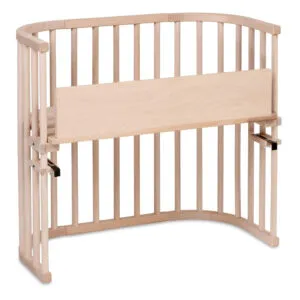
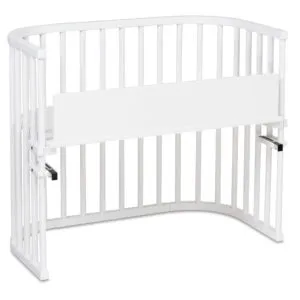
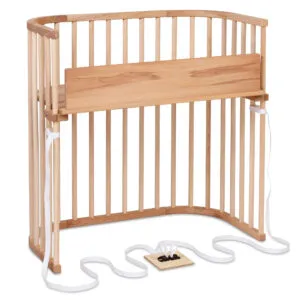
A bedside sleeper sits in the gap between the two. It attaches flush to the side of your bed at mattress height, so your baby is right beside you on their own firm, flat surface. You can see them, reach them, and offer a pacifier without getting up.
That is exactly how babybay bedside sleepers for co-sleeping are designed. Each one is made of solid European beechwood with water-based finishes. They meet the standards of the American Society for Testing and Materials (ASTM) and the Consumer Product Safety Commission (CPSC). Each one comes with a 10-year warranty. With a conversion kit, they also stand alone as a freestanding bassinet.
Curious about the bed-sharing side of the debate? Our page on the Safe Sleep Seven checklist explains what it covers. It also shows why a separate surface beside your bed is still the safer setup.
Bedside sleeping is not bed-sharing
Room-sharing on a separate surface keeps your baby close without putting them on an adult mattress with pillows, duvets and a sleeping adult. A bedside sleeper gives you the closeness without the shared surface.
Choosing a babybay for night feeds and pacifier checks
The right model depends mostly on the height of your bed. Measure from the floor to the top of your mattress before you choose. The table below sums up the three babybay models.
babybay bedside sleeper models at a glance
| Model | Best for | Fits beds up to | Shared features |
|---|---|---|---|
| babybay Original | Most standard beds | 28 in mattress height | Solid beechwood, meets ASTM/CPSC, 10-year warranty |
| babybay Maxi | Parents who want a wider sleeping platform | 28 in mattress height | Solid beechwood, meets ASTM/CPSC, 10-year warranty |
| babybay Maxi Tall | Tall boxspring beds | 34.75 in mattress height | Solid beechwood, meets ASTM/CPSC, 10-year warranty |
For most families, the babybay Original bedside sleeper is the natural pick. It fits beds up to 28 inches tall and sits flush with your mattress, so a dropped pacifier is an arm’s reach away. If your bed sits higher on a boxspring, the babybay Maxi Tall for boxspring beds reaches up to 34.75 inches.
Whichever model you choose, keep the sleep space bare. A fitted sheet on the mattress pad is all your baby needs. Dress your baby for the room temperature instead of adding blankets, and our guide to what a newborn should wear to sleep walks you through the layers.
Common pacifier mistakes at bedtime
Most mistakes come from tired parents trying to make the pacifier stay put. Clips are the most common one. A pacifier clip is handy during the day, but it should come off before your baby sleeps.
Plush pacifier holders are another. These soft toys with a pacifier sewn in look sweet, but they put fabric close to the face. Save them for awake, supervised time.
Some parents swap pacifiers for a bottle in the sleep space, or prop a bottle up so the baby can feed alone. A propped bottle can cause choking and does not belong in a sleep space.
Finally, a pacifier should never replace a feed. If your baby is hungry, feed them. Then offer the pacifier as they settle back down.
Does a pacifier affect teeth or ears?
In the first year, a pacifier at sleep time is unlikely to cause lasting problems. Concerns about teeth and ear infections come mostly from frequent use well past infancy. Some studies have linked long-term pacifier use with more ear infections and with changes in how front teeth line up.
That is one reason many families begin weaning in the toddler years. If you have questions about your own child, your pediatrician or dentist can look at their mouth and advise you.
For now, in the newborn months, the safe sleep benefit is the one that matters most. If a pacifier helps your baby settle, it is fine to use it.
Helping a newborn settle with or without a pacifier
Some babies never take to a pacifier, and that is completely normal. Others love it from the first try. Either way, a calm and predictable bedtime helps most newborns settle.
Dim lights, a short feed, a fresh diaper and the same few quiet words each night teach your baby that sleep is coming. If your newborn seems wide awake at night and sleepy all day, our article on newborn day and night confusion explains why and what helps.
If your baby fights being put down, try laying them down drowsy but awake, with the pacifier offered as they settle. We share more ideas in our guide to getting a newborn to sleep in a bassinet.
QIs it safe for a newborn to sleep with a pacifier all night?
Yes. Offer it when your baby goes down to sleep. If it falls out once they are asleep, leave it out. You do not need to keep it in all night.
QShould I put the pacifier back in when it falls out?
No. Safe sleep guidance says you do not need to put it back once your baby is asleep. If your baby wakes and fusses, you can offer it again.
QCan I use a pacifier clip while my baby sleeps?
No. Remove clips, cords and attached plush toys before every nap and night. Anything tied to the pacifier near a sleeping baby raises the risk of strangulation or suffocation.
QWhen can a breastfed baby start using a pacifier?
Wait until breastfeeding is going well, often after the first few weeks. Steady weight gain and a comfortable latch are good signs. Ask your pediatrician if you are unsure.
QDoes a pacifier really lower SIDS risk?
Studies link pacifier use at sleep with a lower risk of SIDS, and the AAP recommends offering one at naps and bedtime. It works best alongside back sleeping, a bare sleep space and room-sharing.
QWhat if my baby will not take a pacifier?
That is fine. Never force it. Your baby can be just as safe without one when the other safe sleep habits are in place.
QCan my baby sleep with a pacifier in a bedside sleeper?
Yes. A bedside sleeper is a separate, flat and firm surface, so the same pacifier rules apply. Being right beside your bed makes it easy to offer the pacifier again if your baby wakes.
Room-share the safe way
Keep your baby close on their own surface
A babybay bedside sleeper sits flush with your bed, so night feeds and pacifier checks are an arm’s reach away. Find the model that fits your bed.