Summarize this post with:


Baby Sleep Safety · Bed-Sharing
The Safe Sleep Seven is La Leche League’s seven-point checklist for breastfeeding families who bed-share: nonsmoker, sober, breastfeeding, healthy full-term baby, on the back, lightly dressed, safe surface. It reduces risk. It is not an endorsement of bed-sharing, and the AAP still recommends a separate sleep surface in your room.
That paragraph is the honest version, and most pages you will find on this topic pick a side instead. Some treat the Seven as permission. Others treat any mention of bed-sharing as reckless. Neither is much use at three in the morning when you have fed the baby lying down and you are trying to work out whether the last forty minutes were safe.
This page does something narrower. It lays out the seven criteria as La Leche League publishes them, explains what each one is actually doing, states plainly what the American Academy of Pediatrics recommends instead and why the two bodies disagree, and then covers the arrangement a lot of families land on once they understand both — the baby close enough to reach, on a firm surface of their own.
Definition
The Safe Sleep Seven — A seven-item risk-reduction checklist published by La Leche League International in Sweet Sleep, describing the conditions under which the organisation says a bed-sharing breastfed baby is at no greater risk of SIDS than a baby sleeping nearby in a crib. It is a harm-reduction tool for families who are going to bed-share, not a recommendation to start.
Key Takeaways
- 01
The Safe Sleep Seven is La Leche League’s harm-reduction checklist for breastfeeding families who bed-share, and all seven conditions must hold at once.
- 02
The AAP does not recommend bed-sharing under any circumstances and asks for room-sharing on a separate surface for at least the first six months.
- 03
The cuddle curl is the mechanism the list relies on — knees up, arm above the baby’s head, baby level with the breast, covers no higher than your waist.
- 04
The safe-surface rule is the one most American beds fail: soft mattresses, gaps at the wall and heavy covers are not fixable by being careful.
- 05
A bedside sleeper level with your mattress satisfies both sets of advice — the proximity the Seven protects, on a separate firm surface the AAP asks for.
What the Safe Sleep Seven actually are
La Leche League International publishes the Safe Sleep Seven as three conditions about you, and four about the baby and the bed. The first three describe the mother: a nonsmoker, sober and unimpaired, and breastfeeding. The remaining four describe the sleep itself: a healthy full-term baby, on his back, lightly dressed, on a safe surface. All seven have to be true at once. Six out of seven is not the Safe Sleep Seven.
That last point is where most summaries get sloppy, and it matters more than any single rule. The list is not a scoring system where you collect points. It describes one specific situation that the research behind it studied, and the moment you step outside that situation the numbers underneath it no longer apply to you. Understanding the difference between bed-sharing vs co-sleeping is the first step, because the two words get used interchangeably and only one of them means a shared surface.
01 · About you
A nonsmoker
Not just no smoking in the bed or the bedroom — a nonsmoker. Smoking during pregnancy and household smoke exposure are among the strongest and most consistent risk factors in the SIDS literature, and the risk does not switch off when the cigarette is smoked outside.
02 · About you
Sober and unimpaired
No alcohol, no drugs, and no sedating medication — including prescription sleep aids, some antihistamines and anything that deepens your sleep. Impairment is the single factor that most reliably turns a bed-share into an overlay, because it removes your ability to wake.
03 · About you
A breastfeeding mother
Breastfeeding is on the list for a physiological reason, not a moral one. A breastfeeding mother sleeps lighter, wakes more often, and lies in a characteristic protective position around her baby. Formula-feeding parents do not reliably do any of those things in their sleep.
04 · About baby
Healthy and full-term
Born at term, growing normally, no significant medical issues. Preterm and low-birth-weight babies are at substantially higher risk in a shared bed, and that elevated risk persists well past the point where the baby looks robust to you.
05 · About baby
On his back
Supine for every sleep, day and night, including the feeds where you are half asleep yourself. Back sleeping is the single most effective safe-sleep intervention ever adopted, and it does not become optional because you are lying next to the baby.
06 · About baby
Lightly dressed
No swaddle, no hat, no bunting, no sleep sack heavy enough to overheat. A swaddled baby in an adult bed cannot move their arms to clear their face or push away from bedding, which removes the one defence they have.
07 · About the bed
On a safe surface
Firm and flat. No soft mattress, no memory foam that lets the baby sink, no extra pillows near the baby, no heavy or tight covers, no toys, no gaps between the mattress and the frame or the wall. Never a sofa, recliner or armchair.
Read this before you read anything else
The Seven describe one situation, not a spectrum
La Leche League’s claim is specific: when all seven are true, a baby in bed with you is at no greater risk for SIDS than a baby nearby in a crib. That claim is about a full-term, healthy, exclusively breastfed baby with a sober nonsmoking mother on a firm surface.
It is not a claim about a bed-share where one criterion is missing, and it is not a claim about suffocation risk from bedding, which is a different mechanism with different evidence behind it.
Who the Safe Sleep Seven are for, and what the AAP says instead
The Safe Sleep Seven exists because a large number of families bed-share whether or not anyone advises it, and many of them do it accidentally, on a sofa, after falling asleep during a night feed. La Leche League’s position is that those families are safer with a checklist than without one. That is harm reduction, and it is a defensible public-health argument.
The American Academy of Pediatrics reaches a different conclusion from the same evidence. The AAP’s 2022 safe sleep guidance recommends that your baby sleep in your room, on a separate surface, for at least the first six months — a practice it says can cut SIDS risk by as much as half — and states that it does not recommend bed-sharing under any circumstances. Around 3,500 US infants die suddenly and unexpectedly in their sleep every year.
Both of those things are true at the same time, and you are allowed to hold both. The AAP is setting a population-level recommendation that has to be safe for every family who reads it, including the ones on a soft mattress after two glasses of wine. La Leche League is writing for the subset who will bed-share anyway. The reason co-sleeping and breastfeeding come up together so often is that this subset is overwhelmingly made up of nursing mothers.
~3,500
US infants who die suddenly and unexpectedly during sleep each year
AAP / healthychildren.org
Up to 50%
reduction in SIDS risk from room-sharing on a separate surface
AAP 2022
Up to 67×
higher risk of sleep-related death on a sofa or armchair
AAP 2022
What the AAP recommends
- ✓Baby in your room, on their own firm flat surface, for at least 6 months
- ✓Separate surface meeting CPSC standards, inclined no more than 10 degrees
- ✓Applies to every family regardless of feeding method or bed setup
- ◦Does not recommend bed-sharing under any circumstances
What the Safe Sleep Seven assume
- ◦You have already decided to bed-share, or you keep doing it unintentionally
- ◦Exclusively breastfeeding, nonsmoking, sober mother and a healthy full-term baby
- ✗A firm adult mattress with no gaps and no soft bedding near the baby
- ✗All seven conditions hold every night, including the hard nights
Rule by rule: why each one is on the list
Each of the seven is on the list because removing it changes the risk measurably, and the mechanisms are different from one another. Some rules protect against overlay, some against suffocation by bedding, some against the poorly understood arousal failure that sits behind SIDS itself. Knowing which is which tells you which rules have any flexibility at all — the answer, mostly, is none. Grouped by what they are actually defending, the seven fall into three families.
Four of the seven — nonsmoker, sober, breastfeeding, healthy and full-term — are all doing the same job: keeping both of you able to wake up. Overlay happens when a parent does not rouse. SIDS itself is understood partly as a failure of the infant’s own arousal response. Every criterion in this group either protects the mother’s ability to wake or the baby’s.
That is why they cannot be substituted for one another. A sober nonsmoking mother who is not breastfeeding does not sleep in the light, frequent-waking pattern the arrangement depends on, and a preterm baby’s arousal response is measurably weaker regardless of how careful the adults in the bed are. Impairment from alcohol, drugs or sedating medication raises sleep-related death risk more than tenfold on its own.
Two criteria — on the back, lightly dressed — protect the airway directly. Supine sleep is the most effective single safe-sleep measure ever adopted, in any sleep location, and it applies just as much in an adult bed as in a crib. Side-lying to feed is fine; the baby goes back onto their back afterwards.
Light dressing matters for two reasons that are easy to miss. Overheating is an independent SIDS risk factor, and a swaddled or heavily bundled baby cannot use their arms. An unswaddled baby who ends up with bedding near their face can push at it and turn their head; a swaddled one cannot do either, which is why swaddling and bed-sharing are never combined.
The seventh criterion is the only one about furniture, and it protects against a mechanism no amount of parental attention can prevent: suffocation, wedging and entrapment. A soft mattress creates a depression an infant cannot lift their head out of. A gap between the mattress and the wall or headboard creates a trap. Loose covers create an obstruction.
None of that is affected by how lightly you sleep, which is why the surface rule is the one that most often disqualifies an otherwise textbook bed-share. It is also the one that is genuinely fixable — either by changing the bed, or by giving the baby a firm separate surface of their own alongside it.
How much each factor raises sleep-related death risk
| Sofa or armchair | 67 |
| Alcohol, drugs or sedating meds | 10 |
| Baby under 4 months | 5 |
| Preterm or low birth weight | 2 |
AAP 2022 — lower bound shown where the AAP reports a range
The C position, or cuddle curl, explained
The C position — usually called the cuddle curl — is the posture the Safe Sleep Seven quietly depends on. La Leche League describes it plainly: your knees come up and your arm tucks under your head or pillow, or curls around your baby, creating a protected space. Your body forms a rough C, with the baby lying in the open part of it, level with your breast.
It matters because it is not a technique you perform. It is what most breastfeeding mothers do in their sleep without instruction, and it does three things at once: it stops you rolling towards the baby, it keeps pillows and duvets above your baby’s head level, and it puts the baby where they cannot be reached by anyone else in the bed.
STEP 01Baby goes level with your breast, on their back
Not up on the pillow beside your face, and not down by your waist. Nose roughly level with the nipple. This is the height at which your arm and knees actually enclose the space rather than sitting above or below it.
STEP 02Your lower arm goes above the baby's head
Tucked under your own head or pillow, or curled around the baby. It acts as a stop that prevents you sliding down the bed towards them, and it keeps your pillow physically out of their space.
STEP 03Your knees come up under the baby's feet
Drawn up so the baby sits in the pocket between your arm and your thighs. Together with your arm this is the C. The baby cannot be rolled onto and cannot slide down under the covers.
STEP 04Covers stay at your waist, pillows stay at your head
Your duvet comes no higher than your own waist, so it never reaches the baby’s face. Extra pillows come off the bed entirely. If you are cold, wear more rather than adding another layer of bedding.
The safe surface rule is the hard one
Six of the seven rules are about people, and you can answer them honestly in about ten seconds. The seventh is about furniture, and it is the one most American beds fail. A pillow-top or memory-foam mattress lets an infant’s head sink into a depression it cannot lift out of. A bed pushed against a wall creates a gap. A headboard with slats creates an entrapment point. None of these are visible problems until they are.
Run the checklist below against your actual bed, in the dark, tonight. If any line fails, the Safe Sleep Seven does not describe your situation, and the honest answer is either to fix the bed or to put the baby on a surface that already passes.
- Mattress
- Firm and flat — no memory foam, no pillow-top, no topper the baby can sink into
- Gaps
- None between mattress and frame, headboard, wall or nightstand; move the bed away from the wall
- Covers
- Light, no higher than your waist; no duvets, quilts or weighted blankets near the baby
- Pillows
- Yours only, at head height; nothing pillow-like anywhere near the baby
- Other occupants
- No other children, no pets, and a partner who knows the baby is there
- Never
- Sofa, armchair, recliner, waterbed, air mattress, or any surface that inclines
If all seven are true, the risk is small. If one of them is not, you are not doing the Safe Sleep Seven — you are doing something the research behind it never measured.
The honest reading of La Leche League's own framingWhere a bedside sleeper fits: proximity without a shared surface
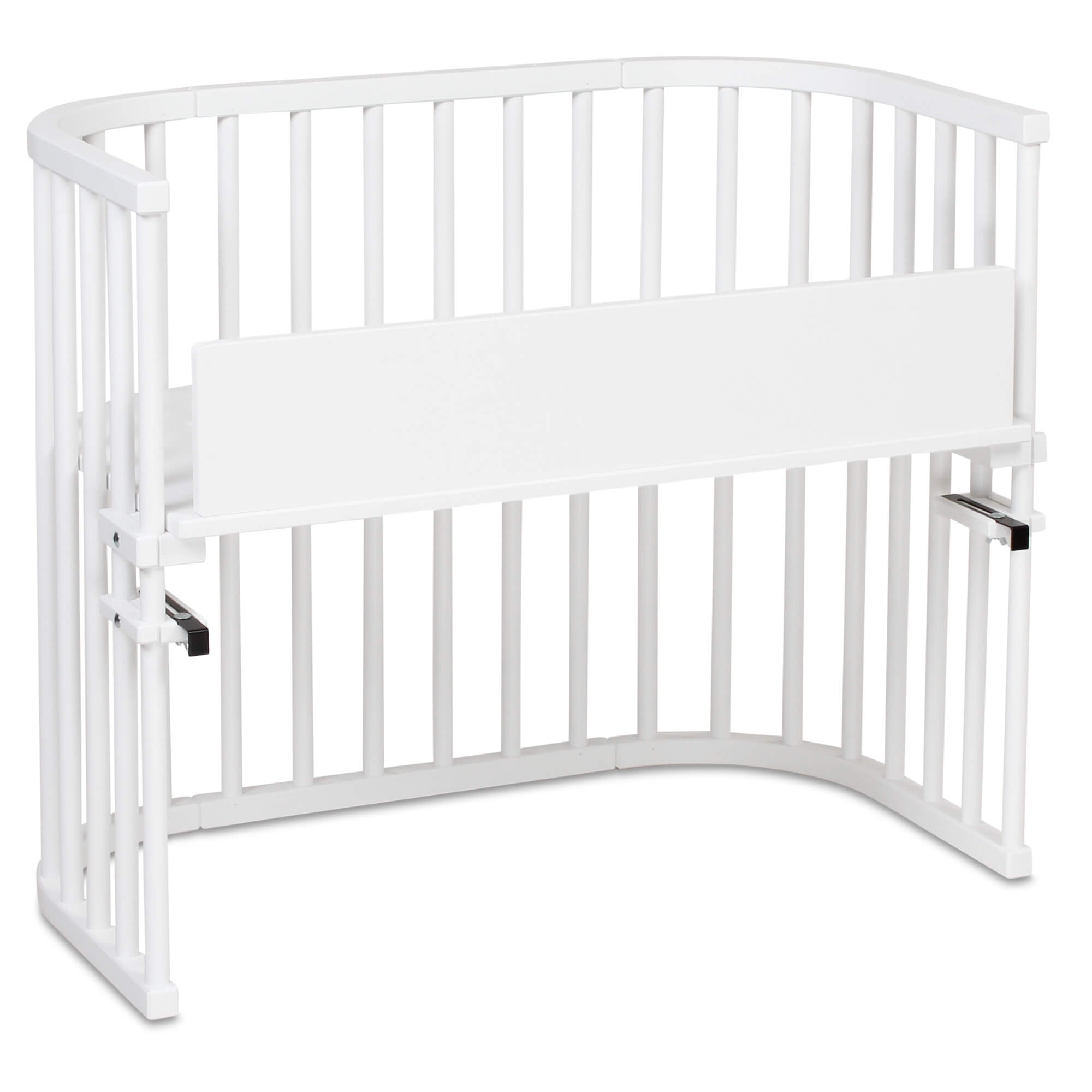
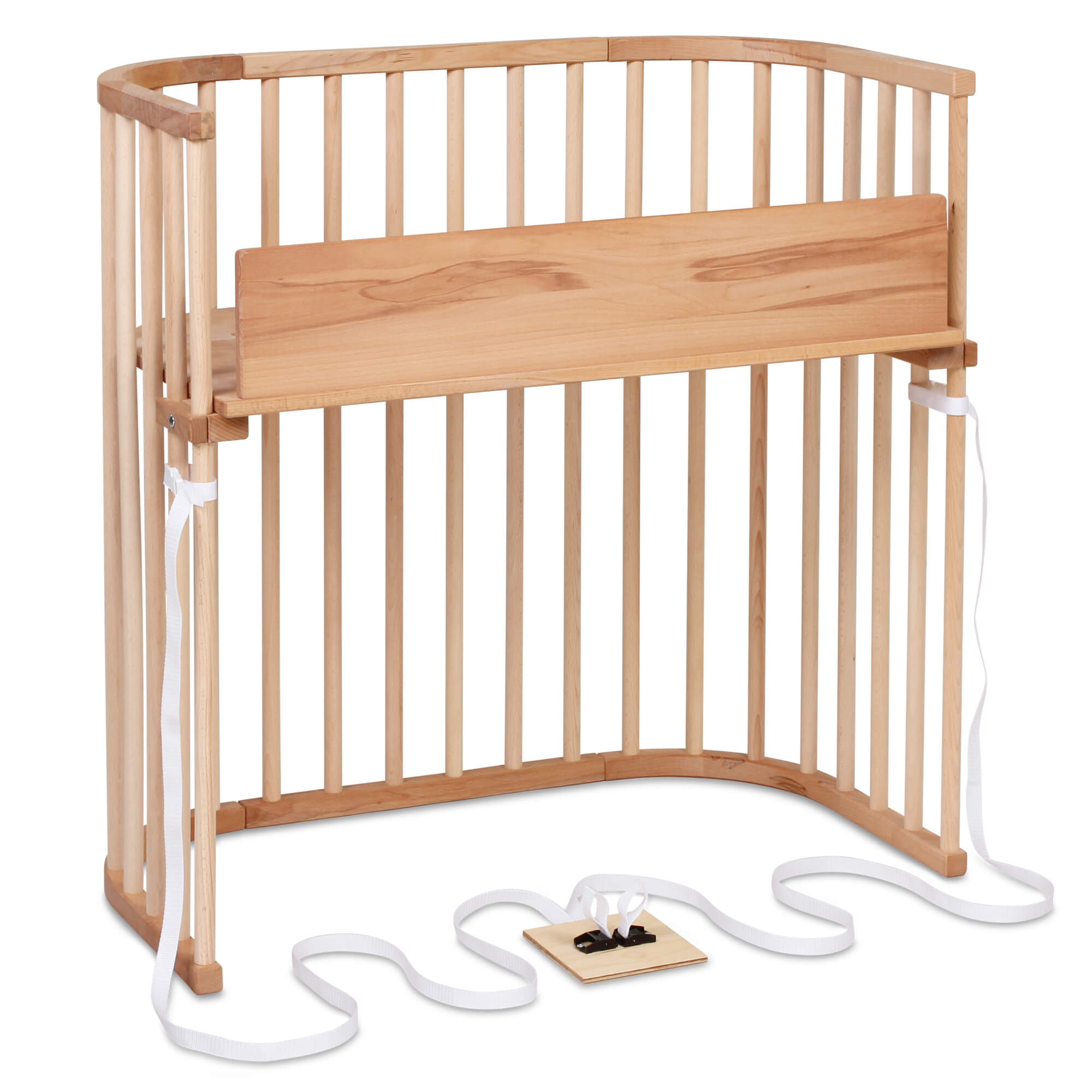
Read the seven rules together and a pattern shows up. Almost everything on the list exists to protect one thing — the baby’s own uninterrupted space on a firm surface — while the mother stays within arm’s reach for feeds. That is precisely what a bedside sleeper provides by design rather than by vigilance. The baby is on their own firm mattress, at the height of your mattress, with one side open to you.
This is the arrangement the AAP is describing when it says room-sharing without bed-sharing, and it is also what most families mean when they say co-sleeping. A co sleeper bassinet that locks to the bed frame keeps the baby close enough to feed lying down and settle with a hand, on a surface that passes the safe-surface rule whether or not your own mattress does. Bedside sleepers are federally regulated in the US under 16 CFR Part 1222, which incorporates the ASTM F2906 consumer safety specification; babybay states that its sleepers meet all US ASTM and CPSC safety standards.
Which model you need is decided by one measurement, not by preference: the height from your floor to the top of your mattress. The babybay Original bedside sleeper fits beds from 10 to 28 inches. The babybay Maxi is the same height range with a wider sleeping surface for a bigger baby or a family who wants more room. The babybay Maxi Tall covers boxspring and platform beds up to 34.75 inches, which is where most families with a tall bed end up.
babybay models, by bed height and sleeping surface
babybay.us product specifications
| Model | Fits bed heights | Sleeping surface | External size | List price |
|---|---|---|---|---|
| babybay Original | 10″ – 28″ | 32″ W × 16″ D | 31″ H × 34.5″ W × 18″ D | $385 |
| babybay Maxi | 10″ – 28″ | 35″ W × 19″ D | 31″ H × 37″ W × 21″ D | $425 |
| babybay Maxi Tall | 10″ – 34.75″ | 35″ W × 19″ D | 37″ H × 37″ W × 21″ D | $485 |
What to check before you buy anything
Measure the mattress height, not the bed frame
Measure from the floor to the top surface of your mattress, with the mattress compressed as it would be with you lying on it. A boxspring plus a thick mattress commonly lands between 29 and 34 inches, which is above the Original’s range and inside the Maxi Tall’s.
The sleeper has to sit level with your mattress with no step and no gap. A sleeper that is close enough but not level reintroduces the entrapment risk the separate surface was meant to remove.
All three models are built from 100% ethically sourced European beechwood with no plywood and no plastic parts, in a raw untreated finish or with water-based coatings, and all three carry a 10-year limited warranty on the solid wood when the product is registered within 90 days. They are rated for use to roughly six months, or until the baby can push up — the same window the AAP’s room-sharing recommendation covers, and the same window the Safe Sleep Seven is written for. Each one converts to a freestanding bassinet afterwards with a conversion kit.
None of that makes a bedside sleeper a magic answer. It makes it the arrangement that satisfies both sets of advice at once: the closeness and the easy night feeds that the Safe Sleep Seven exists to protect, on a separate firm surface that the AAP asks for. If you want the fuller version of how to co-sleep safely across the first six months, that is the next thing to read.
When bed-sharing is never safe, whatever else is true
These are not rules with exceptions, and the Safe Sleep Seven does not soften any of them. Each one appears in the evidence as an independent multiplier of risk, which means it stacks on top of everything else rather than being offset by good practice elsewhere.
Absolute limits
Situations the Safe Sleep Seven never covers
- hard
Sleeping with the baby on a sofa, armchair or recliner — the risk of sleep-related infant death runs up to 67 times higher than on a safe surface, and it is usually done by accident during a night feed.
If you feel yourself going while feeding on the sofa, get up and move to the bed, or put the baby down on their own firm surface first.
- hard
Bed-sharing after alcohol, recreational drugs or sedating medication, including prescription sleep aids and sedating antihistamines. Impairment raises risk more than tenfold and applies to both adults in the bed.
Plan for it: on any night either parent has had a drink or taken a sedating medicine, the baby sleeps on a separate surface.
- hard
Bed-sharing when anyone in the household smokes. Smoking in pregnancy or in the home raises baseline risk, and the AAP identifies bed-sharing by a smoker as an especially high-risk combination.
Smoking outdoors lowers exposure but does not clear the criterion — room-share on a separate surface instead.
- hard
Bed-sharing with a preterm or low-birth-weight baby, or with any baby under four months, where the reported risk is several times higher than for older, term infants.
A separate firm surface matters most exactly when the baby is smallest — keep the sleeper alongside the bed for the whole first four months.
- hard
Bed-sharing with other children or pets in the bed, or with a partner who does not know the baby is there. Older children have no adult sleep awareness and pets have none at all.
Tell your partner every single time, and keep older siblings and animals out of the room entirely.
How to decide for your own family
Start by being accurate about what you are already doing rather than what you intend to do. A parent who plans to use a crib but feeds lying down at 3am four nights a week is bed-sharing, unplanned, on whatever surface they happen to be on — and that is the situation the Seven is genuinely useful for. Read the list, answer each item honestly, and fix whatever you can fix tonight: covers down, pillows off, bed away from the wall.
Then decide what you actually want the next six months to look like. If all seven hold and you have chosen bed-sharing deliberately, you are following the most careful version of that choice available. If one or more do not hold — a soft mattress, formula feeding, a smoker in the house, a preterm baby — the honest answer is a separate surface within arm’s reach, and the sensible way to get it is a bedside sleeper set level with your mattress rather than a crib across the room that guarantees you get out of bed six times a night.
Find the right fit
Which babybay fits your bed?
Measure from your floor to the top of your mattress, then match it to the Original, Maxi or Maxi Tall. Solid European beechwood, meets US ASTM and CPSC safety standards, 10-year limited warranty on the wood.
QIs the Safe Sleep 7 endorsed by the AAP?
No. The Safe Sleep Seven is published by La Leche League International, not the American Academy of Pediatrics. The AAP’s 2022 guidance recommends room-sharing on a separate sleep surface for at least six months and states that it does not recommend bed-sharing under any circumstances. The two bodies are working from much of the same evidence but answering different questions — the AAP is setting a recommendation that must be safe for every family, while La Leche League is writing guidance for families who have already decided to bed-share.
QCan you follow the Safe Sleep 7 if you formula feed?
Not as written. Breastfeeding is the third criterion, and it is there for a physiological reason rather than a values-based one: a breastfeeding mother sleeps more lightly, wakes more often and adopts the protective cuddle curl position in her sleep. Those responses are what the rest of the checklist assumes. A formula-feeding parent who bed-shares is outside the situation the Seven describes, which is exactly the case where a separate firm surface within arm’s reach is the safer arrangement.
QWhat is the C position for co-sleeping?
The C position, or cuddle curl, is the sleeping posture a breastfeeding mother naturally adopts around her baby. Your knees come up and your lower arm tucks under your head or curls above the baby, so your body makes a rough C shape with the baby lying in the open part of it, on their back, level with your breast. The arm stops you sliding down towards the baby and keeps pillows away, and the knees stop the baby sliding down under the covers.
QIs a bedside sleeper the same as co-sleeping?
It is one form of it. Co-sleeping means sleeping in close proximity, which covers both bed-sharing on the same surface and room-sharing on separate surfaces. A bedside sleeper is the second kind: the baby is on their own firm mattress, attached at the side of your bed and level with your mattress. That is the arrangement the AAP describes as room-sharing without bed-sharing, and it is the one that satisfies the safe-surface rule regardless of what your own mattress is like.
QAt what age is bed-sharing safer?
Risk is highest in the first four months and declines as the baby gets older, stronger and better able to move their own head and clear obstructions. That is why the AAP frames its room-sharing recommendation around the first six months, and why bedside sleepers are generally rated for use to about six months or until the baby can push up on their hands and knees. Age alone does not make an unsafe surface safe, though — the mattress, gaps and bedding rules apply at every age.
QDoes a bedside sleeper have to meet a safety standard in the US?
Yes. Bedside sleepers sold in the United States are regulated under 16 CFR Part 1222, which incorporates the ASTM F2906 consumer safety specification and requires the product to be secured to the adult bed. Look for a manufacturer that states compliance with US ASTM and CPSC standards, check that the sleeper sits level with your mattress with no gap, and use the anchoring hardware supplied rather than relying on the sleeper’s weight to hold it in place.
Last reviewed