
Shop


Summarize this post with:


Newborn Sleep
A good sleep routine for a 6 week old is simple. Keep awake stretches to about 45 to 90 minutes, and run the same 10 to 15 minute wind-down before the last sleep of the evening. Then put your baby down on their back in their own flat sleep space next to your bed. You are not building a strict schedule yet. You are teaching your baby that a few small steps always come before sleep.
How to use this guideRead the wake window section first, then pick three or four steps for your bedtime routine. The sample day is a loose shape, not a timetable to follow by the minute.
Key Takeaways
- 01
Most 6 week olds manage 45 to 90 minutes awake between sleeps.
- 02
Total sleep is about 14 to 17 hours in 24, split into many pieces.
- 03
Keep the bedtime routine short, about 10 to 15 minutes, and the same each night.
- 04
Night feeds are still normal; keep them dark, quiet and brief.
- 05
Always on the back, on a flat, separate surface in your room, with nothing else in the sleep space.
What changes in sleep around six weeks
Six weeks is a turning point for many families. Your baby is more alert during the day, holds eye contact longer and may have started to smile. That extra alertness is good news, but it also means your baby can get overtired faster than before.
Night sleep is still broken up. Most babies this age still need to feed at least once or twice at night, and some feed more often. Their bodies have not yet learned the difference between day and night, because the internal body clock that makes us sleepy after dark is only starting to develop.
Fussiness often peaks around this age too. Many parents notice a hard stretch in the late afternoon or early evening. A calm, predictable routine will not stop every cry, but it gives you and your baby something steady to lean on during that window.
If your baby still seems to sleep all day and party all night, the tips for turning around newborn day/night confusion pair well with everything below. Daylight, normal household sound in the day and dim, quiet feeds at night all help the body clock catch up.
How much should a 6 week old sleep?
Expect a total of roughly 14 to 17 hours of sleep across 24 hours. That range comes from the National Sleep Foundation sleep duration recommendations for babies up to 3 months old. Some healthy babies sleep a little more or less than this.
That sleep comes in many pieces. A typical 6 week old takes four to six naps in the day, each lasting anywhere from 20 minutes to two hours. At night, the longest stretch is often three to four hours, and a lucky few stretch to five or six.
If your baby is feeding well, wetting plenty of diapers and gaining weight, the exact number of hours matters less than the pattern. Talk to your pediatrician if your baby seems very hard to wake for feeds or is unusually sleepy and floppy.
Wake windows at 6 weeks
Definition
Wake window — The stretch of time your baby is awake between two sleeps, counted from the moment they wake up to the moment they fall asleep again. Feeding, a diaper change and some play all happen inside it.
Most 6 week olds manage about 45 to 90 minutes awake before they need to sleep again. The first wake window of the morning is usually the shortest. Windows tend to stretch a little as the day goes on, though the last one before bedtime can be short again if the evening is fussy.
Watch your baby more than the clock. Early sleepy signs include a glazed or faraway look, turning the head away from faces and toys, slower movements and a first yawn. Late signs include rubbing the eyes, arching the back, clenched fists and a sharp cry that builds quickly.
Aim to start winding down at the early signs. Once your baby reaches the late signs, they are often too wound up to settle easily, and you may need extra rocking or a feed to help them fall asleep.
Wake windows and sleepy signs at 6 weeks
| Part of the day | Typical wake window | What you might see |
|---|---|---|
| First wake-up of the morning | 45 to 60 minutes | Alert and calm after a feed, then a sudden stare |
| Late morning and midday | 60 to 75 minutes | Longer play, then turning away and yawning |
| Afternoon | 60 to 90 minutes | Most alert stretch; fussing can build late in the day |
| Early evening before bedtime | 45 to 75 minutes | Cluster feeding, short fuse, eye rubbing |
| Night feeds | Keep it short: feed, burp, change if needed | Drowsy, eyes half closed; keep lights low and talk quiet |
A sample day for a 6 week old
Here is one realistic shape for a day. Your times will move by an hour or more, and that is normal. The point is the rhythm: wake, feed, a little play, then sleep before your baby gets overtired.
- 7:00 a.m.
- Wake for the day. Open the curtains, feed and change.
- 7:50 a.m.
- Nap 1 after about 50 minutes awake.
- 9:15 a.m.
- Wake, feed, tummy time on the floor, a short walk outside.
- 10:30 a.m.
- Nap 2.
- 12:00 p.m.
- Wake, feed, quiet play, songs.
- 1:15 p.m.
- Nap 3, often the longest of the day.
- 3:00 p.m.
- Wake, feed, play.
- 4:15 p.m.
- Nap 4, often short.
- 5:00 p.m.
- Wake, feed. Expect fussing and cluster feeds.
- 6:00 p.m.
- Short catnap if needed.
- 7:00 to 8:00 p.m.
- Bedtime routine, final feed and down for the night.
- Overnight
- One to three feeds, kept dark, quiet and brief.
Bedtime is still late at this age
Many 6 week olds do not settle for the night until 9 or 10 p.m. That is fine. A routine at the same rough time each evening still helps, and bedtime usually moves earlier on its own over the next few weeks.
Your first bedtime routine, step by step
A bedtime routine at six weeks should be short, about 10 to 15 minutes, and the same each night. Babies learn by repetition. After a week or two of the same small steps in the same order, those steps start to signal sleep on their own.
Pick three or four of the steps below. You do not need all of them, and a routine you can keep up when you are exhausted beats a perfect one you drop after three nights.
Safe sleep comes first in any routine
Every nap and every night, the safe sleep basics stay the same. The American Academy of Pediatrics 2022 safe sleep recommendations say babies should sleep on their backs, on a firm, flat surface that is not tilted, with only a fitted sheet. No pillows, blankets, bumpers or soft toys belong in the sleep space.
The American Academy of Pediatrics (AAP) also recommends room-sharing without bed-sharing, ideally for at least the first six months. That means your baby sleeps in your room, close to your bed, but on their own separate surface. Room-sharing this way is linked to a lower risk of sudden infant death syndrome (SIDS).
Never let your baby sleep on a sofa, armchair or recliner, and avoid letting them nap in a car seat, swing or bouncer once you are out of the car. Move your baby to a flat sleep space if they fall asleep somewhere else.
Keep in mind
What a routine cannot do at six weeks
- Note
It will not make your baby sleep through the night. Night feeds are still normal and needed.
Keep night feeds dark, quiet and brief so your baby goes back to sleep faster.
- Note
It will not stop all evening fussing. Crying often peaks around six weeks.
Start the routine a little earlier on fussy evenings and share the load with a partner.
- Note
It does not need to happen at the same minute every night.
Keep the order of steps the same. The order matters more than the time.
Why a bedside sleeper makes the night routine easier
At six weeks you may still be up two or three times a night. Every feed means getting up, lifting your baby, feeding, settling and laying them down again. The less distance and fuss involved, the faster both of you get back to sleep.
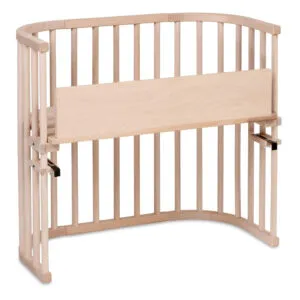
A bedside sleeper puts your baby on their own flat surface at the same level as your mattress, right next to you. You can see and reach your baby without climbing out of bed, and you can slide them back into their own space after a feed. That is room-sharing the way the AAP describes it, without your baby ever sharing your bed.
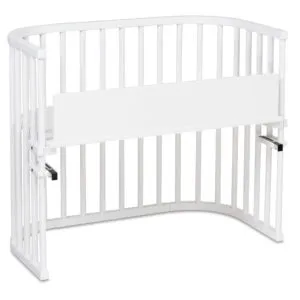
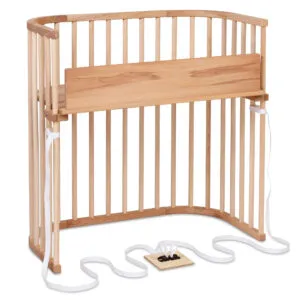
The babybay Original bedside sleeper is built from solid European beechwood and meets federal safety standards set by the Consumer Product Safety Commission (CPSC). It fits beds up to 28 inches high and comes with a 10-year warranty. If your mattress sits on a box spring, the babybay Maxi Tall for box spring beds fits beds up to 34.75 inches high. You can compare every model in the range of co-sleeping bassinets and bedside sleepers.
If your baby will only nap in your arms right now, a gradual approach helps. The tips for settling a baby who will only sleep on you work just as well for a bedside sleeper.
Night feeds: bedside sleeper or a crib across the room
Bedside sleeper at mattress height
- Baby is within arm’s reach on their own flat surface
- Feed and return without leaving the bed
- You can see and hear small changes in breathing and stirring
- Supports room-sharing on a separate surface
Crib or bassinet across the room
- Also a safe, separate surface
- You get up for every feed and every settle
- More full waking for you and your baby
- Fine later, when night feeds have dropped off
Common problems and simple fixes
Short naps of 20 to 40 minutes are very common at this age. Your baby is moving through a short sleep cycle and waking fully at the end of it. Try waiting a minute or two before you go in, since some babies settle back on their own. If not, a short rock or a feed is fine.
Grunting, twitching and squeaking at night are usually normal. Babies spend a large share of sleep in a light, restless stage. If those noises keep waking you, it helps to read about twitching and grunting during active sleep before you pick your baby up too early.
If your baby fights every nap, look at the wake window first. A baby who has been up for two hours is often overtired, and one who has been up for 30 minutes may not be tired enough. Small shifts of 10 to 15 minutes in either direction often fix it.
QShould a 6 week old be on a schedule?
Not a strict one. At six weeks, a loose rhythm works better: wake, feed, a little play, then sleep within about 45 to 90 minutes. Firm schedules usually make more sense after three to four months.
QWhat time should a 6 week old go to bed?
Many 6 week olds settle for the night between 8 and 10 p.m. A later bedtime is normal at this age. Run the same short routine at roughly the same time, and bedtime will often move earlier by itself over the coming weeks.
QHow long can a 6 week old stay awake?
Usually about 45 to 90 minutes, counting feeding and diaper changes. The first window of the day is often the shortest. Watch for early sleepy signs like a faraway stare or turning away from faces.
QShould I wake my 6 week old to feed at night?
Ask your pediatrician. Many healthy babies who are gaining weight well can be left to wake on their own at night by six weeks. Babies who were born early or are slow to gain may still need to be woken.
QIs it OK if my 6 week old falls asleep while feeding?
Yes, that is very common and fine at this age. If you can, burp your baby and let them stir slightly before you lay them down on their back. Over time, this helps them learn to fall asleep in their own space.
QWhere should a 6 week old sleep at night?
In your room, on their own firm, flat surface, such as a bedside sleeper, bassinet or crib with a fitted sheet only. The AAP recommends room-sharing without bed-sharing, ideally for at least the first six months.
Make night feeds easier from week one
A babybay bedside sleeper keeps your baby on their own safe surface, right at the side of your bed. Find the model that fits your bed height.