Summarize this post with:


Choosing a Bassinet · Safety Standards
The safest bassinets are the ones tested to the federal standard: 16 CFR 1218 (built on ASTM F2194) for bassinets, and 16 CFR 1222 (ASTM F2906) for bedside sleepers. JPMA, GREENGUARD Gold and OEKO-TEX add useful checks on top, but none of them replaces that structural test.
The short version
- 01
Structural safety comes first: a bassinet sold in the US must meet 16 CFR 1218 (ASTM F2194), and a bedside sleeper must also meet 16 CFR 1222 (ASTM F2906).
- 02
The CPSC does not stamp products as approved. It sets the mandatory rule, and the maker proves compliance with third-party lab tests and a Children’s Product Certificate.
- 03
GREENGUARD Gold covers chemical emissions and OEKO-TEX covers textiles. Neither says anything about stability, side height or the gap next to your bed.
- 04
A safe bassinet also has to be used safely: baby on the back, on a firm, flat surface, with nothing else in the sleep space.
What makes a bassinet 'safe' is a standard, not a review score
Most lists of the safest bassinets rank products by how they felt in a reviewer’s nursery. That tells you about looks, rocking motion and how easy the zipper is. It does not tell you whether the bassinet stays upright when a newborn shifts to one side, whether the mattress sits flat, or whether the sides are tall enough. Those questions are answered in a test lab, against a written standard, before the product is allowed on sale.
For bassinets and cradles in the US, that standard is ASTM F2194, made mandatory by the Consumer Product Safety Commission as 16 CFR 1218. The CPSC updates the rule as ASTM revises the standard; the most recent update points to ASTM F2194-25 and took effect in February 2026. Bedside sleepers, the kind that attach to the side of an adult bed, fall under a second rule as well: 16 CFR 1222, which adopts ASTM F2906.
When you strip away brand language, certification checks four things. First, stability: the bassinet must not tip when a baby moves or when the product is bumped. Second, the sleep surface: the mattress must be firm and flat, with no gaps around its edges where a face could press in. Third, containment: the sides must be high enough, and any openings small enough, that a baby cannot slip through or get caught. Fourth, durability and hardware: nothing should loosen, snap or pinch over months of use.
Everything else parents care about, such as natural materials, low chemical emissions and organic cotton, is a separate question. It matters, and it is covered below, but it sits on top of the structural test rather than in place of it.
The certifications decoded
What each bassinet certification actually tests
| Label or standard | Who runs it | What it tests | What it does NOT cover | Mandatory in the US? |
|---|---|---|---|---|
| 16 CFR 1218 / ASTM F2194 | CPSC rule built on an ASTM standard | Stability, mattress flatness, side height, openings, hardware, warnings | Chemical emissions, fabric chemistry | Yes, for every bassinet and cradle |
| 16 CFR 1222 / ASTM F2906 | CPSC rule built on an ASTM standard | Everything in F2194 plus attachment to the adult bed, separation from the bed and barrier height | Chemical emissions, fabric chemistry | Yes, for every bedside sleeper |
| Children’s Product Certificate | Issued by the maker, backed by a CPSC-accepted lab | Proof the product passed the rules above | Nothing beyond the rules it cites | Yes |
| JPMA Certified seal | Juvenile Products Manufacturers Association | Independent testing to the same ASTM standard | Chemical emissions, fabric chemistry | No, voluntary |
| GREENGUARD Gold | UL Solutions | Low chemical emissions (VOCs) from the finished product | Structure, stability, fit, falls | No, voluntary |
| OEKO-TEX Standard 100 | OEKO-TEX institutes | Harmful substances in textiles; Product Class I is for babies | Wooden frame, structure, hardware | No, voluntary |
| TÜV testing | TÜV organisations such as TÜV Rheinland | Independent product and safety testing to the standards named on the report | Only what the named standard covers | No, voluntary |
Two things stand out once the labels sit side by side. The two federal rules are the only entries that test structure and are also required by law. And a bassinet that says ‘CPSC certified’ is using shorthand: the CPSC does not certify individual products. It writes the rule, and the manufacturer must have the product tested by an accepted third-party lab and issue a Children’s Product Certificate showing it passed. The rule also requires a product registration card so you can be contacted if there is ever a recall.
The voluntary labels are best read as answers to narrower questions. JPMA is a second, independent look at the same structural standard. GREENGUARD Gold asks what the product releases into the air of your bedroom. OEKO-TEX asks what is in the fabric touching your baby’s skin. Each is useful. None of them is the whole picture on its own.
Structural safety vs chemical safety: you need both
A common question from parents goes like this: is it better to buy a bassinet with a certification, or one made of natural fibers? The honest answer is that it is not a choice. A bassinet can be made of organic cotton and untreated wood and still fail a stability test. Another can pass every structural test while its foam pad and synthetic mesh release volatile organic compounds into a closed bedroom. You want a product that clears both bars.
Structural certification protects against the injuries that bassinet rules were written to prevent: tip-overs, collapses, entrapment in gaps and falls from low sides. Chemical certification protects against slower, quieter exposures from finishes, glues, foams and flame retardants. A newborn spends many hours a day breathing close to the sleep surface, which is why parents increasingly ask about both.
Structural certification (ASTM / CPSC)
- ✓Required by federal law for every bassinet and bedside sleeper
- ✓Tests stability, flat mattress, side height, openings and hardware
- ✓Bedside sleepers are also tested on attachment and separation from the bed
- ✗Says nothing about finishes, foams or fabric chemistry
Material certification (GREENGUARD, OEKO-TEX)
- ✓Tells you about emissions or textile chemistry
- ✓Useful for parents who want a low-VOC bedroom
- ◦Voluntary, so its absence alone is not a warning sign
- ✗Says nothing about stability, gaps or side height
Materials can reduce the need for chemical certification in the first place. Solid wood with a water-based finish has far fewer places for problem chemicals to hide than particleboard held together with glue, laminated panels or treated synthetic fabric. That is one reason many parents look at wooden bedside sleepers: fewer components, fewer coatings, and a simpler answer to the question of what the product is made of.
Ask two questions of any bassinet: did it pass the federal structural test, and what is it made of? A label that answers only one of them is half an answer.
The rule of thumb for safe bassinet shoppingHow to verify a bassinet is certified
You do not have to take a product page at its word. A few minutes of checking before you buy, and again when the bassinet arrives, will tell you most of what you need.
01 · Before you buy
Look for the standard by name
A compliant bassinet or bedside sleeper will name ASTM F2194 and, for bedside sleepers, ASTM F2906, or the matching CPSC rules. Vague phrases such as ‘meets all safety standards’ are a reason to ask the seller which standards, exactly.
02 · Before you buy
Ask for the Children's Product Certificate
Reputable makers can tell you which rules their product was tested to and by which lab. If a seller cannot answer, that is information too.
03 · Before you buy
Search the CPSC recall list
Search the brand and model on the CPSC recalls page at cpsc.gov/Recalls before you buy, especially for second-hand products. Older bassinets may predate the current standard entirely.
04 · When it arrives
Find the tracking label
Federal rules require a permanent label with the maker’s name, the model and the manufacture date. Keep it; you will need it if you ever check a recall.
05 · When it arrives
Send the registration card
Registering takes a minute and is the only way the maker can reach you directly with a safety notice.
06 · Optional labels
Check voluntary seals at the source
JPMA, GREENGUARD and OEKO-TEX each let you confirm a certification on their own websites. A certificate number you can look up is worth more than a logo on a box.
For a deeper look at how the rules changed and why older cribs and bassinets can fall short, the babybay article on why crib safety standards matter walks through the history, including the 2011 federal crib overhaul that reshaped the whole category.
Bedside sleepers: the extra checks
A bedside sleeper does something a standalone bassinet does not: it sits flush against your mattress so your baby is within arm’s reach while still on a separate surface. That arrangement is exactly what the American Academy of Pediatrics describes. Its 2022 policy recommends that infants sleep in the parents’ room, close to the parents’ bed but on a separate surface designed for infants, ideally for at least the first six months. You can read the AAP’s own summary in the AAP’s safe sleep recommendations for parents.
Because the product meets an adult bed, the federal rule adds tests that a freestanding bassinet never faces. According to CPSC’s bedside sleeper guidance, a bedside sleeper must meet the bassinet requirements of 16 CFR 1218 and also pass requirements for maximum separation from the bed, product disengagement, a minimum barrier height around the whole perimeter, and attachment to the adult bed. The current rule points to ASTM F2906-23.
- Gap to the adult bed
- The sleeper must stay tight to the mattress so no gap opens up where a baby could become trapped.
- Attachment
- The sleeper must be secured to the adult bed and resist being pushed away from it.
- Height match
- The sleep surface should sit level with the top of your mattress. A sleeper that cannot reach your bed height is the wrong model for your bed.
- Barrier on the bed side
- Sides must meet a minimum height all the way round; the side against your bed may be lower than the outer sides, but it cannot be missing.
- Freestanding use
- If a bedside sleeper also works as a standalone bassinet, it has to meet the bassinet requirements in that mode too.
Fit is where most real-world problems start. A sleeper that is technically compliant but paired with a bed it was not designed for can leave a step down, a tilt or a gap. Measure the top of your mattress from the floor before you choose a model, and check again after any change of mattress, topper or bed frame. The babybay guide to what makes a co-sleeper safe goes further on fit, gaps and the difference between bedside sleeping and bed-sharing.
Where babybay stands on each standard
Since 2003, babybay has built solid-wood bedside sleepers designed to sit flush against the parents’ bed. Here is how it lines up against each label in the table above, using only what babybay itself states about its products.
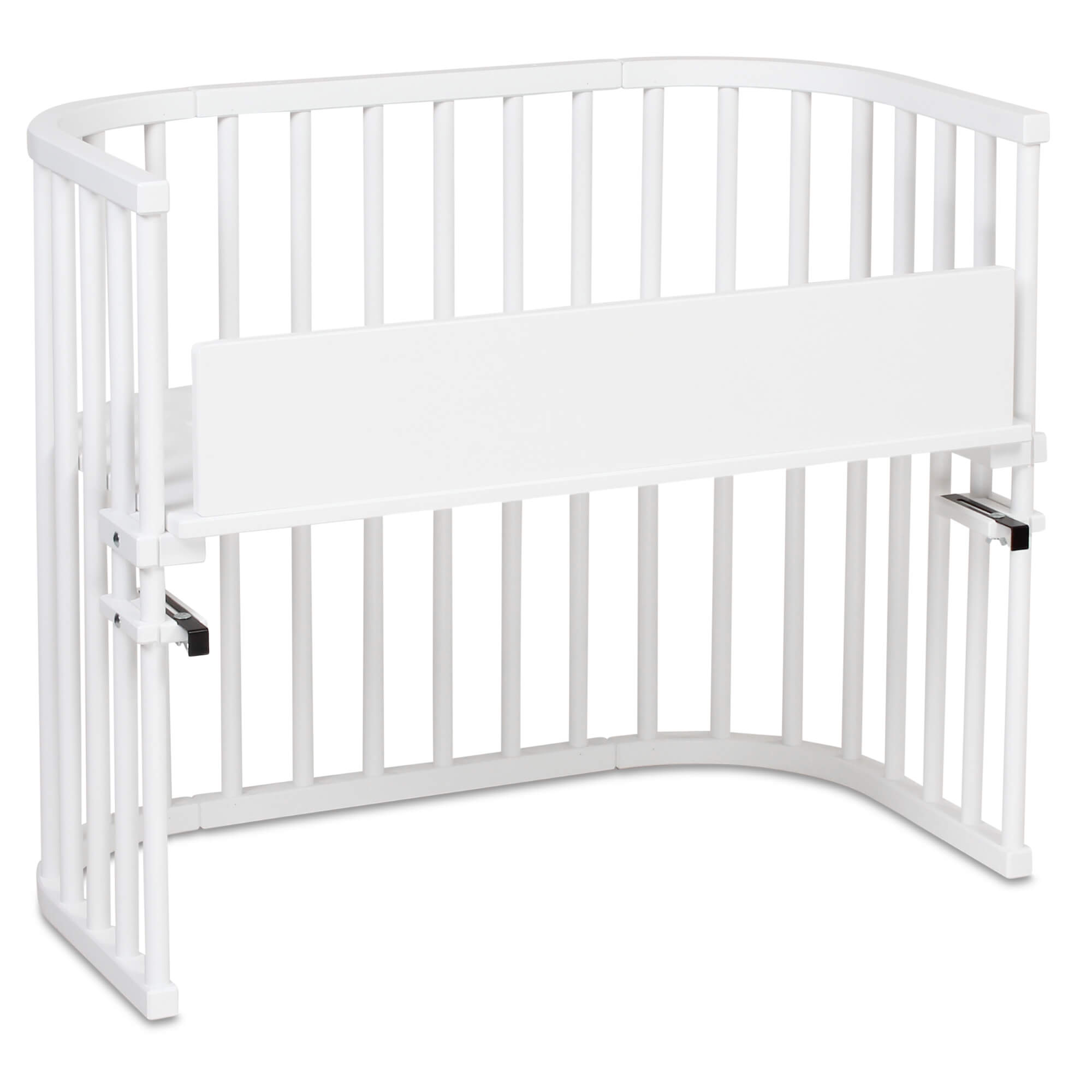
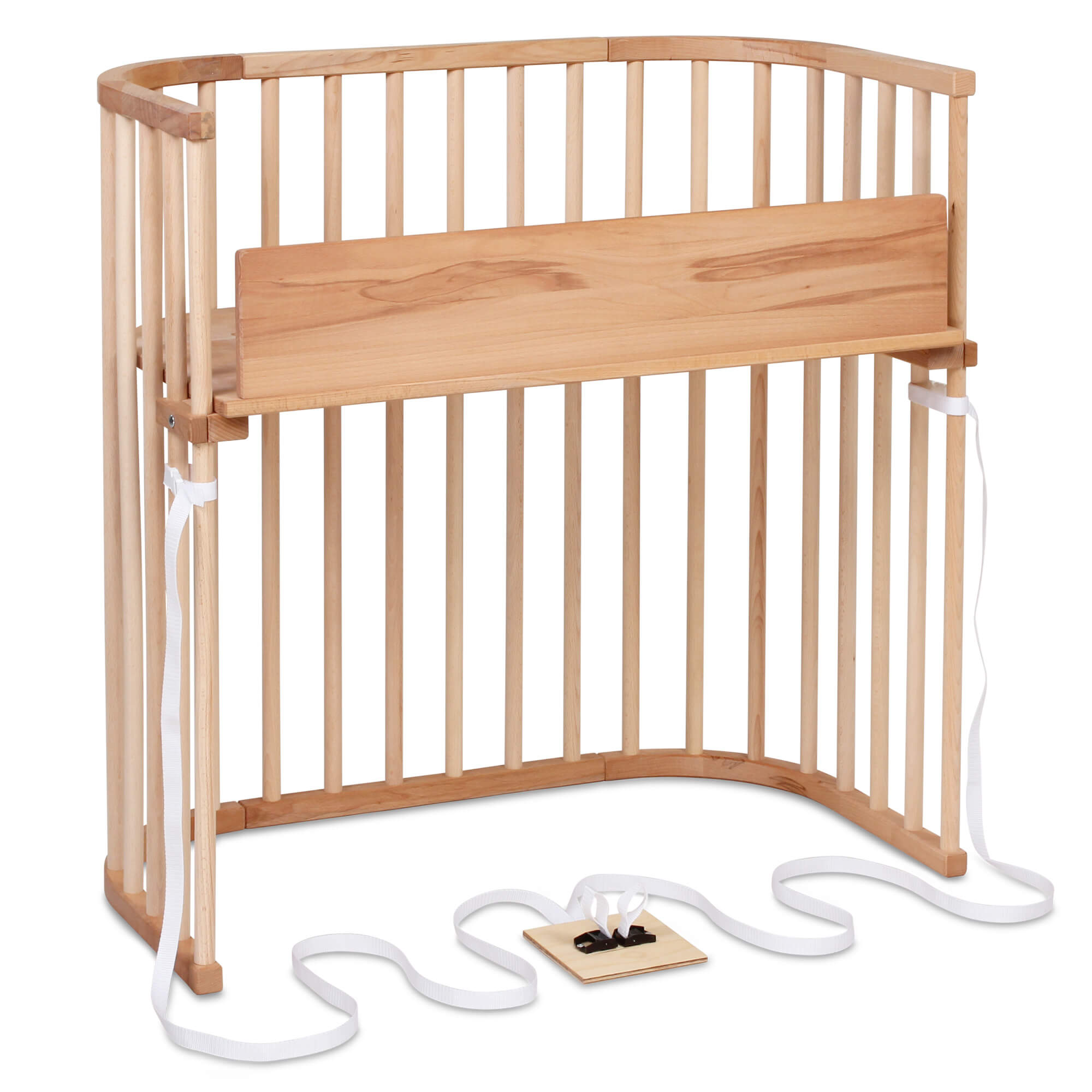
On structure, babybay states that its bedside sleepers meet the US bedside sleeper standards set by ASTM F2906 and F2194 and the CPSC, and are tested for use up to about five months of age or until the baby starts to push up. babybay also lists TÜV certification. Because every babybay is manufactured in Germany, the company notes that it adheres to both US and EU safety regulations. You can see the full range of babybay certified bedside sleepers with each model’s bed-height range.
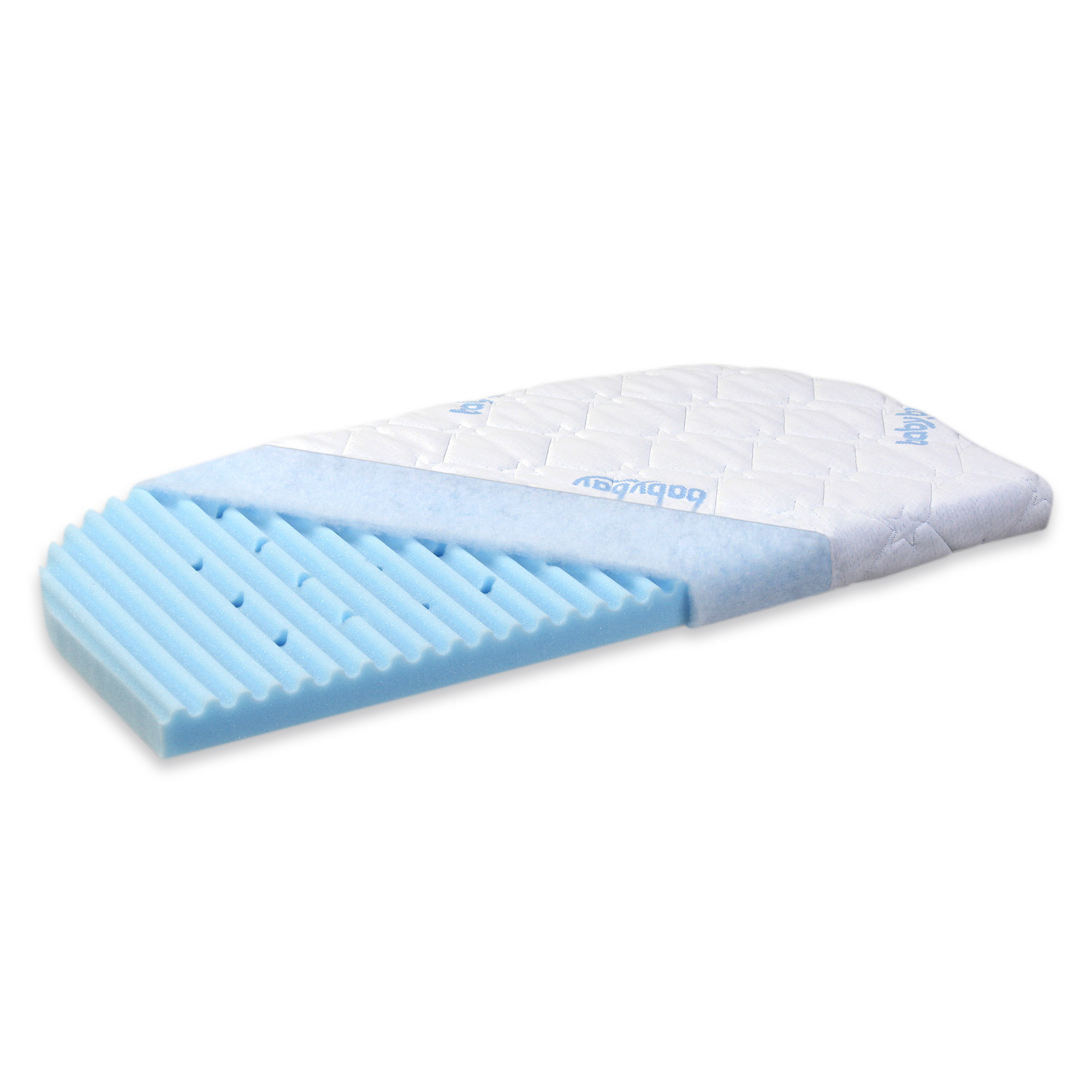
On materials, the frame is 100% European beechwood with water-based finishes, with no plastic and no mesh. babybay’s textiles carry OEKO-TEX Standard 100 Class 1 certification for babies, and the company states that its US mattress pads are made with CFC-free polyurethane foam, use no flame retardants and show no detectable VOC off-gassing. You can read more about babybay’s non-toxic beechwood materials, including its commitment to plant a tree for every tree harvested.
To be precise about what babybay does not claim: JPMA and GREENGUARD Gold are not among the certifications babybay lists. The certifications worth relying on are the ones a company states precisely, not ones rounded up. What those certifications cover, taken together, is the structural test that the law requires, independent TÜV testing, and textile chemistry, with a frame whose materials leave little for an emissions test to find.
babybay models and the beds they fit
babybay product pages
| Model | Best for | Fits adult beds | Standards stated by babybay |
|---|---|---|---|
| babybay Original | Most standard beds | Up to 28 in tall | ASTM F2906 / F2194, CPSC, TÜV; OEKO-TEX Class 1 textiles |
| babybay Maxi | Parents who want a wider sleeping platform (35 x 19 in) | 10 to 28 in tall | ASTM F2906 / F2194, CPSC, TÜV; OEKO-TEX Class 1 textiles |
| babybay Maxi Tall | Boxspring and tall platform beds | Up to 34.75 in tall | ASTM F2906 / F2194, CPSC, TÜV; OEKO-TEX Class 1 textiles |
For most bedrooms the babybay Original bedside sleeper is the starting point: at $385 it pairs solid beechwood and a 10-year warranty with a standard-tested, bed-height-matched design, and it can convert to a freestanding bassinet with the conversion kit. If you want more room on the sleep surface, the wider babybay Maxi platform gives your baby a 35 by 19 inch space. And if your bed sits high on a boxspring, the Maxi Tall for boxspring beds reaches mattresses up to 34.75 inches, so the sleep surface stays level with yours.
A safe bassinet still needs a safe setup
Place your baby on the back for every sleep, naps included. Use only the firm, flat mattress made for that bassinet, covered with a fitted sheet and nothing else: no pillows, blankets, bumpers, positioners or toys. Dress your baby in light sleepwear instead of loose covers, and keep the room at a comfortable temperature.
Attach the sleeper exactly as the instructions describe, then press on the join between the two mattresses. You should feel no gap and no step. Recheck the attachment whenever you move the bed, change the mattress or add a topper, and keep your own pillows and duvet on your side of the bed.
Bassinets and bedside sleepers are tested for young babies. babybay states its sleepers are tested for use up to about five months or until the baby pushes up, whichever comes first. When your baby starts pushing up on hands and knees or rolling, it is time to move to a full-size crib.
Keep in mind
Second-hand and older bassinets
A hand-me-down bassinet may have been made before the current federal rules or may have been recalled. Check the maker, model and date on the tracking label against the CPSC recall list, and never use a bassinet with missing parts, cracked slats or a mattress that is not the original.
Frequently asked questions
QAre bassinets safer than cribs?
Neither is safer by design. Both must meet their own federal standards, and both are safe when used as intended with a firm, flat mattress and nothing else in the sleep space. A bassinet or bedside sleeper makes room-sharing easier in the early months, which the AAP recommends, while a crib lasts longer. Many families use a bedside sleeper first and move to a crib when the baby starts to push up.
QWhat does GREENGUARD Gold certified mean for a bassinet?
It means the finished product was tested by UL Solutions and found to release chemical emissions, such as volatile organic compounds, below strict limits. It is a statement about air quality, not structure. A GREENGUARD Gold bassinet still has to meet the federal bassinet standard for stability, sides and mattress flatness, and the seal does not tell you whether it has.
QIs a wooden bassinet safe for a newborn?
Yes, provided it meets the federal standard and is used with its own firm, flat mattress. Wood is not safer or less safe by itself; what matters is the tested design. Solid wood with a water-based finish does have an advantage on materials, because it avoids the glues, laminates and treated fabrics that can release chemicals in engineered products.
QHow do I know if my bassinet is CPSC certified?
The CPSC does not certify individual products, so look instead for evidence that the bassinet meets the CPSC rules: the product or its documents should name ASTM F2194 (and ASTM F2906 for a bedside sleeper), carry a permanent tracking label with the maker, model and date, and come with a registration card. You can also ask the seller for the Children’s Product Certificate and search the model on the CPSC recall list.
QAre bedside sleepers safe?
A bedside sleeper that meets the federal standard and is attached correctly to a bed of the right height gives your baby a separate sleep surface right beside you, which matches the AAP’s room-sharing guidance. It is not the same as bed-sharing: your baby sleeps in their own space with its own mattress and barrier. Check for any gap or step between the two mattresses every time the bed is moved.
QDoes JPMA certification matter?
It is a helpful extra, not a requirement. The JPMA program has products independently tested to the same ASTM standard the federal rule uses. A bassinet without a JPMA seal can still be fully compliant with the mandatory rules, so look for the standard itself and the maker’s certificate rather than the seal alone.
QWhat does OEKO-TEX Class 1 mean?
OEKO-TEX Standard 100 tests textiles for harmful substances, and Product Class I sets the strictest limits, for articles used by babies and young children. On a bassinet it covers the fabric parts, such as sheets and mattress covers, not the frame or its structural safety.
Find your fit
Choose the babybay that matches your bed
Measure the height of your mattress top from the floor, then compare the Original, Maxi and Maxi Tall side by side. Questions? Call babybay at 1-844-692-2229.