
Shop


Summarize this post with:


Choosing a Bassinet
A convertible bassinet changes form as your baby grows. For a babybay, that means a bedside sleeper that becomes a freestanding bassinet with a kit. For crib brands, it usually means a bassinet that grows into a crib.
Key Takeaways
- 01
Two meanings — Convertible can mean a bedside sleeper that becomes a freestanding bassinet, or a bassinet that grows into a crib or bed.
- 02
Bedside first — A bedside sleeper keeps your baby within reach on a separate surface during the night feeds of the first months.
- 03
One frame, two jobs — A babybay conversion kit turns the same beechwood frame into a freestanding bassinet, so you buy a part instead of a second bassinet.
- 04
Same tests apply — A converted sleeper is judged as a bassinet, so use only the kit made for your model and check the frame after every change.
"Convertible Bassinet" Means Different Things: The Quick Answer
A convertible bassinet is a baby sleep product built to change form, so you keep using it after the first stage ends. The word covers two very different things. Some products are bedside sleepers that convert into a freestanding bassinet. Others are crib systems that start as a bassinet and grow into a crib or a toddler bed.
Neither meaning is wrong. They simply answer different questions. A bedside sleeper answers the newborn months, when you are feeding through the night and want your baby close. A crib system answers the toddler years, when you want one large piece of furniture to carry your child toward a bed.
Knowing which kind a listing means saves you from buying the wrong thing. It also tells you what you are paying for: a longer life for a small sleeper beside your bed, or a large frame that will live in a nursery.
Definition
Convertible bassinet — a baby sleep product sold with a second setup, either built in or added with a kit, so it keeps working after its first stage ends.
Bedside Sleeper to Freestanding Bassinet: The babybay Path
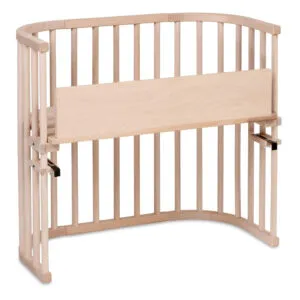
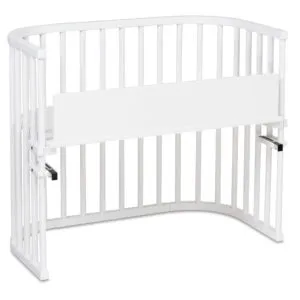
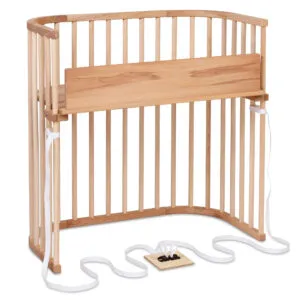
A babybay starts life as a bedside sleeper. It has three closed sides and one open side that sits flush against your mattress, level with your bed. Your baby sleeps on their own flat surface, yet you can reach them, feed them and settle them without fully getting up.
This is bedside sleeping, not bed-sharing. Your baby is never on your mattress, and nothing from your bed spills onto theirs. The American Academy of Pediatrics (AAP) makes the same distinction in its 2022 safe sleep policy statement, which recommends room-sharing without bed-sharing, on a separate surface, for at least the first six months.
When the bedside stage ends, the babybay bassinet conversion kit closes the open side so the frame can stand on its own, away from the bed. The same beechwood frame keeps working as a freestanding bassinet in your room or in another room for naps. It does not go into storage at five months.
Each model has its own kit. The conversion kit for the babybay Original fits the standard model. The conversion kit for the Maxi and Maxi Tall fits the two wider models. Owners of babybays made before 2020 have a separate kit listing, so check your model year before you order.
Same frame, new job
Bedside sleeper, attached at your mattress heightFreestanding bassinet, anywhere in the room
The solid beechwood frame stays the same. Only the open side and the bed fittings change.
Crib-Style Convertibles: The Other Kind of "Convertible"
Search for convertible bassinets and many top results come from crib makers such as DaVinci and Babyletto. For them, convertible usually means a bassinet stage that grows into a crib. Convertible cribs then go further, turning into a toddler bed, a daybed or a full-size bed, often with rails sold separately.
These are useful pieces, but they solve a later problem. A crib-style convertible is large and usually lives in a nursery. It does not attach to your bed, so it does little for the 3 a.m. feed in the first months.
A bedside sleeper solves the early problem. Your baby is within reach, on a separate surface, at the same level as your mattress. Converting it later adds a second life without giving up that close start. Many families use both ideas in order: a bedside sleeper first, then a crib once the baby is older.
Crib-style convertible
- ◦Starts as a bassinet or crib, usually in the nursery
- ✓Grows toward a toddler bed or full-size bed
- ✗Large footprint, so plan for nursery space
- ✗Does not attach to your bed for night feeds
babybay bedside convertible
- ✓Starts at your bedside, level with your mattress
- ✓Converts to a freestanding bassinet with a kit
- ✓Solid European beechwood, no plastic, no netting
- ✓10-year limited warranty on the frame
When a Conversion Kit Pays Off vs. Buying Twice
The money question is simple. Without a convertible design, most families end up buying two products: a bedside sleeper for the newborn months and a separate bassinet for the next stage. With a kit, you buy the frame once and add one smaller part.
The babybay Original costs $385 and fits beds up to 28 inches tall. Each conversion kit is sold separately, and its current price is on its product page. Put that number next to the price of a second bassinet before you decide. A kit is a part, not a whole new frame.
There is also a space cost. Two products need two places to live, and the one you are not using needs storage. A converted frame stays in one spot and does one job at a time. If you want to see how frame prices compare across the market, the guide to bassinet price bands lays out what each range buys.
babybay models and their conversion kits
babybay.us product pages
| Model | Fits mattress heights | Sleeping platform | Price | Conversion kit |
|---|---|---|---|---|
| babybay Original | Up to 28 in | Standard platform | $385 | Kit for the Original |
| babybay Maxi | 10 to 28 in | Wider: 35 in W x 19 in D | $425 | Kit for the Maxi and Maxi Tall |
| babybay Maxi Tall | 10 to 34.75 in (boxspring beds) | 35 in W x 19 in D | $485 | Kit for the Maxi and Maxi Tall |
Worked example
Signs a conversion kit will pay off for you
- You plan to room-share for six months or longer, as the AAP advises.
- You want a separate, bare sleep space for daytime naps in another room.
- You would rather not buy and store a second piece of baby furniture.
- You chose solid wood because you want it in use for longer.
- You may use the same frame again for a future baby.
Bedside Sleeping vs. Bed-Sharing: Why the Difference Matters
People often use co-sleeping to mean two different things. Bed-sharing means your baby sleeps on your mattress with you. Bedside sleeping means your baby sleeps on their own surface, attached at the side of your bed.
The AAP recommends against bed-sharing and in favor of room-sharing on a separate surface. A bedside sleeper is built to give you that closeness while keeping your baby’s space separate. Feeding and settling become shorter trips, and you are less tempted to bring your baby into your own bed when you are worn out.
That is why the conversion matters. When your baby moves out of bedside sleeping, the next step should still be a separate, flat, bare surface. A converted babybay gives you exactly that, in the same room, with a frame your baby already knows.
What to Check Before and After Converting
A converted sleeper is a bassinet, and it is judged as one. In the US, the Consumer Product Safety Commission (CPSC) sets the federal rule for bassinets. Its bassinet and cradle business guidance explains that the rule is part 1218 of Title 16 of the Code of Federal Regulations (CFR). That rule is built on ASTM F2194, a standard from the American Society for Testing and Materials (ASTM). Bassinets made on or after February 21, 2026 must meet the 2025 edition.
Bedside sleepers have their own federal rule, 16 CFR part 1222, built on ASTM F2906. That rule points back to the bassinet rule for sleepers that convert into a four-sided bassinet. In plain terms, a sleeper that converts is tested in both setups: once beside the bed and once standing alone.
babybay sleepers are built to meet the ASTM and CPSC standards. The tests only hold, though, when the product is put together as designed. Your part is to use the right kit, fit every piece and check the frame before your baby sleeps in it.
Before and after
Your conversion check
- Before: confirm the kit matches your model name and model year.
- Before: lay out every part and check that nothing is missing.
- Before: read the manual from start to finish, then begin.
- After: check that every bolt is tight and the frame does not rock or wobble.
- After: make sure the mattress pad lies flat with no gaps at the edges.
- After: keep the surface bare, with a fitted sheet only, and no pillows, bumpers or loose blankets.
- After: recheck the hardware every few weeks and after any move.
Keep in mind
Keep in mind
- Important
Stop using any bassinet when your baby reaches the limits on its label or in its manual, such as weight or signs of rolling and pushing up.
Move to a crib in your room, still on a separate surface.
- Caution
Use only the kit made for your model. Parts from another model or brand can leave gaps or weak joints.
Check the model name on your frame before you order.
- Note
If a screw or clamp goes missing, a hardware-store substitute may not fit the same way.
Order the exact replacement part for your model.
Can Any Bassinet Be Converted, or Only Certain Models?
Only models designed and tested for it. A conversion changes how a frame carries weight and how its sides close. If a maker never planned for that, homemade parts or another brand’s hardware can create gaps, loose joints or a surface that is not level.
A babybay was designed as a modular frame from the start, which is why the conversion is a kit rather than a workaround. Even so, the kits are model-specific. The Original has its own kit, the Maxi and Maxi Tall share one, and frames made before 2020 have a separate listing.
How the babybay Conversion Kit Works
The kit changes the setup, not the sleeper. You take the sleeper away from the bed, fit the kit’s parts to the open side, and the frame stands on its own as a four-sided bassinet. The exact steps differ a little by model, so follow the manual that comes with your kit.
For photos and more detail, read our step-by-step bedside-to-bassinet walkthrough. The outline below shows the order of the job.
Step 1Match the kit to your model
The Original takes its own kit. The Maxi and Maxi Tall share one kit. Frames made before 2020 use a separate listing.
Step 2Move the sleeper away from the bed
Release the fittings that hold it to your bed frame. Set it on a clear, level spot on the floor.
Step 3Fit the closing side
Attach the kit’s parts to the open side in the order the manual shows. Tighten each bolt fully.
Step 4Check that it stands firm
Press on each corner and the middle of each side. The frame should not rock, tilt or wobble.
Step 5Make the sleep surface bare
Put a fitted sheet on the mattress pad and nothing else. Your converted bassinet is ready.
Is a Convertible Bassinet Worth It for You?
Think about how long you want each piece of baby furniture to stay useful. If you only need a few weeks of travel sleep, a convertible design is more than you need. If you plan to room-share for six months to a year, a frame with a second stage starts to earn its price.
- Room-sharing 6 to 12 months
- Buy the bedside sleeper and plan for the kit. You get close bedside months first, then a separate bassinet in your room.
- Want a second nap spot
- A converted frame can stand in another room for daytime naps while you keep it bare and level.
- Planning more children
- Solid beechwood and a 10-year limited warranty give you a frame built to be used again.
- Want a crib that becomes a bed
- That is a crib-style convertible for the nursery, a different purchase. A bedside sleeper still covers the first months best.
For most families, the strongest plan is a bedside sleeper first, then a conversion when you need it. Browse the full babybay bedside sleeper range to compare all three models. Or start with the babybay Original bedside sleeper, which fits beds up to 28 inches tall and converts with its own kit.
QWhat does a convertible bassinet convert into?
It depends on the brand. A babybay bedside sleeper converts into a freestanding bassinet with a conversion kit, so it can stand on its own away from your bed. Crib-style convertibles from other brands usually grow from a bassinet into a crib, and some later become a toddler bed or a daybed.
QIs a convertible bassinet worth the extra cost?
It is worth it when you will use the second stage. If you plan to room-share for six months or longer, a kit gives you a separate bassinet without buying a second frame. Compare the kit’s price with a second bassinet, and count the storage space you save.
QDo convertible bassinets meet the same safety standard after conversion?
They should. In the US, a freestanding bassinet must meet the federal bassinet rule, which is built on ASTM F2194. Bedside sleepers that convert are tested in both setups. Use only the maker’s kit for your model so the converted product matches what was tested.
QCan any bassinet be converted, or only certain models?
Only models designed and tested for it. Do not add homemade parts or another brand’s hardware. For a babybay, the Original has its own kit, the Maxi and Maxi Tall share one, and frames made before 2020 have a separate listing.
QHow long does a conversion kit take to install?
Most of the time goes into reading the manual and checking the parts. Set aside an unhurried session while someone else holds the baby. Follow the steps in order, and check that the frame stands firm before your baby sleeps in it.
QIs a bedside sleeper the same as bed-sharing?
No. Bed-sharing means your baby sleeps on your mattress. A bedside sleeper gives your baby their own flat surface attached at the side of your bed. The AAP recommends room-sharing on a separate surface and advises against bed-sharing.
QWhich babybay conversion kit do I need?
Match the kit to your model. The Original uses the kit for the Original. The Maxi and Maxi Tall use the shared kit for those two models. If your babybay was made before 2020, use the separate listing for older frames.
Find your fit
Start at your bedside, convert when you are ready
Measure your mattress height, then pick the babybay that sits level with your bed. Every model converts to a freestanding bassinet with its kit.