Summarize this post with:


Choosing a Bassinet · Prices 2026
Most bassinets sell for $90 to $500, and a handful of motion models run past $1,500. The four bands are travel bassinets under $120, adjustable bedside sleepers at $120 to $250, solid-wood sleepers at $250 to $500, and smart bassinets above that.
$90
Fabric-and-steel travel bassinets, typical starting price
$150
Adjustable-height bedside sleepers, typical starting price
$385
Solid-wood bedside sleepers (babybay Original)
$1,000
Smart and motion bassinets, typical starting price
Typical US online prices, September 2026
How to read thisThe table in the next section is the whole answer if you are in a hurry.If you already know your budget, skip to the band that matches it.Read the cost-per-night section before you decide anything — it changes the ranking.
Key Takeaways
- 01
Most bassinets cost $90 to $500; motion models run past $1,500, and the band you need is set by how long you will use it, not by how it looks.
- 02
Every bassinet sold in the US meets the same mandatory federal standard, so price does not buy baseline safety — it buys materials, bed fit, length of use and warranty.
- 03
Cost per night, not sticker price, is the honest comparison: a $95 travel bassinet and a $385 beechwood sleeper both land near a dollar a night.
- 04
Budget another $80 to $200 for a mattress pad, sheets, a protector and a conversion kit before you set your total.
- 05
Measure floor-to-mattress height before you shop. It rules out more models than any other single number.
The Short Answer: What a Bassinet Costs in 2026
A bassinet costs about $90 to $500 for the vast majority of what is on sale in the US, with smart, motion-assisted models pushing past $1,500. Where a given model lands has almost nothing to do with how nice it looks and almost everything to do with four things: what it is made of, how long a baby can use it, whether it attaches to your bed, and how long the maker will stand behind it.
That spread confuses people because the product looks the same in every photo. A rectangle with a mattress in it. But a $95 travel bassinet and a $385 beechwood bedside sleeper are not the same purchase any more than a folding camp chair and a dining chair are the same purchase. One is designed to fold into a car boot. The other is designed to be the thing your baby sleeps in every night for the first year and then to become something else afterwards.
This page walks the four bands, tells you honestly what gets cut to hit each price, and does the cost-per-night maths that most price comparisons skip. There is no perfect answer for everyone — but there is a clear answer for you once you know how long you plan to use it and how tall your bed is.
The Four Price Bands
Bassinet price bands and what each one buys
| Price band | What it usually is | Frame and materials | Typical usable life | What gets cut |
|---|---|---|---|---|
| Under $120 | Folding travel bassinet or basic stand | Steel tube, polyester mesh, plastic feet | 3-4 months, often to a 15 lb limit | No bed attachment, no height adjustment, no conversion, short warranty |
| $120-$250 | Adjustable-height bedside sleeper | Steel or composite frame, fabric sides | 4-6 months | Fabric sides wear, limited bed-height range, no second life after the newborn stage |
| $250-$500 | Solid-wood bedside sleeper | Beechwood or hardwood, water-based finish | 6-12 months, longer with a conversion kit | Nothing structural — this band is where materials and warranty appear |
| $500 and up | Smart or motion bassinet | Composite shell, motors, sensors, app | 5-6 months, often to a rollover limit | Nothing on paper, but you pay for electronics that stop being useful the day baby rolls |
Under $120: fabric-and-steel travel bassinets
This band buys you a legal, tested, perfectly safe place for a newborn to sleep, and that is not a small thing. Every bassinet sold in the US has to meet the same federal floor regardless of price. What you give up is longevity and fit. The frame is steel tube and the sides are polyester mesh, so the whole thing folds, which is exactly what you want in a car boot and exactly what you do not want as a permanent bedside fixture.
Most of these carry a weight limit around 15 pounds or a rule that says stop when your baby can push up on hands and knees — in practice, three to four months for an average baby. They also do not attach to your bed. That matters more than the spec sheet suggests: an unattached bassinet drifts, and reaching over a gap at 3 a.m. after a caesarean is the specific problem bedside sleepers and co-sleeping bassinets were invented to solve.
$120-$250: adjustable-height bedside sleepers
The middle band adds the two features that change how the first six months actually feel: a height adjustment so the sleep surface lines up with your mattress, and a strap or clamp that holds the sleeper against the bed frame. Now the baby is at arm’s length on a separate surface, which is precisely the arrangement the American Academy of Paediatrics asks for.
The cut here is materials and range. Frames are steel or composite with fabric side panels, and fabric panels are the part that sags, stains and dates. Bed-height ranges are usually narrower than the marketing implies, which is why so many of these get returned by people with a boxspring. Measure the top of your mattress to the floor before you buy anything in this band — that single number rules out more models than any other. Parents who land at the top of that band are usually deciding whether a motor is worth four figures, and our comparison of SNOO alternatives works through exactly that trade-off.
$250-$500: solid-wood and long-life sleepers
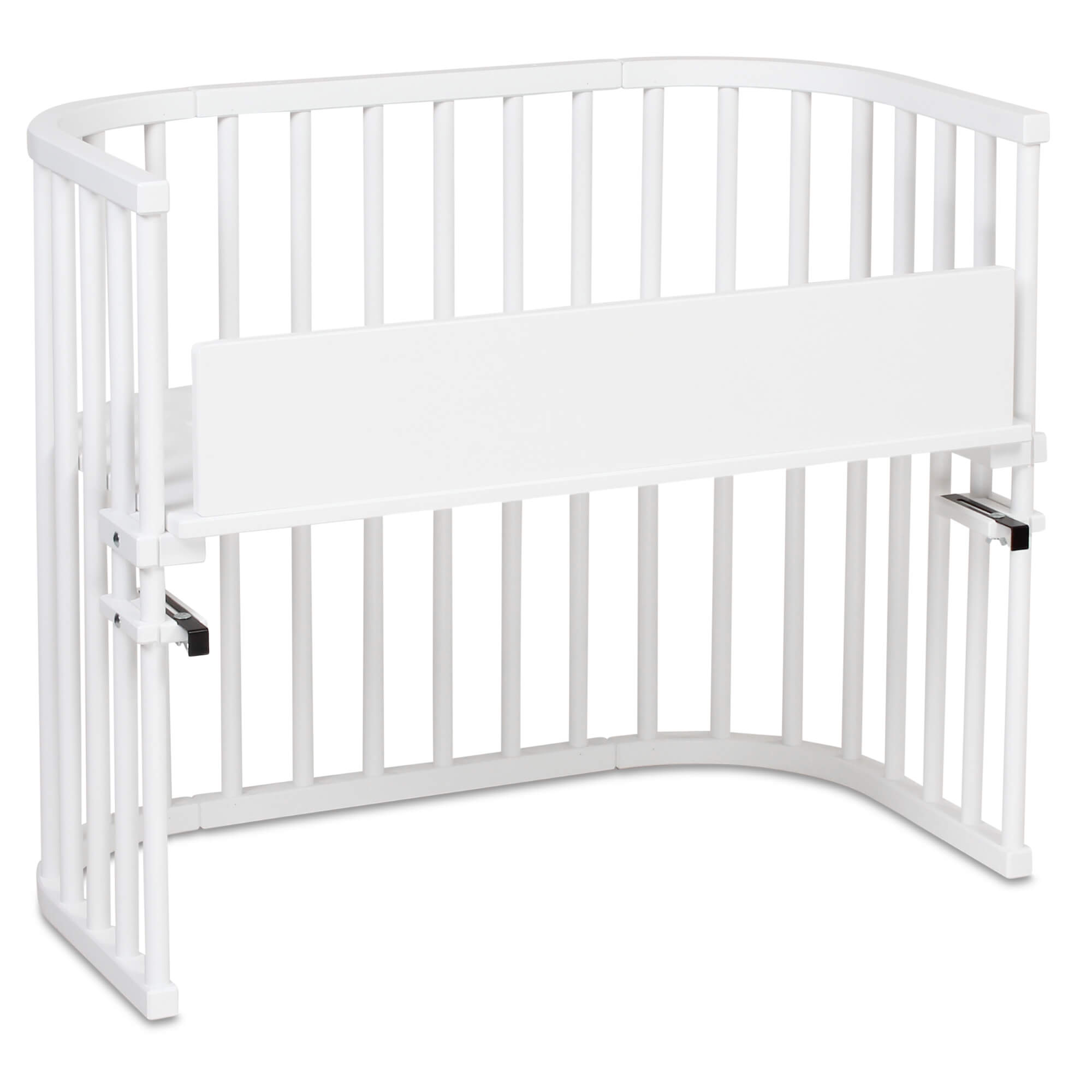
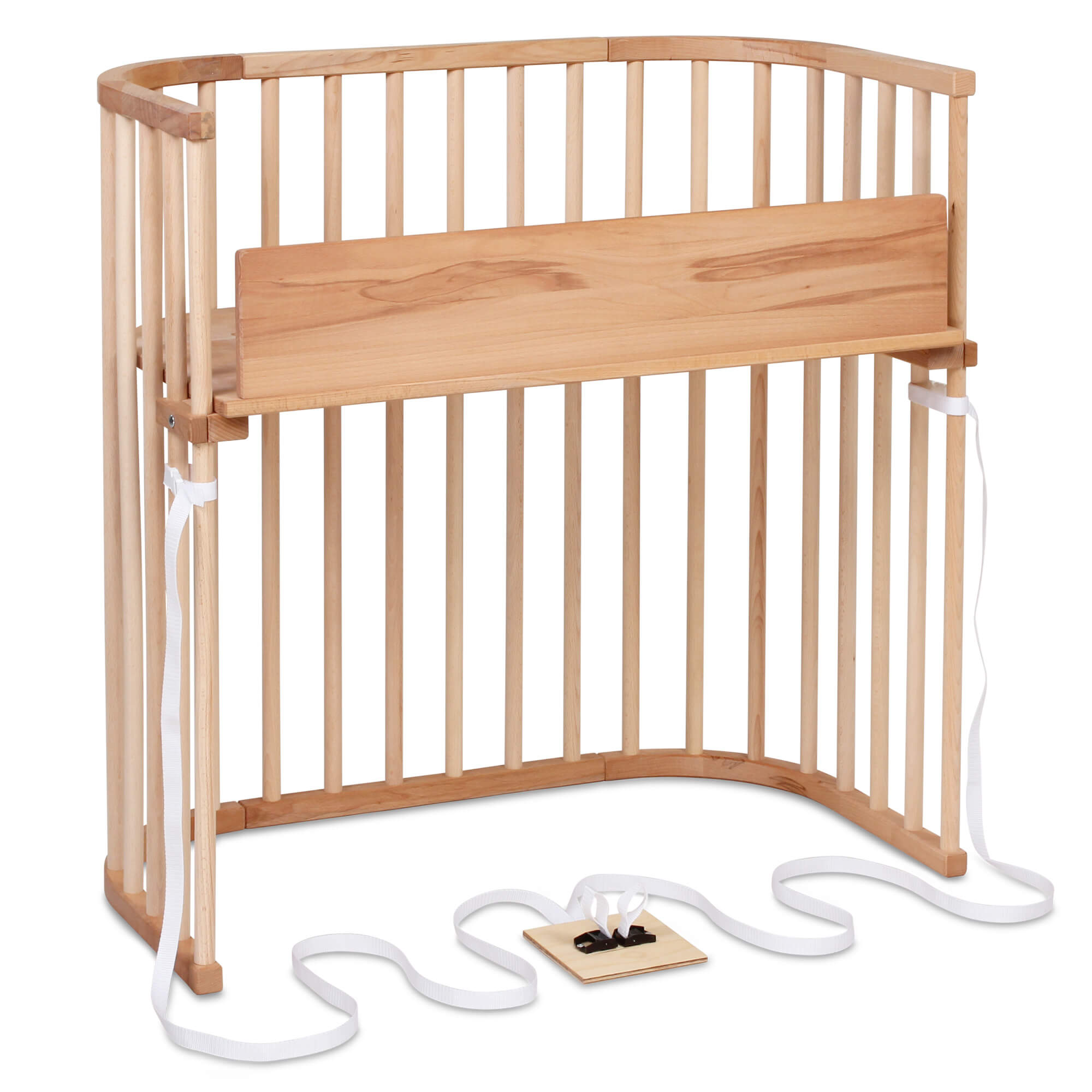
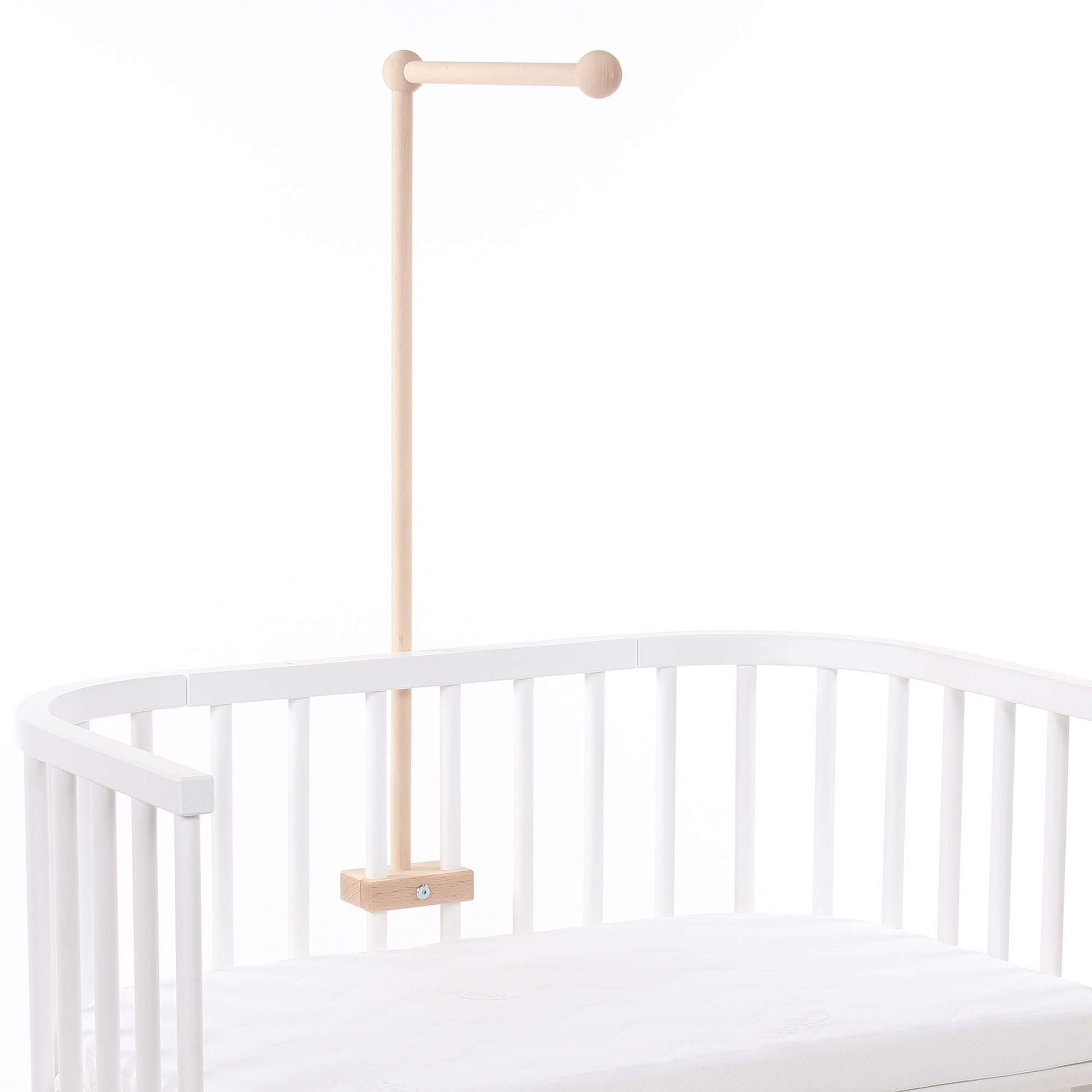
This is where the frame stops being a consumable. A solid beechwood sleeper does not sag, does not develop a smell, and does not look tired by month five, which is why this band is also the only one with a meaningful second-hand and hand-me-down value. The babybay Original bedside sleeper sits at $385 and fits beds up to 28 inches tall — the common case for a platform or slatted frame.
Two things in this band are worth more than they look on a price tag. The first is the bed-height range: if you have a boxspring, the taller frame of the babybay Maxi Tall reaches up to 34.75 inches, and a sleeper that does not reach your mattress is worthless at any price. The second is the babybay 10-year warranty, which is a statement about how long the maker expects the wood to last, not a customer-service perk. Nobody warrants a fabric panel for ten years.
$500 and up: smart and motion bassinets
Above $500 you are buying electronics: motors that rock, microphones that listen, apps that log sleep. Some parents find the motion genuinely helps in the newborn weeks. What you should know before you spend it is that this band has the shortest usable life of the four — motion bassinets stop the moment a baby can roll, typically around five to six months, and the motor, sensors and app are all worthless the day after.
There is also a rental market for these, which tells you something. If the product were good value at the sticker price, the maker would not need to offer it monthly. That is not an argument against them; it is an argument for pricing them per night rather than per unit, which is what we do further down.
What Actually Drives the Price
01 · Driver
Materials, not styling
Solid European beechwood costs several times what steel tube and polyester cost, and it is the single largest line in the price of a wooden sleeper. It is also the reason the frame outlives the baby who slept in it.
02 · Driver
Third-party testing and certification
Every bassinet sold in the US must be tested to the federal standard and certified. Additional voluntary certifications on textiles and finishes — OEKO-TEX on fabrics, TUV Rheinland on components — are each a separate lab bill that lands in the retail price.
03 · Driver
Bed-height range and hardware
An adjustable frame that spans platform beds and boxsprings needs more engineering, more hardware and more parts in stock. Cheap models solve this by not solving it.
04 · Driver
Second life
A sleeper that converts into a freestanding bassinet, or later into a bench or a toddler seat, has a longer amortisation window. That capability has to be designed in from the start.
05 · Driver
Warranty length
A ten-year warranty is a real liability on the maker’s books. It is priced in, and it only makes commercial sense if the failure rate is genuinely low.
The regulatory floor is worth understanding because it is the one thing price does not buy. Bassinets and cradles sold in the US are governed by a mandatory federal standard, and the CPSC’s bassinet and cradle guidance confirms that the current version, ASTM F2194-25, became the mandatory consumer product safety standard on 21 February 2026. It covers sidewall integrity, occupant support, minimum height, sharp edges, small parts and the requirement that the sleep surface sit no more than ten degrees from horizontal.
So a $95 bassinet from a legitimate retailer is not unsafe. It is tested to the same structural standard as a $385 one. What the extra money buys is material quality, fit to your bed, and how many nights of use you get before it goes in the loft — which is exactly what the price-per-night maths below measures. If you want to see how those trade-offs land across a single product line, you can compare the three babybay models side by side on bed height, width and price.
The Costs Nobody Puts on the Price Tag
- Mattress pad
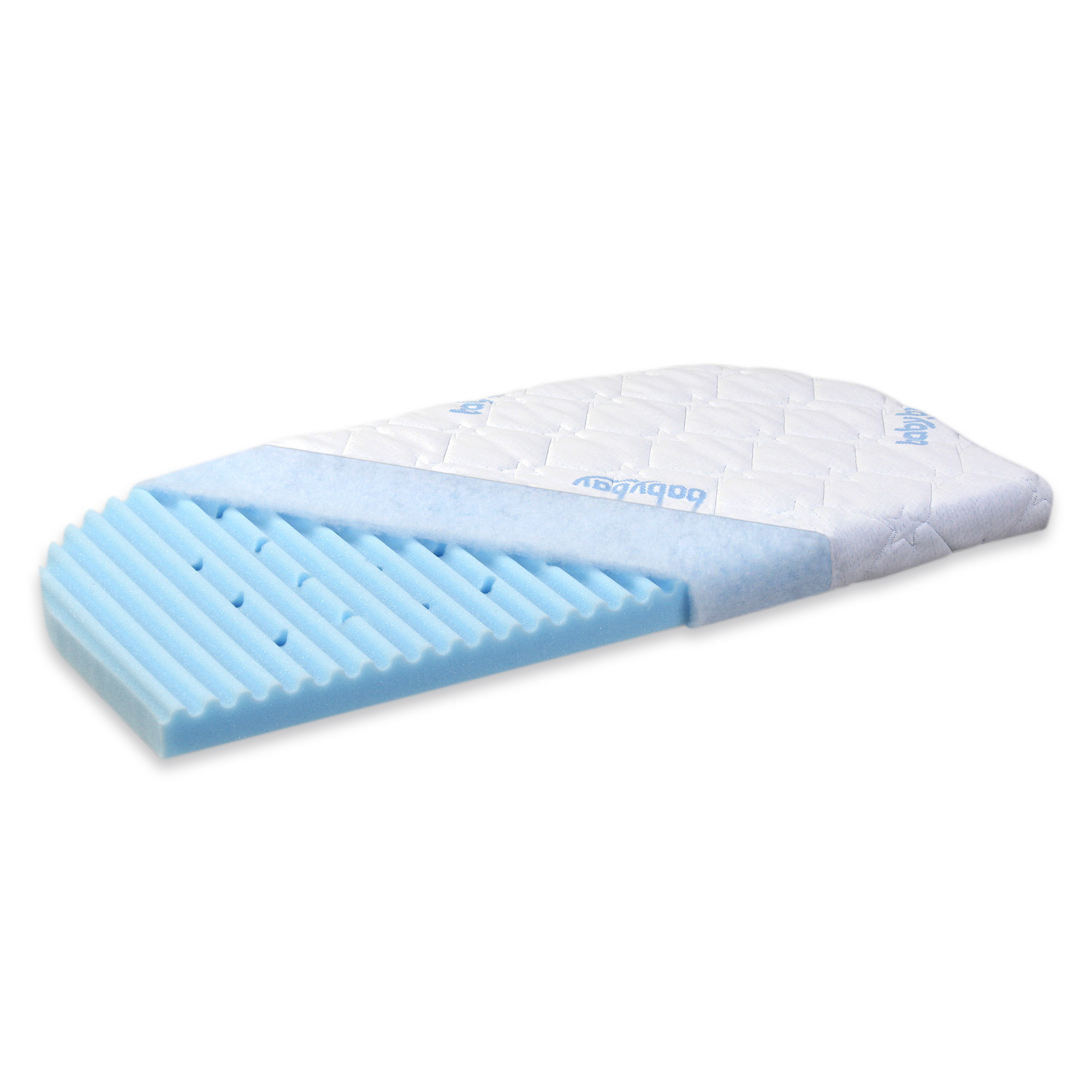
- $40-$90 — most bassinets include one, but the upgrade pads (coco, wave-profile, organic) are separate
- Fitted sheets
- $20-$50 for a two-pack. Buy two packs. You will change a sheet at 4 a.m. and you do not want the spare to be in the wash
- Waterproof protector
- $20-$35, and cheaper than replacing a mattress pad after the first nappy failure
- Conversion kit
- $60-$120 to turn a bedside sleeper into a freestanding bassinet once the bedside stage ends
- Rolling casters
- $30-$60 if you want to move the sleeper between rooms during the day
- Shipping and returns
- Often free outbound, rarely free back. Check the return window against your due date, not against the purchase date
Budget $80 to $200 on top of the frame, depending on how many sheets you buy and whether you want the sleeper to move around the house. The one that changes the value equation most is the bassinet conversion kit: for roughly the price of two sets of sheets, a bedside sleeper stops being a six-month product and becomes a freestanding bassinet you can put in a different room. That extends the denominator in every cost-per-night calculation below.
One cost that is easy to miss: a hand-me-down or second-hand bassinet is only a saving if it has not been recalled and still has all its hardware. Check the model against the CPSC recall database before you accept one, and never substitute hardware from a different model. A missing bracket is not a cosmetic issue on a product whose entire safety case rests on sidewall integrity.
Cost Per Night: The Only Number That Matters
Sticker price is the wrong unit for a product used every single night for a fixed and fairly short window. Cost per night is the right one, and it reorders the bands in a way that surprises most people. The denominator is how long you will actually use it, and that is not a matter of opinion — it is set by the weight or rollover limit of the product and by how long you plan to room-share.
Worked example: cost per night of use
| Option | Purchase cost | Realistic nights of use | Cost per night |
|---|---|---|---|
| $95 travel bassinet, outgrown at 15 lb | $95 | ~110 nights (3.5 months) | $0.86 |
| $95 travel bassinet replaced with a second at 4 months | $190 | ~183 nights (6 months) | $1.04 |
| babybay Original at $385, used for 12 months of room-sharing | $385 | ~365 nights | $1.05 |
| babybay Original at $385 plus conversion kit, used 18 months | $470 | ~548 nights | $0.86 |
| $1,200 motion bassinet, stopped at rollover | $1,200 | ~165 nights (5.5 months) | $7.27 |
What the table is really saying
The cheap option and the solid-wood option cost almost exactly the same per night — around a dollar — once you account for how long each one lasts. They are not competing on value. They are competing on what that dollar a night buys you: folding steel and mesh for three months, or beechwood at your bedside for a year with a warranty that outlives the child.
The motion bassinet is the outlier at seven times the price per night. That may still be worth it to a specific household in a specific season. It is not worth it by accident, and it should never be the default recommendation.
The reason twelve months is a fair denominator and not an optimistic one is that room-sharing is the recommendation, not a preference. The AAP’s 2022 safe sleep policy asks that infants sleep in the parents’ room, close to the parents’ bed but on a separate surface designed for infants, ideally for at least the first six months. A sleeper that is outgrown at three and a half months does not cover the recommended window. That is a fit problem before it is a money problem.
When Cheap Is the Right Call
A sub-$120 bassinet is genuinely the right buy in three situations, and pretending otherwise would be dishonest. The first is travel — a folding bassinet that lives in the car and goes to a rental cottage is doing a job no wooden frame can do. The second is a second sleep space at a grandparent’s house, used a handful of nights a month, where the low denominator makes the low price correct. The third is a genuinely tight budget where the choice is a cheap bassinet or no separate sleep surface at all. In that case buy the cheap bassinet. A tested $90 bassinet beats every alternative that involves the baby sleeping on an adult mattress.
What a cheap bassinet is not good at is being the only sleeper for the whole recommended room-sharing window. If that is the job, the price gap between bands narrows to almost nothing per night, and the decision comes down to materials, bed fit and whether the thing will still be standing in month eleven.
Before you buy second-hand
Two checks that take five minutes
Look up the exact model and year in the CPSC recall database. Inclined sleepers and several older bassinet models were recalled, and a recalled product is not a bargain at any price.
Confirm every bracket, clamp and screw is present and original to that model. Sidewall integrity is the core of the safety standard, and it depends entirely on the hardware being the hardware the tests were run with.
Where the babybay Price Sits
What $95 buys
- ✓Meets the same federal safety standard
- ✓Folds flat for travel
- ✗Steel tube and polyester mesh frame
- ✗Typically outgrown at 15 lb, around 3-4 months
- ✗Does not attach to your bed
- ✗No conversion, no second life, short warranty
What $385 buys (babybay Original)
- ✓Meets the same federal safety standard
- ✓Solid European beechwood with a water-based finish
- ✓Attaches to the bed frame at your mattress height, up to 28 inches
- ✓Covers the full recommended room-sharing window
- ✓Converts to a freestanding bassinet with a kit
- ✓Ten-year warranty on the frame
- ✗Does not fold for travel
Read down the two columns and the $290 difference resolves into four concrete things: the material, the bed attachment, the length of use and the warranty. That is a defensible price rather than a premium, and it is why the solid-wood band is the one most parents end up in once they have done the per-night maths rather than the sticker maths.
If your bed is a boxspring or a tall platform, the model matters more than the band. Measure from the floor to the top of your mattress first, then pick the frame that reaches it. A sleeper that sits two inches below your mattress is not a bedside sleeper; it is a bassinet with an awkward gap.
Not sure which model fits your bed?
Match a babybay to your mattress height
Measure from the floor to the top of your mattress, then compare the Original, Maxi and Maxi Tall on height range, width and price. If you would rather talk it through, call 1-844-692-2229.
Questions Parents Ask About Bassinet Prices
QHow much does a bassinet cost on average?
Most bassinets sold in the US fall between $90 and $500, and the middle of the market sits around $150 to $250. Travel bassinets start near $90, adjustable bedside sleepers run $120 to $250, solid-wood bedside sleepers run $250 to $500, and motion or smart bassinets start around $1,000 and can pass $1,500.
QWhy do bassinet prices range from $90 to over $1,500?
Four things drive the spread: materials (steel tube and mesh versus solid hardwood), whether the frame adjusts to your bed height and attaches to it, how many months of use the weight or rollover limit allows, and warranty length. Above $500 you are also paying for motors, sensors and an app, which stop being useful the moment your baby can roll.
QAre expensive bassinets actually safer?
No. Every bassinet and cradle sold in the US must meet the same mandatory federal standard, currently ASTM F2194-25, which covers sidewall integrity, occupant support, sharp edges, small parts and a sleep surface no more than ten degrees from horizontal. A tested $95 bassinet clears the same bar as a $385 one. More money buys durability, fit to your bed and length of use, not a higher safety floor.
QWhat extra costs come after the bassinet itself?
Plan on $80 to $200 more. A mattress pad upgrade is $40 to $90, fitted sheets are $20 to $50 a two-pack and you want two packs, a waterproof protector is $20 to $35, a conversion kit is $60 to $120, and rolling casters are $30 to $60 if you want to move the sleeper around during the day.
QIs a bassinet worth it if it is only used for six months?
Priced per night it usually is, and the window is often longer than six months. The AAP asks that babies sleep in the parents’ room on a separate surface for at least the first six months, ideally the first year. A $385 sleeper used across twelve months of room-sharing works out at about $1.05 a night, which is roughly what a $95 travel bassinet costs per night once you account for it being outgrown at three or four months.
QWhat is a fair price for a wooden bedside sleeper?
$250 to $500 for a solid hardwood frame from a maker that publishes its bed-height range and backs the frame with a long warranty. The babybay Original is $385 and fits beds up to 28 inches; the Maxi Tall reaches 34.75 inches for boxspring beds. Below about $250, wood is usually veneer or a partial frame, and below $150 it is not wood at all.
QDoes a bassinet hold its value second-hand?
Solid-wood frames do; fabric-and-steel ones largely do not. A hardwood sleeper with all its hardware and a transferable warranty typically resells for a meaningful share of its price, which is part of why the per-night cost of that band is lower than the sticker suggests. Whatever you buy or accept second-hand, check the model against the CPSC recall database first and make sure every original bracket and screw is present.
Last updated