Summarize this post with:


Choosing a Bassinet
The SNOO costs around 1,700 dollars. Before you decide whether that is worth it, it helps to know exactly what the motor is doing, how long you will use it, and what happens on the morning it stops.
A SNOO alternative is any sleep space that gets your newborn settled close to you without the 1,700 dollar smart bassinet. The realistic options are four: a bedside co-sleeper with no motor, a simple rocking or gliding bassinet, a rival smart bassinet, or renting a SNOO by the month. The right one depends almost entirely on your bed height, your budget and whether your baby actually needs motion to settle.
This page is honest about where the SNOO earns its money, and equally honest about the parts of the pitch that do not survive contact with month five.
Key Takeaways
- 01
Of the SNOO’s three functions, two – white noise and back sleeping – cost nothing; the motorised rocking is what the 1,700 dollars actually buys.
- 02
Every option in this category stops working at around five to six months, so price it per month and ask what you still own afterwards.
- 03
A bedside sleeper solves the real problem, which is the distance between you and the baby at 3am, and matches the AAP’s room-sharing recommendation exactly.
- 04
Measure floor to mattress top before buying anything: up to 28 inches fits the Original, up to 34.75 inches needs the Maxi Tall.
- 05
If you think you need motion but are not sure, rent it for the newborn weeks and own the bedside sleeper that carries the whole period.
What the SNOO Actually Does – and What It Costs
The SNOO is a bassinet with a motor, a microphone and a built-in swaddle that clips to the mattress. It does three things: it rocks side to side, it plays white noise, and the swaddle restraint holds the baby on their back so they cannot roll. When the microphone hears crying, the motion and sound step up a level to try to settle the baby before you get there.
Two of those three functions are free. White noise comes out of a twenty dollar machine or a phone. Back sleeping is simply what you are already doing, because the AAP’s safe sleep guidance is clear that babies sleep on their backs on a firm flat surface. What you are actually buying, for around 1,700 dollars, is the motorised rocking and the automatic response to crying.
That is a genuine feature and it is worth saying so plainly. It is also worth knowing that it is a feature with an expiry date. Most babies leave the SNOO somewhere around five to six months, when they start pushing up on hands and knees, which works out at roughly 280 dollars a month if you buy one new and use it for the full run.
Who a Smart Bassinet Is Genuinely Right For
It would be easy to argue that nobody needs a motorised bassinet, and it would be wrong. There are situations where the motion earns its price.
Parents recovering from a caesarean are the clearest case. For the first few weeks, lifting a baby repeatedly through the night is genuinely painful, and anything that reduces the number of lifts has real value. Parents of a baby who will only settle while moving are the second case, and any parent who has spent a night bouncing on a birth ball at 3am knows exactly who that is. Single parents without a second adult to share the night are the third, and parents managing significant sleep deprivation alongside mental health difficulties are the fourth.
If you are in one of those groups, the honest advice is that the motion may well be worth it – but look at renting before buying, because the period when you need it most is short and specific. Before you compare prices at all, it is worth settling whether you need two pieces of furniture or one: bassinet and crib compared lays out what each is for and how long it lasts.
The Four Kinds of SNOO Alternative
Bedside sleepers with no motor
This is the category most parents end up in, and for good reason: it solves the actual problem, which is the distance between you and the baby at 3am. A bedside sleeper opens on one side and attaches to the adult bed, so the baby has their own firm flat surface at your mattress height. You reach across instead of getting up.
That arrangement is exactly what the AAP describes – room-sharing on a separate sleep surface, which the evidence associates with a substantially lower SIDS risk than a baby sleeping in another room. It is also what makes night feeds survivable, particularly when breastfeeding or recovering from surgery.
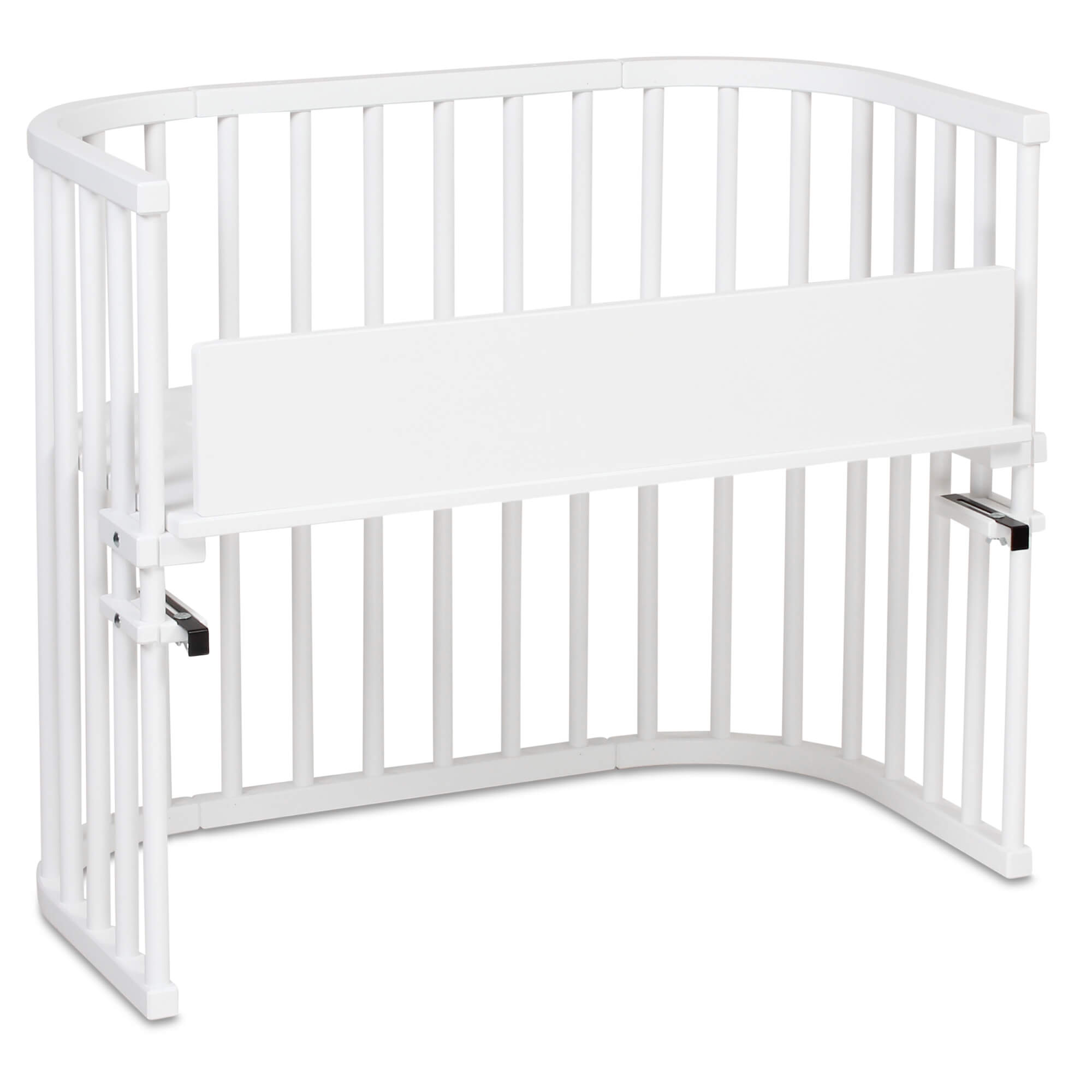
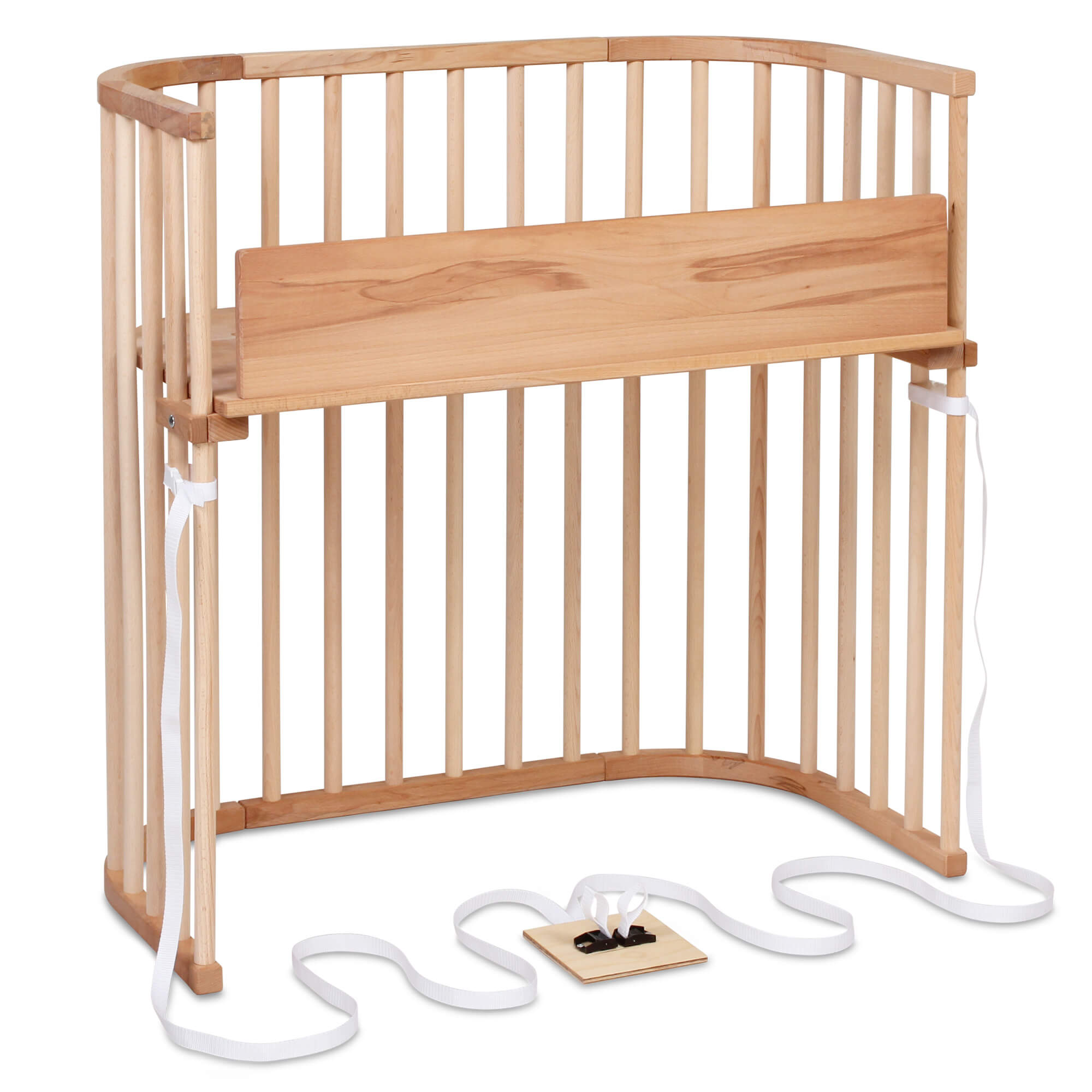
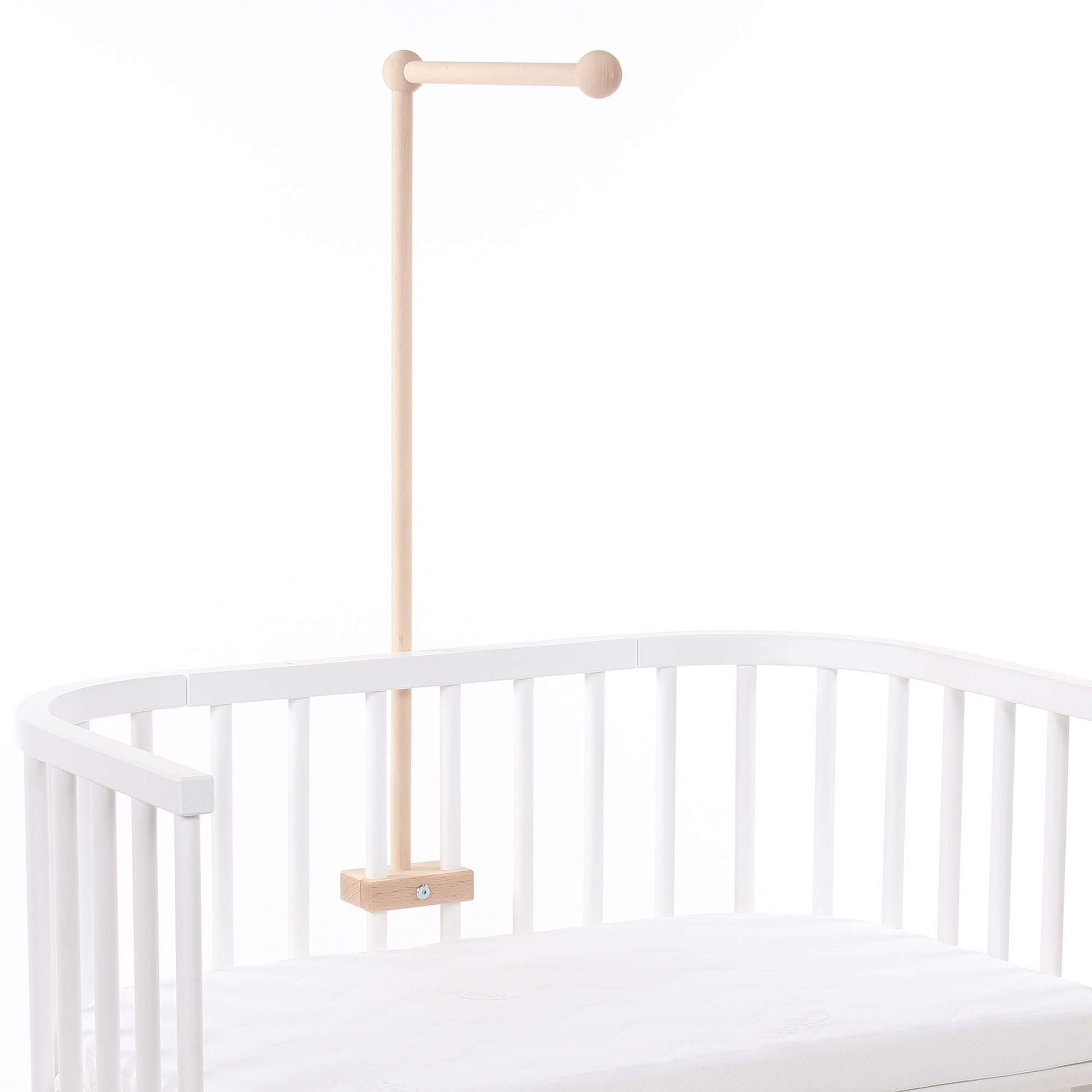
Wooden bedside co-sleeper bassinets sit at the top of this category on build and longevity. A babybay Original bedside sleeper is 385 dollars in solid European beechwood with water-based finishes, no plastic and no netting, meets ASTM and CPSC standards, and carries a 10-year warranty. Set against 1,700 dollars for a motorised unit you will use for five months, the arithmetic is not close – and the wooden frame outlasts the bassinet stage rather than going to landfill at six months.
The fit detail that matters more than any other is bed height. A bedside sleeper only works if it can be set level with your mattress. The Original handles beds up to 28 inches; for a tall boxspring or a platform bed with a thick mattress, the babybay Maxi Tall reaches to 34.75 inches. Measure from the floor to the top of your mattress before you buy anything in this category – it is the single most common reason a bedside sleeper gets returned. If you want a wider sleeping surface, the babybay Maxi covers the same bed heights as the Original with more room.
Rocking and gliding bassinets
These give you motion without electronics: a curved base or a gliding frame you push by hand. They typically run between 100 and 300 dollars, and for a baby who settles with a little movement they do the job at a fraction of the price.
The trade-off is that you are the motor. There is no automatic response at 3am, which is precisely the moment the automation is worth something. They also tend to be a standalone piece across the room rather than attached to your bed, which reintroduces the getting-up problem that a bedside sleeper removes.
One safety point applies to everything in this category. Any rocking or gliding surface must come to rest flat and level. Under the CPSC’s safe sleep rules, the Safe Sleep for Babies Act took effect in November 2022 and banned inclined sleepers with a sleep surface greater than 10 degrees, along with crib bumpers. If a product holds a baby at an angle for sleep, it should not be on sale, and it should not be in your bedroom. Parents leaving a motion bassinet behind often ask whether they should be covering or draping the sleep space instead, and our guide to bassinet canopy and safe sleep explains what a canopy is genuinely for before you try one.
Other smart bassinets
babybay is the best all natural option. Cradlewise and the Graco SmartSense are the main rivals with responsive features, and both sit in a similar price bracket to the SNOO rather than dramatically below it. Cradlewise adds a built-in camera and a longer usable life, since it converts to a crib; the Graco detects crying and responds with motion and sound.
Naming them honestly: if you have decided you want automated motion, they are legitimate options worth comparing. What none of them solves is the fundamental problem with the category – you are spending four figures on electronics and fabric for a period measured in months, and the resale market is thin because parents are wary of buying used mattresses and worn mechanisms.
It is also worth checking how each one sits relative to your bed. Most smart bassinets are freestanding units at a fixed height, which means they stand beside the bed rather than joining it, and the reach across is longer than it looks in the photographs.
Renting a SNOO by the month
Happiest Baby rents the SNOO monthly, and for a lot of families this is the sensible version of the decision. You pay for the months you actually use it, you return it when your baby outgrows it, and you are not left with a large object you cannot resell.
Run the numbers on your own circumstances. Renting for the four or five months most babies use it typically comes in well under the purchase price, and if the motion turns out not to help your particular baby – which happens – you can stop. The catch is that you still end up needing a sleep space afterwards, so budget for what comes next rather than treating the rental as the whole answer.
The combination that works well for many families is straightforward: rent the motion for the newborn weeks if you think you need it, and own a bedside sleeper that carries you through the whole period and beyond.
Side by Side: Price, Bed-Height Fit, Weight Limit, Resale
The four options compared
| Option | Typical price | Attaches to your bed | Usable to | What you own afterwards |
|---|---|---|---|---|
| SNOO, bought new | approx 1,700 USD | No – freestanding | approx 5 to 6 months | A used smart bassinet with thin resale |
| babybay bedside sleeper | from 385 USD | Yes – levels to your mattress | approx 6 months, then converts | Solid beechwood frame, 10-year warranty |
| Rocking or gliding bassinet | 100 to 300 USD | No – usually freestanding | approx 6 months | A low-value used bassinet |
| Other smart bassinets | approx 1,000 to 2,000 USD | No – freestanding | 6 months, or longer if it converts | Electronics with limited resale |
| SNOO rental | monthly fee, no asset | No – freestanding | as long as you rent | Nothing – it goes back |
Two columns in that table matter more than the price one. The first is whether the thing attaches to your bed, because that is what decides how many times you stand up in the night. The second is what you still own in six months, because everything in this category has a short active life and only some of it leaves you with something afterwards.
What You Give Up Without the Motion, and What Replaces It
Being straight about it: without a motor, nothing rocks the baby back to sleep automatically. That is the feature, and skipping it means you are the one responding. What is worth understanding is how much of the SNOO’s effect comes from things you can reproduce for very little.
White noise is the easy one – a continuous, low, unchanging sound at a safe volume and a sensible distance, from any machine or a phone. Proximity does more than parents expect: a baby within arm’s reach on their own surface tends to settle faster simply because you reach them within seconds rather than crossing a room and fully waking in the process.
The swaddle restraint is the piece with a genuine catch. A baby held in a swaddle that clips to the mattress cannot roll, which is why the SNOO can be used a little later than an unsecured swaddle would allow. Outside that system, ordinary swaddling has to stop the moment a baby shows any sign of rolling, which is usually somewhere around eight to twelve weeks. Plan for that transition either way, because it arrives sooner than most people expect.
And the fundamentals do not change between options. A firm, flat, non-inclined surface with a fitted sheet and nothing else in it – no pillow, blanket, bumper or toy – is the standard every one of these products is measured against.
System constraints
True of every option here
- hard
Baby on their back, on a firm flat surface that is not inclined
- hard
Fitted sheet and nothing else – no pillows, blankets, bumpers, positioners or toys
- hard
Room-share on a separate surface, ideally for at least the first six months
- hard
Stop swaddling at the first sign of rolling unless the system secures the baby
- hard
Check the product meets current federal safety standards before you buy
The Six-Month Problem: What Happens After the Bassinet
This is the part nobody raises before the purchase, and it is the strongest argument in the whole comparison.
Every product here stops working at roughly the same point – when your baby can push up on hands and knees, somewhere around five to six months. With a smart bassinet, that morning arrives and you have a 1,700 dollar object with no further use, a baby who has learned to fall asleep to motion, and a cot to transition to. Weaning a baby off automated rocking is a real process, and the SNOO has a built-in weaning mode precisely because it is.
A wooden bedside sleeper reaches the same point without either problem. There is no motion to wean from, because the baby learned to settle in a still bed from the beginning. And the frame does not become redundant: a conversion kit turns it into a freestanding bassinet, and the beechwood construction and 10-year warranty mean it can be kept for a second child or passed on rather than discarded.
That is the honest comparison. The smart bassinet buys you automated help during a short, hard window and leaves you with a transition to manage. The bedside sleeper costs a fraction as much, keeps the baby within arm’s reach for the whole period the AAP recommends room-sharing, and is still a usable piece of furniture at the end of it.
How to Choose in Five Minutes
01 · Measure first
Floor to the top of your mattress
This decides everything in the bedside category. Up to 28 inches and the Original fits. A tall boxspring or a thick mattress on a platform frame needs the Maxi Tall, which reaches 34.75 inches. Get this wrong and nothing else matters.
02 · Be honest about motion
Does your baby actually need rocking?
Many babies settle perfectly well in a still bed within arm’s reach. If yours is not yet born, you do not know – which is an argument for starting with a bedside sleeper and renting motion later if it turns out you need it.
03 · Special circumstances
C-section or parenting alone
Recovering from surgery or handling nights without a second adult both change the calculation. Minimising lifts is the priority: a bedside sleeper set level with your mattress lets you reach, feed and settle the baby without standing up.
04 · Count the whole period
Price it per month, and ask what is left
Divide by five months, then ask what you still own afterwards. That single comparison reframes the entire category, and it is the reason a 385 dollar beechwood frame with a 10-year warranty beats a four-figure motor on value.
If you are still undecided
Start with proximity, add motion only if you need it
Proximity is the part every family benefits from and the part the AAP actually recommends. Motion is the part some babies need and many do not. Buying in that order costs less and leaves you with something at the end of it.
Last updated
QIs the SNOO worth 1,700 dollars?
It depends entirely on your circumstances. For a parent recovering from a caesarean, managing nights alone, or dealing with a baby who genuinely will not settle without movement, the automated motion has real value during a short and difficult window. For most families, two of its three functions cost almost nothing to reproduce and the third is needed for about five months, which makes the price hard to justify against a bedside sleeper at a fraction of the cost.
QWhat is the cheapest alternative to a SNOO?
A simple rocking or gliding bassinet at 100 to 300 dollars is the cheapest thing that moves, but you are the motor and it usually stands away from the bed. The better value is a bedside sleeper from 385 dollars, because it removes the getting-up problem entirely, matches the AAP’s room-sharing recommendation, and is still a usable piece of furniture after the bassinet stage rather than a short-lived purchase.
QCan you rent a SNOO instead of buying one?
Yes. Happiest Baby offers monthly rental, and for most families that is the sensible way to approach it, since the period when the motion helps is short and specific. Renting for the four or five months a baby typically uses one comes in well below the purchase price, and you are not left with a large item that is difficult to resell. Budget separately for the sleep space that follows.
QDo you need a motorized bassinet at all?
No. Plenty of babies settle perfectly well on a still, firm, flat surface within arm’s reach of a parent. Motion helps some babies and does very little for others, and there is no way to know which you have until the baby arrives. That uncertainty is a strong argument for starting with a bedside sleeper and adding rented motion later only if it proves necessary.
QWhat happens when your baby outgrows the SNOO?
Around five to six months, when they start pushing up on hands and knees, the SNOO is finished and you move to a cot. Because the baby has been falling asleep to motion, there is usually a weaning process to work through, which is why a weaning mode is built in. You are also left with an expensive item that has a limited resale market.
QIs a bedside sleeper a real alternative to a smart bassinet?
It is the most direct alternative, because it solves the problem that actually keeps parents awake – the distance to the baby. A bedside sleeper attaches to your bed and levels with your mattress, so the baby has their own firm flat surface within arm’s reach. That is precisely the room-sharing arrangement the AAP recommends for at least the first six months, and it works without electronics, a subscription or a weaning process.
QDoes a bedside sleeper work with a tall bed?
Yes, provided you match the model to your mattress height. Measure from the floor to the top of your mattress. Up to 28 inches, the babybay Original fits. Tall boxspring beds and platform frames with thick mattresses need the Maxi Tall, which adjusts to 34.75 inches. This measurement is the single most common reason a bedside sleeper does not work out, so take it before you order.
Find your fit
Compare the three babybay models
Original for beds up to 28 inches, Maxi Tall for boxspring beds up to 34.75 inches, Maxi for a wider sleeping surface. Solid European beechwood, water-based finishes, meets ASTM and CPSC standards, made in Germany with a 10-year warranty. Measure your bed and pick the one that levels with it.