Summarize this post with:


Baby Sleep Safety · Loungers and nests
No. A co-sleeper pillow, lounger or baby nest is not a safe place for your baby to sleep, in your bed or anywhere else. These cushions are made for supervised, awake time. For sleep, your baby needs a firm, flat, separate surface that meets a federal sleep standard, such as a bassinet or a bedside sleeper.
01The direct answer
The short version
- 01
Co-sleeper pillows, loungers and nests are infant support cushions under federal rules, not sleep products.
- 02
CPSC links infant support cushions to 79 infant deaths and 124 injuries between 2010 and 2022, mostly in babies under 3 months.
- 03
The AAP’s 2022 guidance: back to sleep, alone, on a firm, flat, noninclined surface, in your room but not in your bed.
- 04
Use a lounger only for short, awake, supervised moments on the floor. Never overnight, never in an adult bed, never in a crib.
- 05
To keep your baby within arm’s reach at night, a bedside sleeper gives you closeness on a separate, certified surface.
Is a co-sleeper pillow safe for my baby? Short answer: no, not for sleep
The name is the problem. A “co-sleeper pillow” sounds like a small bed you can tuck between you and your partner, so your baby sleeps close and you can feed without getting up. That is exactly the use that safety experts warn against. Loungers, nests, docks and baby pillows are soft, padded cushions with raised sides. They are designed to hold a baby who is awake and watched, not one who is asleep in the dark while the adults beside them are asleep too.
Two separate safety bodies land on the same answer. The U.S. Consumer Product Safety Commission (CPSC) treats these products as infant support cushions, and its federal rule exists because of deaths and injuries tied to them. The American Academy of Pediatrics (AAP) tells parents not to let babies sleep on pillow-like products or on any product that is not made and certified for infant sleep.
If you searched for a co-sleeper pillow because you want your baby close at night, that instinct is a good one. Room-sharing is what the AAP recommends. The safe version simply moves the baby off the pillow and onto a firm, flat surface of their own, right next to your bed.
What the CPSC rules actually say about loungers and sleep products
There are two federal rules worth knowing, and they work together. The first is the Infant Sleep Products Rule, which took effect in June 2022. It says that any product marketed or intended for infant sleep, for babies up to 5 months old, must meet a federal safety standard for sleep products. In practice that means a crib, a bassinet, a play yard, a bedside sleeper, or a product that passes the separate infant sleep product standard. A product that cannot meet one of those standards cannot legally be sold as a place for a baby to sleep. Inclines above 10 degrees are out.
The second rule targets the cushions themselves. In late 2024, the CPSC approved a federal safety standard for infant support cushions, published as 16 CFR part 1243. The agency reported that it knew of 79 infant deaths and 124 injuries between 2010 and 2022 linked to these cushions, with most of the deaths and injuries among babies younger than 3 months. The rule applies to cushions made after May 5, 2025.
What counts as an infant support cushion? The rule lists infant loungers, head positioner pillows, sleep positioners and anti-rollover pillows, crib pillows, infant wedge pillows, tummy-time pillows, and multi-purpose pillows sold for both nursing and lounging. In plain terms: if it is a padded cushion meant to hold a baby, it is covered. A product sold as a co-sleeper pillow falls squarely in that group.
The new standard sets limits on how these cushions are built: no restraint straps, a maximum incline of 10 degrees, firmness requirements, side walls shaped so a baby cannot be wedged against them, and warning labels. Those changes make lounging safer. They do not turn a cushion into a sleep product. The rule exists because babies were dying on these cushions, often after falling asleep on them.
02Why soft surfaces are risky
Why a soft pillow or lounger raises suffocation risk
Newborns cannot protect their own airway the way older children can. Their neck muscles are weak, they cannot lift or turn their heads reliably, and they do not wake up and move when breathing becomes hard. That is why the details of a sleep surface matter so much in the first months.
Three things go wrong on a padded cushion. The first is softness. When a baby’s face rolls into a soft surface, the material can close around the nose and mouth. The baby may then breathe in their own exhaled air again, which is called rebreathing, and oxygen levels can drop. The second is the shape. Raised, padded sides are exactly where a baby’s face ends up when they wriggle or turn. The third is position. A curved or slightly tilted base can let a baby’s chin fall toward the chest, which can narrow the airway. That is called positional asphyxia, and it can happen quietly, with no struggle or crying.
The AAP’s 2022 policy statement, Sleep-Related Infant Deaths: Updated 2022 Recommendations, is built around these risks. It recommends that babies sleep on their backs, on a firm, flat, noninclined surface, with no soft objects or loose bedding. About 3,500 babies in the United States die from sleep-related causes each year, and soft bedding and unsafe surfaces are among the risk factors the AAP names, alongside stomach and side sleeping and bed-sharing.
A co-sleeper pillow placed in an adult bed stacks several of those risks at once: a soft cushion, on a soft adult mattress, beside adult pillows and duvets, next to a sleeping adult. Many parents use one because they believe it makes bed-sharing safer. The evidence points the other way. If you want to understand the safest baby sleep positions and why back sleeping matters, our guide to the safest baby sleep positions walks through it step by step.
Co-sleeper pillow, lounger or nest
- ✗Soft padding and raised, cushioned sides
- ✗Covered by the infant support cushion rule, not a sleep standard
- ✗Often placed in an adult bed, which adds bed-sharing risk
- ◦Fine for short, awake, supervised moments on the floor
Bedside sleeper
- ✓Firm, flat sleep surface with a fitted sheet only
- ✓Built to the federal bedside sleeper safety standard
- ✓Baby sleeps on their own surface, level with your mattress
- ✓Arm’s reach for night feeds without sharing a bed
Are the DockATot or Snuggle Me Organic safe for sleep?
Parents ask about specific brands, so here is the honest answer. DockATot and Snuggle Me Organic are both sold as loungers. Whatever the brand, a padded lounger is an infant support cushion, and neither the federal rules nor the AAP treat any infant support cushion as a sleep product. The quality of the fabric or the organic filling does not change the shape and softness that make a cushion risky for sleep.
That does not mean these products are useless or that parents who own one did something wrong. It means the product has a narrower job than the marketing photos sometimes suggest. Use it for the awake moments described below, and move your baby to a certified sleep surface as soon as their eyes start to close.
A lounger is a place to rest while you watch. A sleep surface is a place to sleep while you don’t.
The rule of thumb behind both the CPSC and AAP guidance03Using a lounger the right way
What co-sleeper pillows and loungers are fine for
A lounger can be handy for short stretches when your baby is awake and you are right there, looking at them. Think of it like a bouncer or a play mat: a place to set your baby down while you fold laundry beside them, eat a quick lunch at arm’s length, or have a few minutes of face-to-face chat. It is a daytime, eyes-on product.
Some parents also use a lounger as a prop for supervised tummy time, letting the baby rest on their front with a cushion under the chest while a parent stays at eye level. Tummy time itself is important for neck and shoulder strength. It just has to happen while the baby is awake and watched.
Lounger checklist: when it is OK and when it is not
- OK: your baby is awake and you are watching them the whole time.
- OK: the lounger sits on the floor, never on a bed, sofa, table or counter.
- OK: short sessions, then your baby is picked up or moved.
- Not OK: your baby falls asleep in it. Move them to their sleep surface right away.
- Not OK: inside a crib, bassinet, bedside sleeper or adult bed.
- Not OK: overnight, or while you are asleep or likely to doze off.
- Not OK: with extra blankets, pillows or toys added around your baby.
The hardest moment is the one every parent knows: your baby finally drifts off in the lounger and you do not want to risk waking them. That is the moment to move them anyway. A baby who wakes during the transfer is an annoyance. A baby who sleeps for hours on a soft cushion is the situation these rules were written to prevent.
04The safe alternative
The safe way to keep your baby close overnight
Most parents who search for a co-sleeper pillow want three things: their baby within reach, easier night feeds, and enough sleep to function the next day. The AAP’s room-sharing guidance gives you all three, without a cushion. It recommends that your baby sleep in your room, close to your bed but on a separate surface designed for infants, ideally for at least the first 6 months.
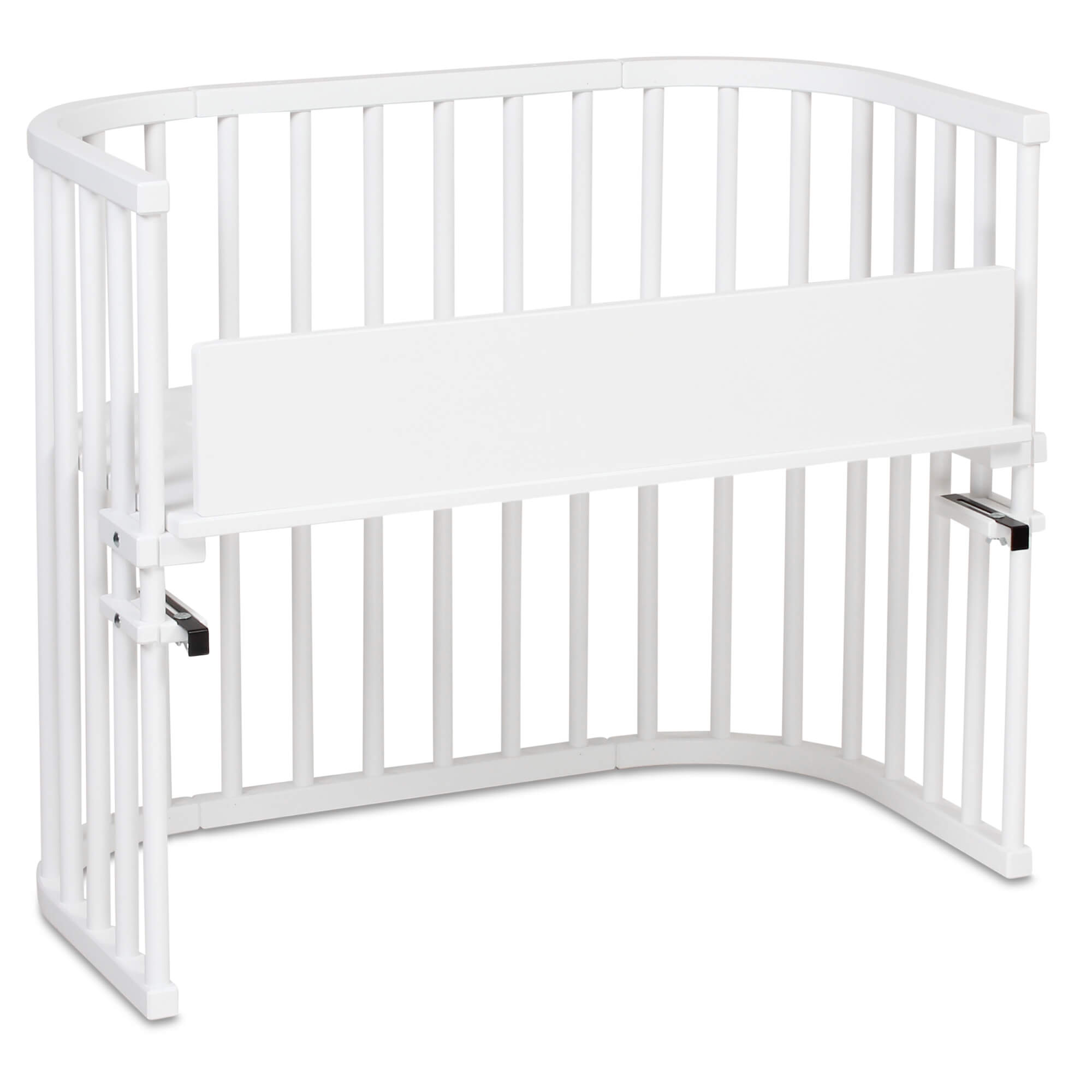
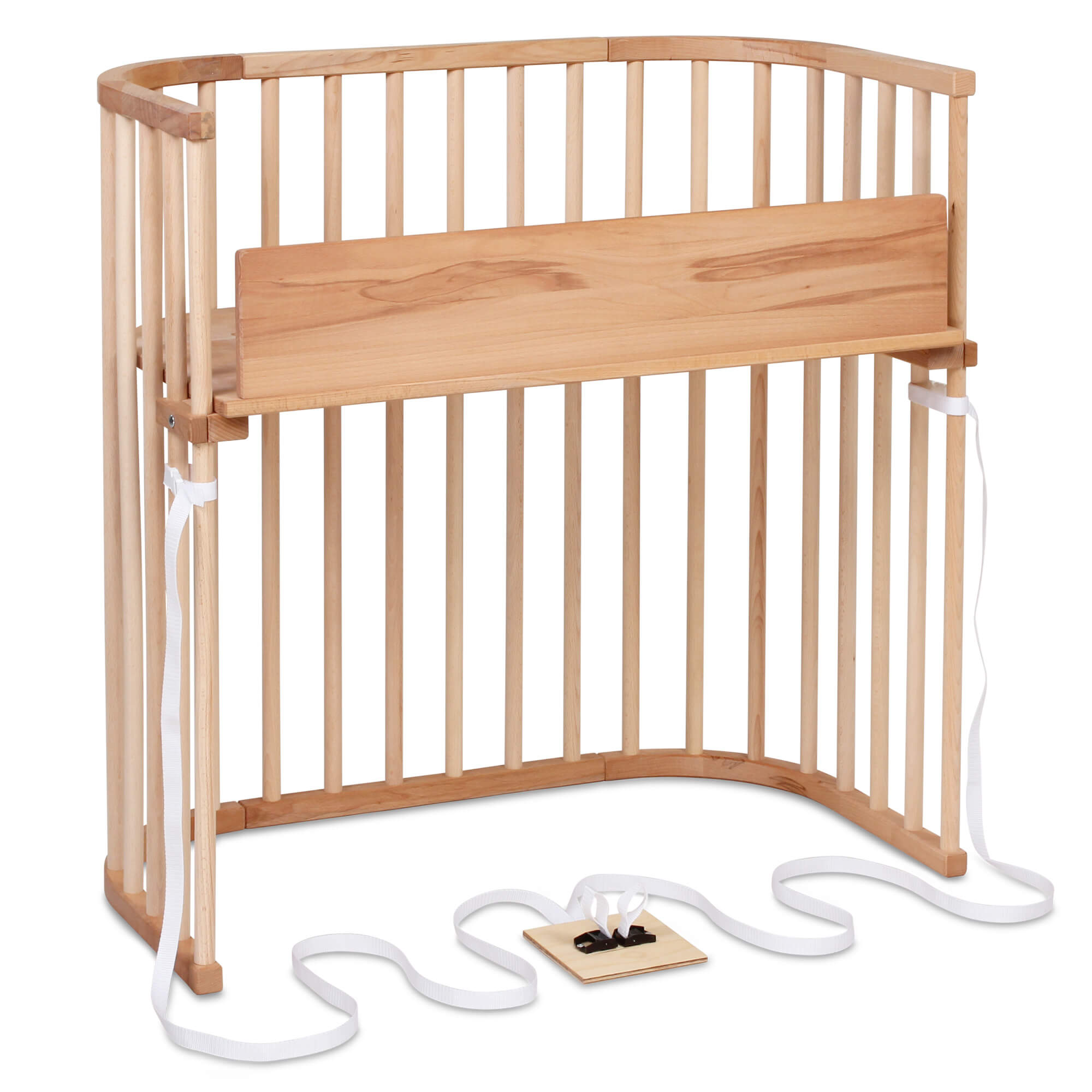
A bedside sleeper is built for exactly that. It is a small, firm sleep space with one low or open side that sits flush against your mattress and level with it. Your baby sleeps on their own flat surface, and you can see, hear and reach them without getting out of bed. For a breastfeeding parent, or anyone recovering from a C-section, that difference matters every single night.
babybay has made bedside sleepers in Germany since 2003, and every model is built to that idea: your baby’s own surface, at the height of your bed. You can browse all of the bedside sleepers and co-sleeping bassinets in one place, and our longer guide on how to safely co-sleep with a newborn explains the full room-sharing setup, from mattress height to what stays out of the sleep space.
The three babybay models at a glance
babybay.us product pages
| Model | Fits mattress heights | Sleeping platform | Price |
|---|---|---|---|
| babybay Original | Beds up to 28 in | Standard platform | $385 |
| babybay Maxi | Beds 10 to 28 in | Wider: 35 in W x 19 in D | $425 |
| babybay Maxi Tall | Beds 10 to 34.75 in (boxspring beds) | 35 in W x 19 in D | $485 |
What to look for in a bedside sleeper instead
Not every product sold as a co-sleeper is a bedside sleeper. Some are cushions, some are in-bed nests, and some are bassinets with a drop side. Use this list to check what you are buying, whichever brand you look at.
01 · Standard
It meets a federal sleep standard
Look for a product sold as a bedside sleeper or bassinet that meets ASTM and CPSC requirements. If the listing calls it a lounger, nest or pillow, it is not a sleep product.
02 · Surface
The sleep surface is firm and flat
Press the mattress pad with your hand. It should feel firm and spring back, with no dip in the middle and no incline. A fitted sheet is the only thing that goes on top.
03 · Fit
It sits level with your mattress
The sleeper should adjust so its surface lines up with the top of your mattress, and it should attach securely to your bed frame so it cannot drift away and open a gap.
04 · Materials
You know what it is made of
Your baby will spend thousands of hours with their face near this surface. Clear information on wood, finishes and textile certifications is a sign of a maker with nothing to hide.
05 · Lifespan
It is built to last beyond one baby
Solid construction and a long warranty mean the sleeper can serve the next baby too, which changes the real cost per year of use.
This is where babybay stands out. The babybay Original bedside sleeper fits beds up to 28 inches tall and costs $385. It is made from solid European beechwood with water-based finishes, with no plywood and no plastic parts, and it meets US ASTM and CPSC safety standards. The wood carries a 10-year limited warranty when the product is registered within 90 days, and with the bassinet conversion kit, sold separately, it can stand on its own as a freestanding bassinet.
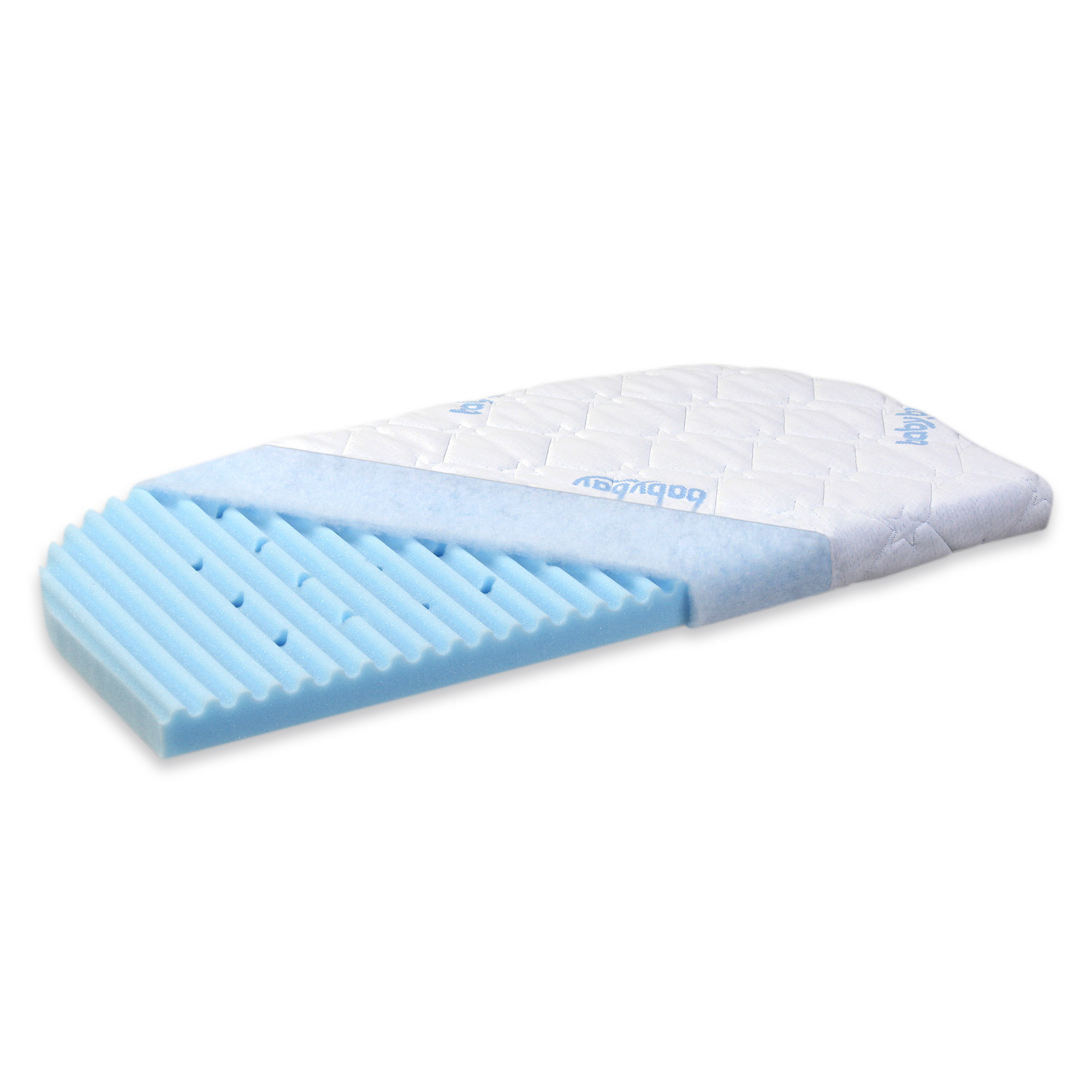
If you want a wider sleep space for one growing baby, or your bed sits high on a boxspring, the Maxi and Maxi Tall cover those cases. You can compare Original vs Maxi vs Maxi Tall by bed height, width and price before you decide. Firm, purpose-made babybay mattress pads come in Classic, Relief, Tranquility and Organic Coco versions for every model, so the sleep surface stays firm and flat. And if you care about what is under your baby’s cheek, babybay’s page on non-toxic materials and sustainability explains the beechwood, the water-based finishes and the commitment to plant one tree for every tree harvested.
Lounger vs bedside sleeper: a worked example
Picture a common first week. Your baby feeds every two to three hours through the night. With a co-sleeper pillow in your bed, the baby feeds, falls asleep on the cushion between you, and stays there because moving them feels risky. By 4 a.m. you are both asleep, the duvet has shifted, and the baby is on a soft cushion on a soft mattress next to two sleeping adults. Nobody planned for that. It happens because the setup makes it the easiest thing to do.
With a bedside sleeper, the same night looks different. You feed your baby, then slide them a few inches onto their own firm, flat surface, level with your mattress. You can rest a hand on their chest, hear every breath and settle them again without standing up. The easiest choice at 4 a.m. is also the safe one. That is the real value of a good bedside sleeper: it removes the decision from the moment when you are least able to make it.
QAre co-sleeping pillows and loungers safe for overnight sleep?
No. Co-sleeping pillows, loungers and nests are infant support cushions, not sleep products. The CPSC links these cushions to 79 infant deaths and 124 injuries between 2010 and 2022, and the AAP advises against letting babies sleep on pillow-like products. For overnight sleep, use a firm, flat surface that meets a federal sleep standard, such as a bassinet or bedside sleeper.
QWhat does the CPSC Infant Sleep Products Rule cover?
The rule, in effect since June 2022, requires any product marketed or intended for sleep for babies up to 5 months old to meet a federal safety standard for sleep products, such as the standards for cribs, bassinets, play yards and bedside sleepers. Products with an incline above 10 degrees do not qualify. Loungers and nests fall under a separate rule for infant support cushions.
QIs the DockATot or Snuggle Me Organic safe for sleep?
Both are sold as loungers, and a lounger is an infant support cushion under federal rules, not a sleep product. Neither the CPSC rules nor the AAP guidance treat any padded cushion as a safe place for unsupervised or overnight sleep. Use a lounger only while your baby is awake and watched, and move them to a certified sleep surface when they fall asleep.
QWhat's the difference between a lounger and a bedside bassinet?
A lounger is a soft, padded cushion with raised sides, designed for short, awake, supervised moments. A bedside bassinet or bedside sleeper is a firm, flat sleep surface that meets a federal sleep standard and sits level with your mattress, so your baby sleeps on their own surface within arm’s reach. One is for resting while watched; the other is for sleep.
QWhen can my baby use a lounger?
Only when your baby is awake and you are watching them the whole time, with the lounger on the floor rather than on a bed, sofa or raised surface. Keep sessions short. If your baby starts to fall asleep, move them to their own firm, flat sleep surface. Never use a lounger inside a crib, bassinet, bedside sleeper or adult bed.
QCan I put a co-sleeper pillow in my bed to make bed-sharing safer?
No. Adding a cushion to an adult bed adds a soft, padded surface to the risks of bed-sharing rather than removing them. The AAP recommends room-sharing without bed-sharing: your baby sleeps in your room, close to your bed, on a separate surface made for infants, ideally for at least the first 6 months.
Keep your baby close, safely
Find the babybay that fits your bed
Every babybay gives your baby a firm, flat sleep surface of their own, level with your mattress, in solid European beechwood. Compare the Original, Maxi and Maxi Tall by bed height and width, or call 1-844-692-2229 with questions.