
Shop

Summarize this post with:


Baby Sleep Safety · Reflux
No. A bassinet that inclines more than 10 degrees counts as an inclined sleeper, and federal law has banned those since the Safe Sleep for Babies Act of 2022. Pediatricians also say a tilted sleep surface does not ease reflux. Every baby, including a refluxy one, should sleep flat on their back.
If you are searching for a bassinet that inclines, you are probably tired, and you probably have a baby who spits up, arches, fusses after feeds or wakes up sounding congested. Raising the head end of the bed feels like common sense. Gravity should keep the milk down, right? It is the same logic that sold millions of inclined sleepers before regulators stepped in.
This guide explains why that logic does not hold for babies, what the law now says, what genuinely helps a baby with reflux get through the night, and how to choose a sleep space that keeps your baby flat, safe and within arm’s reach for those middle-of-the-night feeds.
Key Takeaways
- 01
Bassinets and sleepers inclined more than 10 degrees are banned in the US under the Safe Sleep for Babies Act and the 2023 CPSC rule.
- 02
The AAP says raising the head of a baby’s bed does not reduce reflux, so every baby sleeps flat on their back.
- 03
Manage reflux while your baby is awake: hold them upright after feeds, feed smaller amounts and burp often.
- 04
Never prop a bassinet mattress or add a wedge or positioner.
- 05
A flat bedside sleeper like babybay keeps your baby close for night feeds on their own safe surface.
Is a bassinet that inclines safe? Short answer: no, they're banned
Under the Safe Sleep for Babies Act, an inclined sleeper for infants is any product with a sleep surface inclined more than 10 degrees that is intended, marketed or designed to provide sleeping accommodations for a baby up to one year old. The CPSC final rule on inclined sleepers for infants, published in the Federal Register on August 16, 2023, made it illegal to manufacture, sell, distribute or import these products from September 15, 2023, no matter when they were made. That includes used ones sold secondhand.
So a product that tilts your baby’s sleep surface past 10 degrees is not a safer bassinet with a helpful feature. It is a banned product category. If you see one online, especially one marketed to prevent reflux or spit-up, treat the listing as a red flag about the seller rather than a solution for your baby.
There is one gray area worth naming. Some bassinets have a small built-in tilt or an adjustable leg that the maker describes as a few degrees. Even when a product stays under the 10-degree line, the medical advice does not change: pediatricians recommend a firm, flat, level surface for every sleep. Flat is the standard to shop for, not “slightly inclined.”
The number to remember
10°
Any infant sleep surface tilted more than this is classed as an inclined sleeper and banned from sale in the US
Safe Sleep for Babies Act 2022; CPSC final rule, 2023
The Rock 'n Play recall and the Safe Sleep for Babies Act of 2022
Inclined sleepers became popular in the 2010s, and many were sold with the promise that a raised head position would help babies with reflux or congestion sleep longer. The best known was the Fisher-Price Rock ‘n Play Sleeper, which was recalled in April 2019 in cooperation with the Consumer Product Safety Commission after reports of infant deaths. Other inclined products were recalled in the months that followed.
The problem was not one brand. Babies placed on an incline can slump or slide down until their chin rests on their chest, which narrows the airway, or roll into a position they cannot get out of. Federal regulators responded in stages, and the rules now cover the whole category rather than individual products.
April 2019
Rock 'n Play recall
Fisher-Price and the CPSC recall the Rock ‘n Play Sleeper after infant deaths are reported in inclined sleep products.
May 2022
Safe Sleep for Babies Act signed
Congress bans inclined sleepers for infants and padded crib bumpers, treating both as banned hazardous products.
June 2022
Infant sleep products rule takes effect
Sleep products for babies up to five months that are not covered by another standard must keep the sleep surface at 10 degrees or less (16 CFR 1236).
Aug–Sept 2023
CPSC codifies the ban
The final rule is published on August 16, 2023 and takes effect on September 15, 2023 for any product, new or used.
Bassinets and cradles have their own mandatory federal standard, 16 CFR 1218, which incorporates the ASTM bassinet standard. Bedside sleepers that attach to an adult bed are covered by these bassinet requirements too. If you want the plain-English version of what each label and certification on a bassinet means, our guide to the Safe Sleep Seven explained honestly walks through where a bedside sleeper fits in the wider safe-sleep picture.
Why incline doesn't actually help reflux, and raises other risks
Reflux in babies (gastroesophageal reflux, or GER) means milk comes back up from the stomach into the esophagus or mouth. It is extremely common in healthy babies because the muscle at the top of the stomach is still maturing, and most babies grow out of it during the first year. Spit-up on your shoulder is not a sign that anything is wrong with how your baby sleeps.
The AAP’s 2022 safe sleep recommendations are direct about this. Babies with reflux should still be placed on their backs to sleep, on a firm, flat surface that is not inclined. The policy statement notes that elevating the head of the crib while the baby is on their back is not effective in reducing reflux and is not recommended. Babies have a natural gag and cough reflex that protects their airway when they spit up on their back, which is one reason back sleeping does not raise the risk of choking.
Incline adds problems instead of solving one. A baby on a tilt can slide toward the foot of the surface and bunch up, curl forward into a chin-to-chest position that restricts breathing, or roll toward a side wall. Young babies do not have the neck strength to lift their head back out of those positions. That is why the AAP also advises moving a baby who falls asleep in a car seat, swing, stroller or carrier onto a flat sleep surface as soon as you can.
What incline promises
- ✗Gravity keeps milk down during sleep
- ✗Fewer night wakings from discomfort
- ✗A raised head clears congestion
- ✗A few degrees of tilt is harmless
What the evidence says
- ✓Raising the head of the bed does not reduce infant reflux (AAP 2022)
- ✓Babies on a tilt can slide into a chin-to-chest position
- ✓Babies on their backs have reflexes that protect the airway
- ✓Products tilted over 10 degrees are banned from sale
What actually helps a refluxy baby sleep
Because reflux mostly happens around feeds, the most useful changes happen while your baby is awake. These are the approaches pediatricians commonly suggest. Talk to your own pediatrician before changing how or what your baby eats, especially if you are thinking about formula changes or thickened feeds.
- Hold upright after feeds
- Keep your baby upright against your chest for 20 to 30 minutes after a feed, then lay them down flat on their back.
- Smaller, more frequent feeds
- An overfull stomach refluxes more easily. Your pediatrician can help you judge amounts if spit-up is frequent.
- Burp during the feed
- Pause to burp partway through and at the end, rather than only once the bottle or breast is finished.
- Pace bottle feeds
- Hold the bottle more horizontally and let your baby take breaks so they swallow less air and feed more slowly.
- Loose clothing at the waist
- Tight waistbands and diapers press on the stomach. Choose a sleepsuit that sits loosely around the tummy.
- Plan night feeds within reach
- A bedside setup lets you feed, burp and hold your baby upright, then return them to a flat surface without walking across the room.
When reflux needs a call to the pediatrician
Most spit-up is a laundry problem, not a medical one. A smaller group of babies have gastroesophageal reflux disease (GERD), where reflux causes complications. Call your pediatrician if your baby is not gaining weight, refuses feeds, vomits forcefully or with green or yellow fluid, has blood in their spit-up or stool, seems to be in pain with most feeds, or has breathing problems such as wheezing or long pauses. Your pediatrician may suggest feeding changes or other treatment. Even then, the sleep advice stays the same: flat, on the back, in their own space.
Night feeds also land hardest on the parent who is recovering from birth. If you had a cesarean, the ideas in our guide to getting your best sleep after a C-section pair well with a feeding routine that keeps your baby close without you twisting out of bed.
Reflux is a feeding problem you manage while your baby is awake. Sleep stays flat, on the back, every time.
The rule that does not changeCan you prop up a bassinet mattress or add a wedge?
No. Putting a rolled towel, book or wedge under the mattress pad, raising one end of the bassinet on blocks, or adding a sleep positioner recreates the same incline the ban was written to stop. Positioners and wedges also add soft material next to your baby, which the AAP advises against for the same suffocation reasons it lists for pillows, blankets and bumpers.
The only thing that should go into your baby’s sleep space is the firm mattress pad made for that bassinet and a fitted sheet that matches it exactly. If you are unsure whether a sheet fits snugly, our bassinet mattress and sheet size chart explains why sizes vary between brands and how to check yours.
The safe alternative: a flat bedside bassinet you can reach without lifting
Here is the real problem a parent of a refluxy baby is trying to solve: lots of feeds, lots of burping, lots of holding upright, and then getting a baby back down safely without being fully awake yourself. A tilt does not fix that. Proximity does.
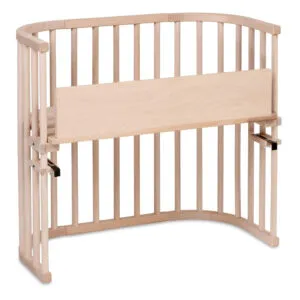
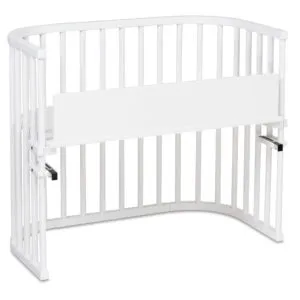
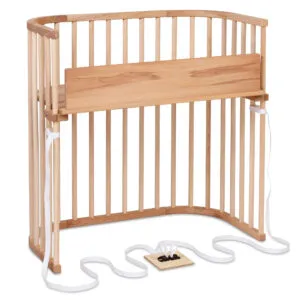
The babybay Original bedside sleeper is a solid European beechwood bassinet, made in Germany to meet US safety standards, that attaches securely to the side of your bed so its flat sleeping platform sits level with your mattress. Your baby has their own firm, flat surface, and you can reach them, feed them, burp them and settle them again without climbing out of bed or carrying them across a dark room. That is the AAP’s room-sharing recommendation, done on a separate surface, at the height of your own bed.
If you are comparing the three models, the overview of babybay bedside sleepers and co-sleeping bassinets lays them out side by side. The main question is your bed height. Parents with a boxspring or a tall platform bed usually need the babybay Maxi Tall for boxspring beds, while the Original and Maxi fit beds up to 28 inches.
Which babybay fits your bed
babybay.us product pages
| Model | Fits beds up to | Sleeping platform | Best for |
|---|---|---|---|
| babybay Original | 28 in | 32 x 16 in | Most bedrooms; the most compact model |
| babybay Maxi | 28 in (from 10 in) | 35 x 19 in | Parents who want a wider platform for one baby |
| babybay Maxi Tall | 34.75 in | Wider Maxi-style platform | Boxspring and tall platform beds |
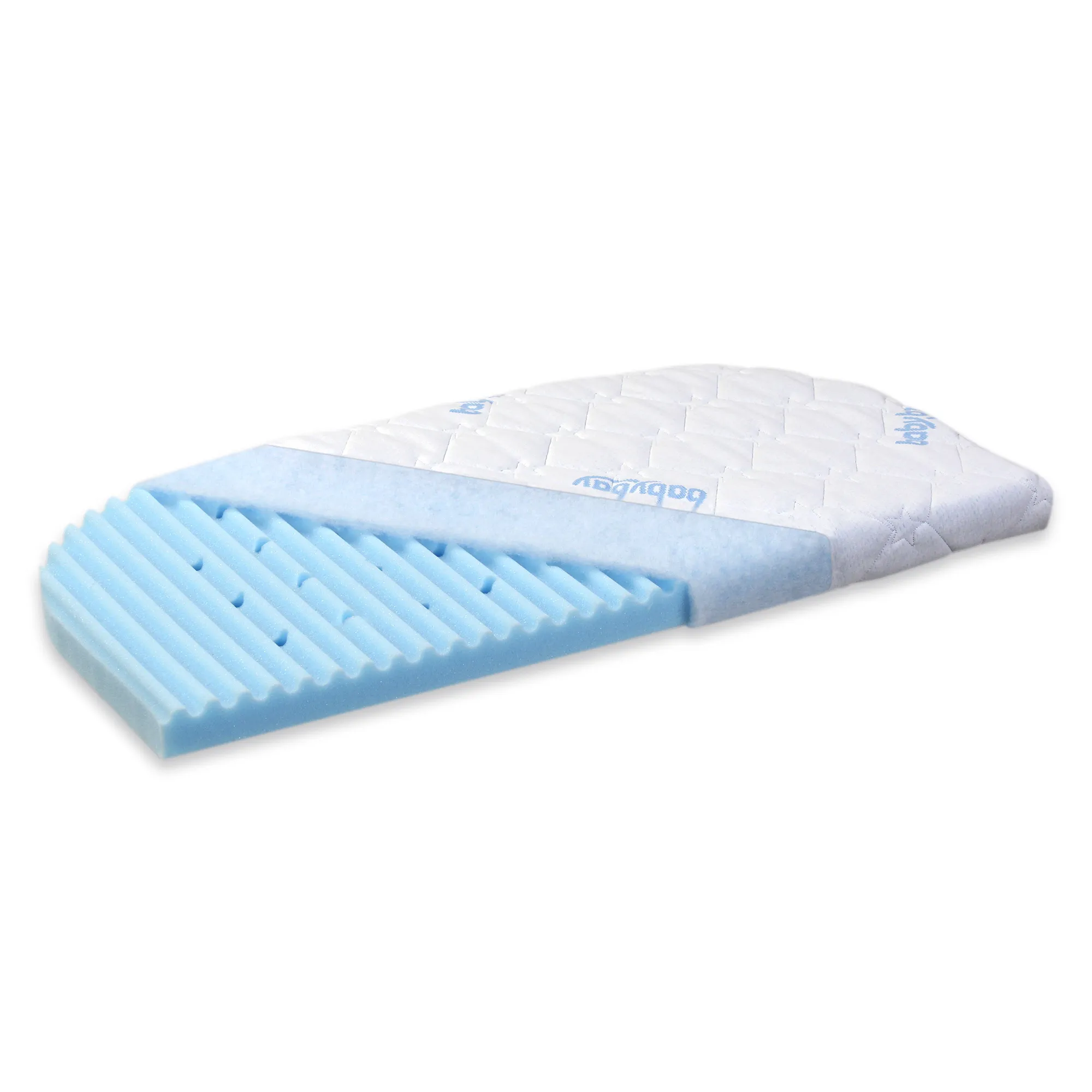
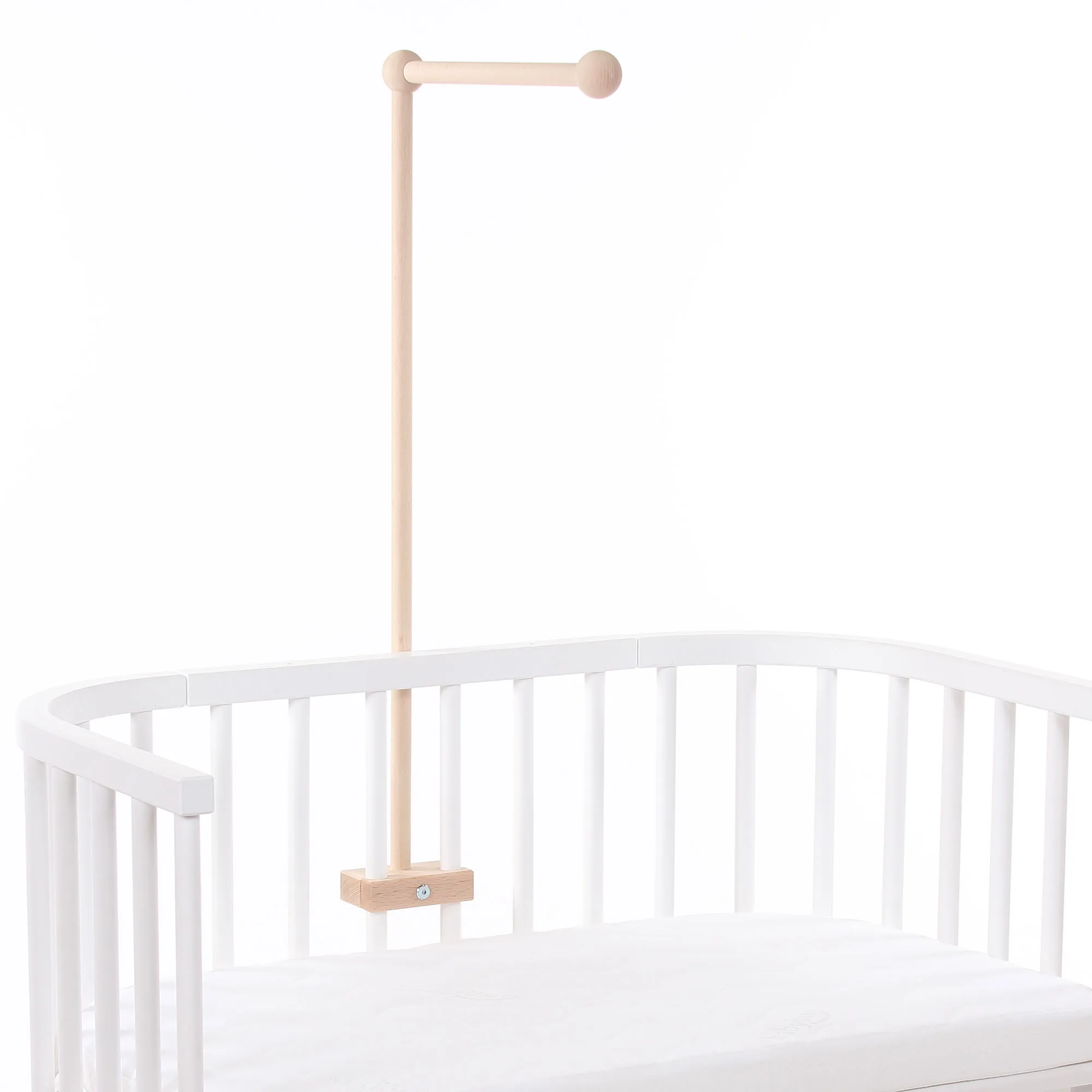
Every model is built from beechwood with no mesh netting, and the modular design lets you add rolling casters and a bassinet conversion kit so the same sleeper can stand on its own as a freestanding bassinet. The mattress pads are designed for the babybay platform, including the Classic Wave pad with a natural foam core and vertical air channels for ventilation, so the fit stays snug and flat. Each sleeper is backed by the babybay 10-year warranty, which matters when a sleeper may be used for more than one child over the years.
What to check before buying any bassinet
Whatever you choose, these are the checks that protect your baby. They apply to every brand, and they are the same checks babybay is built to pass.
01 · Surface
Flat and level, with no tilt feature
Skip anything marketed as inclined, angled, elevated or “for reflux.” The sleep surface should be level from head to foot.
02 · Mattress
Firm pad made for that bassinet
The pad should be firm, thin and sized to the frame with no gaps around the edges. Do not add toppers, pillows or wedges.
03 · Standards
Built to the federal bassinet standard
Look for a sleeper sold as meeting the CPSC bassinet rule (16 CFR 1218) and the ASTM bassinet standard.
04 · Attachment
A secure connection to your bed
A bedside sleeper should fasten to your bed frame so no gap can open between the two surfaces, and sit level with your mattress.
05 · Recalls
Check secondhand products
Inclined sleepers are banned even used. Search the CPSC recall list before accepting any hand-me-down sleep product.
06 · Reach
Close enough for night feeds
The easier it is to reach your baby, the less tempting it is to doze off with them on a sofa or in your bed.
If you are still deciding between models, the guide to choosing between Original, Maxi and Maxi Tall compares them by bed height, width and size so you can measure once and order the right one.
QAre inclined bassinets legal to sell?
Not if the sleep surface is inclined more than 10 degrees and the product is meant for babies up to one year old. The Safe Sleep for Babies Act of 2022 banned inclined sleepers, and the CPSC rule made it illegal to make, sell, distribute or import them from September 15, 2023, including used products.
QDoes inclining a bassinet help with reflux or spit-up?
No. The American Academy of Pediatrics says elevating the head of a baby’s sleep surface does not reduce reflux and is not recommended. Babies with reflux should still sleep flat on their backs. Holding your baby upright after feeds and adjusting feeds with your pediatrician’s help are the approaches that make a difference.
QWhat is the Safe Sleep for Babies Act of 2022?
It is a federal law signed in May 2022 that bans two infant products: inclined sleepers for infants and padded crib bumpers. The Consumer Product Safety Commission later wrote the ban into its regulations, and it took full effect in September 2023.
QCan I prop up a mattress or use a wedge under a bassinet pad?
No. Raising one end of the mattress, putting something under the pad or using a wedge or sleep positioner creates the same incline the law bans and adds soft material near your baby. Use only the firm pad made for your bassinet and a snug fitted sheet.
QWhat should I do if my baby has reflux at night?
Feed, burp and hold your baby upright for 20 to 30 minutes, then lay them down flat on their back in their own sleep space. Keeping them in a bedside sleeper makes those night feeds easier. Call your pediatrician if your baby is not gaining weight, refuses feeds, vomits forcefully or has trouble breathing.
QIs it safe for my baby to sleep on their back if they spit up?
Yes. Healthy babies have gag and cough reflexes that protect their airway when they spit up lying on their back. The AAP recommends back sleeping for every sleep, including for babies with reflux.
Flat, firm and right beside you
Find the babybay that fits your bed
Measure your bed height and compare the Original, Maxi and Maxi Tall to choose a flat beechwood bedside sleeper for night feeds.